
Harihareshwar
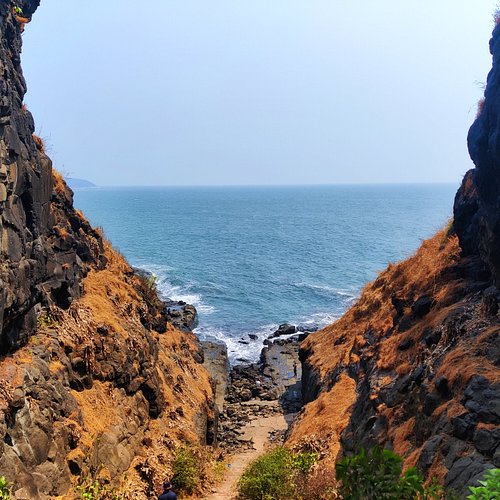
Nestled in the Raigad district of Maharashtra, Harihareshwar is a mesmerizing coastal town surrounded by four holy hills: Harihareshwar, Harshinachal, Bramhadri, and Pushpadri.
Unlike purely military coastal setups, Harihareshwar is primarily celebrated as a profound spiritual sanctuary. Affectionately called “Dakshin Kashi” (The Kashi of the South) and “Dev-Ghar” (The House of God), its history elegantly blends natural geological wonders, ancient Puranic legends, and Royal Maratha patronage.
Historical & Spiritual Background
1. The Puranic Origins & The Sacred Trimurti
The name Harihareshwar represents the holy convergence of Hari (Lord Vishnu), Hara (Lord Shiva), and Ishwar (Supreme God). According to ancient Hindu texts:
- The town marks the precise location where the sacred Sitri River completes its long journey from Mahabaleshwar and merges into the Arabian Sea at the Bankot Creek.
- Unlike standard Shiva temples that house a single Shivaling, the inner sanctum here holds a rare “Triple Linga” representing the Trimurti: Lord Brahma, Lord Vishnu, and Lord Mahesh (Shiva), alongside an idol of Goddess Parvati.
2. The Era of the Peshwas (Maratha Prime Ministers)
While the ancient foundations of the temple remain untimed, it shot into major historical prominence during the 17th and 18th centuries under the Maratha Empire.
- The Ancestral Deity: Harihareshwar was regarded as the Kula-Daivat (ancestral family deity) of the Peshwas, the powerful prime ministers of the Marathas.
- The 1723 Reconstruction: In the early 1700s, a devastating fire nearly destroyed the medieval wooden structure of the temple. In 1723, the legendary Peshwa Bajirao I (celebrated for his undefeated military record) completely funded and ordered the rebuilding of the temple into the stone structure seen today.
- Royal Visits: Queen Ramabai (wife of Madhavrao Peshwa) historically spent long periods at this temple, praying for her husband’s health.
3. Structural Additions by Chandrarao More
Before the Peshwas, the region was governed by local feudal lords. Chandrarao More of Jawali constructed the initial Pradakshina Marg (the cliffside circumambulatory path) around the temple hills, recognizing that wrapping a path around the holy mountain itself was the ultimate act of devotion.