
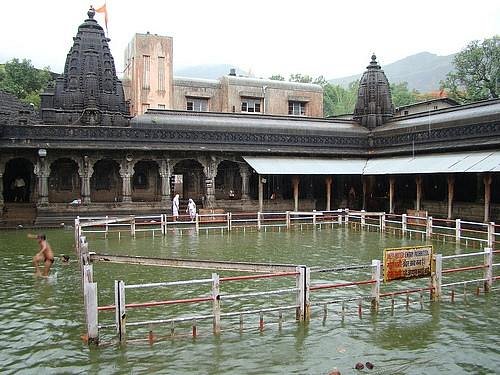
Trimbakeshwar
Trimbakeshwar, a serene ancient town nestled at the foothills of the Brahmagiri mountains in the Nashik district of Maharashtra, holds immense historical and spiritual weight. It is globally renowned for housing one of the twelve sacred Jyotirlingas (self-manifested shrines of Lord Shiva) and serves as the literal birthplace of the Godavari River, the longest river in Peninsular India.
Historical & Mythological Highlights
1. The Mythological Origin: Sage Gautama & the Godavari
According to ancient Hindu scriptures (Puranas), the region faced a catastrophic, multi-year drought.
- The great Sage Gautama lived here and maintained an inexhaustible granary through his severe penance. Jealous of his virtue, other sages engineered a trick involving a magical cow that died in his fields.
- To purify himself of the sin of Gau-hatya (killing a cow), Sage Gautama prayed intensely to Lord Shiva to bring the celestial river Ganga down to earth.
- Shiva granted the boon, releasing the river from his locks onto the Brahmagiri hills. The river became known locally as Gautami or Godavari. At Gautama’s request, Lord Shiva also manifested himself there as the Trimbakeshwar Jyotirlinga.
2. Construction of the Modern Temple (1755–1786)
While the site has been a place of worship for millennia, the magnificent black-stone structure standing today was commissioned by Peshwa Balaji Baji Rao (also known as Nana Saheb) in the mid-18th century.
The construction began around 1755 and took 31 years to complete, costing an astronomical sum at the time. The Peshwas built it using local black basalt stone, designing it to look like a formidable structural fortress capable of resisting invasions.
3. The Royal Maratha Subjugation & Trimbak Fort
Perched on the cliffs right above the temple town sits the historic Trimbak Fort (Brahmagiri Fort). It was a highly contested military asset during the Anglo-Maratha Wars.
The fort was seamlessly captured by Chhatrapati Shivaji Maharaj in 1670, bringing it into the Maratha Empire. It later served as a vital stronghold for the Peshwas before eventually being besieged and ceded to the British East India Company in 1818.
Key Historical & Sacred Structures
- Trimbakeshwar Jyotirlinga Mandir: A spectacular example of Indo-Aryan temple architecture. The entire temple is surrounded by massive stone walls. The apex of the temple is adorned with an intricate, towering Sikhara.
- Kushavarta Kund: A sacred, stone-rimmed water tank located inside the town center. Built in the 18th century by Maratha naval chief Shrimant Raoji Saheb Parnerkar, it captures the underground flow of the Godavari River. Taking a dip here is considered a mandatory purification ritual before entering the main temple sanctum.
- Brahmagiri Hill: A steep, rugged mountain rising 1,298 meters above sea level. Devotees climb a historic stone staircase of over 700 steps to reach the top, where the river Godavari trickles out from a stone reservoir shaped like a cow’s mouth (Gorakhnath Cave).