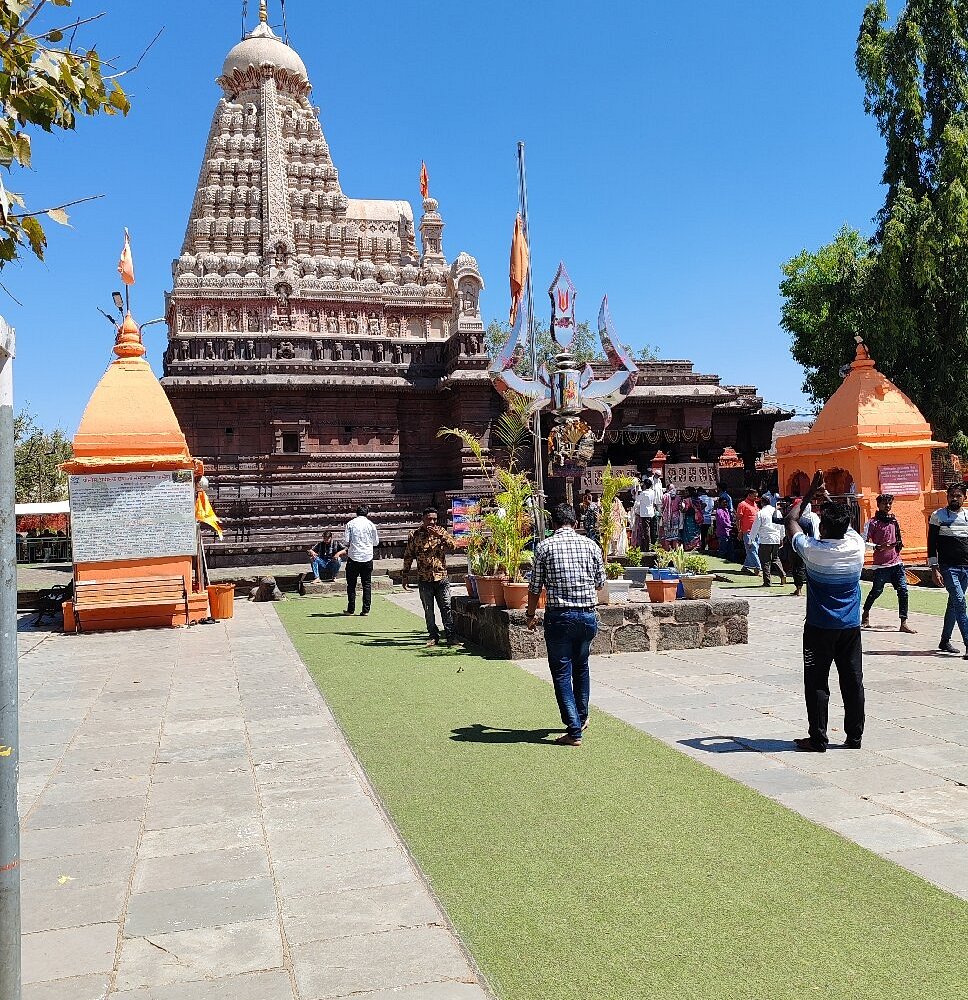
Where is Grishneshwar Temple located, and how do I reach it?
It is located in Verul village, Maharashtra, about 30 km from Aurangabad city. The nearest airport and major railway station are in Aurangabad. It sits right next to the Ellora Caves, making it highly accessible by local buses, taxis, or private cars.
What are the official temple timings?
The temple is generally open for darshan from 5:30 AM to 9:30 PM daily. During the holy month of Shravan (usually August/September), the temple hours are often extended to accommodate the massive influx of devotees.
Is there a specific dress code for entering the temple?
Yes, a strict traditional rule applies to men entering the inner sanctum (Garbhagriha): men must remove their shirts/tops and leather items (belts, wallets) before entering the core worship area. Women are expected to wear traditional Indian attire like sarees or salwar suits.
Can devotees touch the Jyotirlinga directly?
Yes, Grishneshwar is one of the few Jyotirlingas where devotees are permitted to perform Sparsh Darshan (physically touching the Linga) to offer water, flowers, and prayers directly, provided they follow the clean entry rules.
How long does the Darshan take on average?
On standard weekdays, it takes anywhere from 30 minutes to 1 hour. However, on Mondays, weekends, and major festivals like Mahashivratri, the queue can take several hours. A VIP/Speedy Darshan line is often operated by the temple trust for a nominal fee during peak rush times.
What other attractions are nearby for a combined itinerary?
Because of its prime location, you can easily combine your visit with:
Ellora Caves (under 1 km away)
Daulatabad Fort (15 km away)
Bibi Ka Maqbara (in Aurangabad city, approx 30 km away)
Create a detailed 2-day travel itinerary covering Grishneshwar Temple, Ellora Caves, and nearby historical monuments in Aurangabad?
Here is a detailed 2-day travel itinerary optimized for geographical flow and timing, ensuring you experience the best of Chhatrapati Sambhajinagar (Aurangabad) and the surrounding monuments.
Important Note: Plan this trip so that Day 1 does not fall on a Tuesday, as the Ellora Caves are closed every Tuesday.
Day 1: Spiritual Roots and Architectural Wonders
Focus: Verul region (approx. 30 km from the city center)
Morning: Shri Ghrishneshwar Jyotirlinga Temple
Start your journey early in the morning at the Shri Ghrishneshwar Jyotirlinga Temple to experience the temple when it is least crowded and most peaceful. Built of distinctive red basalt stone by Rani Ahilyabai Holkar, it offers a deeply spiritual ambiance. Devotees can stand in queue for a Sparsh Darshan to touch the final sacred Jyotirlinga directly.
Time to allocate: 1 to 1.5 hours (depending on line lengths).
Key Rules: Men must remove their shirts/tops and all leather items to enter the core sanctum.
Mid-Day to Afternoon: Ellora Caves
Head less than a kilometer down the road to the UNESCO World Heritage Ellora Caves. This massive complex features 34 major rock-cut caves carved out of the Charanandri hills between the 6th and 10th centuries, representing Buddhist, Hindu, and Jain faiths side-by-side.
Time to allocate: 3 to 4 hours.
Signature Highlight: Spend the majority of your time at Ellora Cave No. 16., home to the Kailash Temple. It is the world’s largest monolithic rock-cut structure, carved from the top down out of a single massive rock. Also consider visiting Ellora Cave No. 10 (Vishvakarma Cave), which is a spectacular Buddhist prayer hall with a vaulted roof line.
Day 2: Fortresses and Royal Legacies
Focus: The route back to Aurangabad city center
Morning: Daulatabad Fort
Set out after breakfast to climb the formidable Daulatabad Fort (Deogiri), located halfway between Ellora and Aurangabad. This 14th-century mountain fortress is legendary for its multi-layered, deceptive defense systems, including deep moats, concentric defensive walls, and an infamous pitch-black zigzag tunnel called the Bhool Bhulaiya designed to trap invaders.
Time to allocate: 2.5 to 3 hours.
Key Tips: Wear sturdy walking shoes and bring a water bottle. The climb to the top features hundreds of stairs but rewards you with a panoramic view of the plains and a look at the pink-hued Chand Minar tower.
Afternoon: Bibi Ka Maqbara
Head into the city center to visit BIBI KA MAQBARA, often beautifully referred to as the "Taj of the Deccan." Built in the mid-to-late 1600s by Mughal Emperor Aurangzeb’s son in memory of his mother, Dilras Banu Begum, the mausoleum heavily mirrors the design architecture of the original Taj Mahal with its white dome, four minarets, and formal Charbagh-style gardens.
Time to allocate: 1 to 1.5 hours.
Atmosphere: It is particularly striking in the softer late-afternoon light as the sun reflects off the polished marble and stone architecture.