
Tadoba

Tadoba

The history of the Tadoba Andhari Tiger Reserve (TATR)—Maharashtra’s oldest and largest national park—is a fascinating mix of tribal legends, royal dynasties, British exploitation, and ultimate conservation success.

The Historical Timeline of Tadoba

​1. The Mythological Origins (How it Got its Name)

​The name “Tadoba Andhari” reflects both the cultural spiritualism and geography of the region:

  • The Legend of Taru (Tadoba): According to local Gond tribal folklore, Taru was a brave village chief who met a tragic, heroic end in a fierce, hand-to-hand battle with a mythological tiger on the banks of a local lake. Deified by his people, a shrine was built in his honor beneath a massive tree by the water. Over time, “Taru-van” (the forest of Taru) evolved into Tadoba. To this day, indigenous tribes gather at the Tadoba Lake shrine for a major festival during the Hindu month of Pausha (December–January).
  • The Hidden River (Andhari): The second half of the name comes from the Andhari River, which gracefully meanders through the forest. It translates to “dark/blind” because its exact physical source is deeply shrouded within the dense, overlapping forest canopy of the Pandharpaoni region.

​2. Dynastic Era: The Gond Kings

​Between the 14th and 18th centuries, the dense wilderness of the Chimur hills was ruled by the Gond Dynasty.

  • Raja Khandkhya Ballal Shah (the 10th Gond King) even established his capital nearby in Chandrapur.
  • ​The Gond rulers treated the forest with deep spiritual reverence, coexisting with its wildlife. They built advanced irrigation networks and stone structures. Deep within the core reserve, you can still find historical 9-foot-tall stone pillars that were used to pass messages and signal the arrival of royalty to local forest temples.
  • ​The Gond rule eventually fell to the Marathas (the Bhonsle kings of Nagpur) in the late 18th century, before the region passed into the hands of the British Empire.

​3. The Colonial Era & Royal Hunting Grounds

​When the British took control in the 19th century, the forest’s timeline shifted from tribal harmony to commercial exploitation and sport.

  • 1879: The British designated Tadoba as a Reserved Forest under the Indian Forest Act. However, this was done primarily to secure control over its highly valuable timber (teak and bamboo) rather than to protect the animals.
  • Trophy Hunting: The area became a prominent hunting ground for British officers and Indian elites. While partial hunting restrictions were introduced in 1905 (requiring special permits for big cats), massive damage had already been done to the tiger populations.

​4. The Path to Protection & Legal Milestones

​Recognizing the rapid decline of wildlife, the region underwent a series of protective changes over the 20th century:

First Hunting Bans
1935
The British administration officially banned the hunting of all animals within a 45-square-mile radius surrounding Tadoba Lake, though adjacent areas remained open as designated “shooting blocks.”
Declaration as a National Park
1955
Post-Independence, an area of 116.55 sq. km was formally declared Tadoba National Park, making it Maharashtra’s very first national park.
Creation of Andhari Sanctuary
1986
To protect the surrounding contiguous forest, the adjacent Andhari Wildlife Sanctuary was established, spanning over 500 sq. km.
The Modern Tiger Reserve (TATR)
1995
The National Park and the Wildlife Sanctuary were formally amalgamated to create the unified Tadoba Andhari Tiger Reserve (TATR), expanding the protected core zone to roughly 625 sq. km.

FAQs

Where is Tadoba Andhari Tiger Reserve located?
It is located in the Chandrapur district of Maharashtra, India. The nearest major city with an international airport is Nagpur, which is about 140 km away (approximately a 3-hour drive).
Is the Taru shrine still accessible?
Yes. The temple/shrine of the tribal god Taru is located on the banks of Tadoba Lake inside the core zone. Visitors can view it while passing on safari routes, and the local Gond adivasis hold an annual pilgrimage festival there.
What is the difference between the Core Zone and the Buffer Zone in Tadoba?
​Core Zone: This is the strictly protected inner forest areas (Moharli, Tadoba, and Kolsa ranges) where human activity is highly restricted. It contains the original National Park boundaries. ​Buffer Zone: This is the ring of forest surrounding the core. It serves as a transition space where local villages coexist with wildlife. Wildlife viewing in Tadoba's buffer zones (like Devada, Adegaon, Junona, and Agarzari) is exceptional and often rivals the core.
How many entry gates does Tadoba have?
Tadoba has over a dozen gates divided between the Core and Buffer zones. The major Core gates are Moharli, Khutwanda, and Kolara. Prominent Buffer gates include Junona, Devada, Agarzari, and Pangdi.
When is the park open and what is the best time to visit?
The Core zones close completely during the monsoon season (typically July 1 to October 15), while several Buffer zones remain open year-round. ​For photography/high tiger sighting probability: Peak summer (March to June) is best because the drying vegetation increases visibility and tigers frequent the remaining waterholes. ​For pleasant weather & landscape beauty: Winter (November to February) offers lush greenery and comfortable temperatures.
Which major animals can be spotted here besides the Bengal Tiger?
Tadoba boasts rich biodiversity, including Indian Leopards, Sloth Bears, Gaur (Indian Bison), Dhole (Wild Dogs), Striped Hyenas, Marsh Crocodiles, Honey Badgers, and diverse deer species like Sambar, Chital (Spotted Deer), and Barking Deer. It is also an excellent birdwatching destination with over 200 bird species.
Are private vehicles allowed inside the reserve?
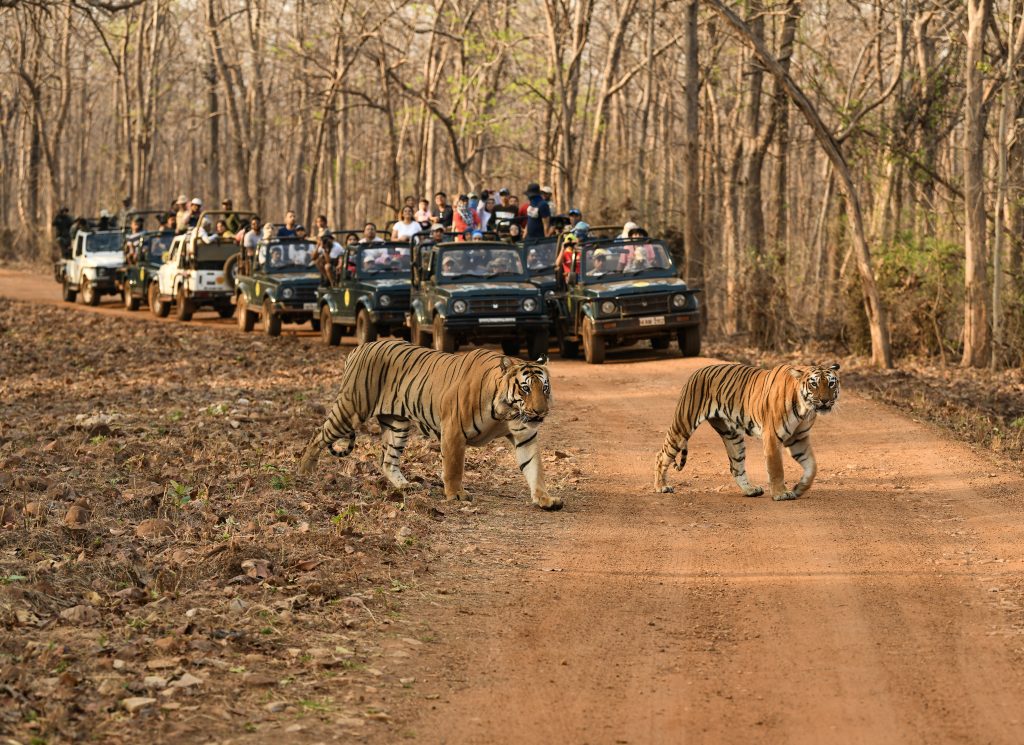
No. To protect the environment and maintain safety, only government-authorized open gypsy vehicles and safari buses with registered eco-guides are permitted to enter the safari tracks. Safaris must be booked well in advance through the official Maharashtra Forest Department portal.
What are the booking procedures, online portals, and best safari gates for visiting Tadoba?
Planning a trip to Tadoba requires a bit of strategy, as the best zones book out months in advance. The official booking mechanics, timelines, and gate performance details map out as follows: 1. The Official Online Portals ​To avoid third-party markups and scams, always secure your permits through the official government platforms run by the Maharashtra Forest Department: ​Primary Online Booking Portal: ​Alternative Core Portal: ​Important Note: A confirmed booking covers your park entry permit, vehicle charges, and guide fees. The physical Gypsy cost is separate and paid locally to your assigned driver at the gate. ​2. Booking Timelines & Procedures ​The forest department operates two primary windows for locking in jeep safaris: ​Regular Booking (Highly Recommended) ​Window: Opens exactly 120 days in advance at 12:00 AM IST. Strategy: For peak months (March–June) and prime core gates like Moharli or Kolara, permits often sell out within minutes of opening. Plan your dates four months ahead. ​Tatkal Booking (Last-Minute Option) ​Window: Opens 3 days in advance at 08:00 AM IST (e.g., booking for a Friday safari opens Tuesday morning). Strategy: Ideal if you are planning a spontaneous trip, though it carries a premium "tatkal fee" and limited availability mostly tied to core ranges. ​3. Best Safari Gates (Core vs. Buffer) ​Tadoba's gates are grouped into interconnected geographic ranges. A core gate and its nearby buffer gates often share the exact same tiger territories and water holes. The Top Buffer Gates ​Do not underestimate Tadoba's buffer gates—because tigers cross back and forth seamlessly, the buffers frequently match or exceed core track sightings with far lower crowd density. ​Devada-Adegaon & Junona (Moharli Range): These gates border the Telia Lake buffer zones. Tiger tracking here is exceptional, and they are premium hotspots for birdwatchers and night safaris. ​Agarzari (Moharli Range): Highly connected range with dense forest foliage and great waterhole visibility. ​Madnapur & Alizanza (Kolara Range): Extremely active buffer zones running alongside Kolara's prime territory, highly frequented by dominant breeding tigresses. ​Quick Logistics Checklist ​Weekly Closures: All Core Gates are completely closed on Tuesdays, and all Buffer Gates are closed on Wednesdays. Plan your travel itinerary around these days. ID Proof: You must carry the original ID proof (Aadhaar, Passport, or PAN card) that you used while booking online. Photocopies or phone screenshots are strictly rejected at checkpoint gates. Monsoon Shutdown: Core zones close from July 1 to October 15 for regeneration, while major buffer gates remain open year-round.

Price From : ₹4500/-

Address

Near Avaloormadam temple, thathampally po, pin code 688013, Alleppey, Kerala, India