
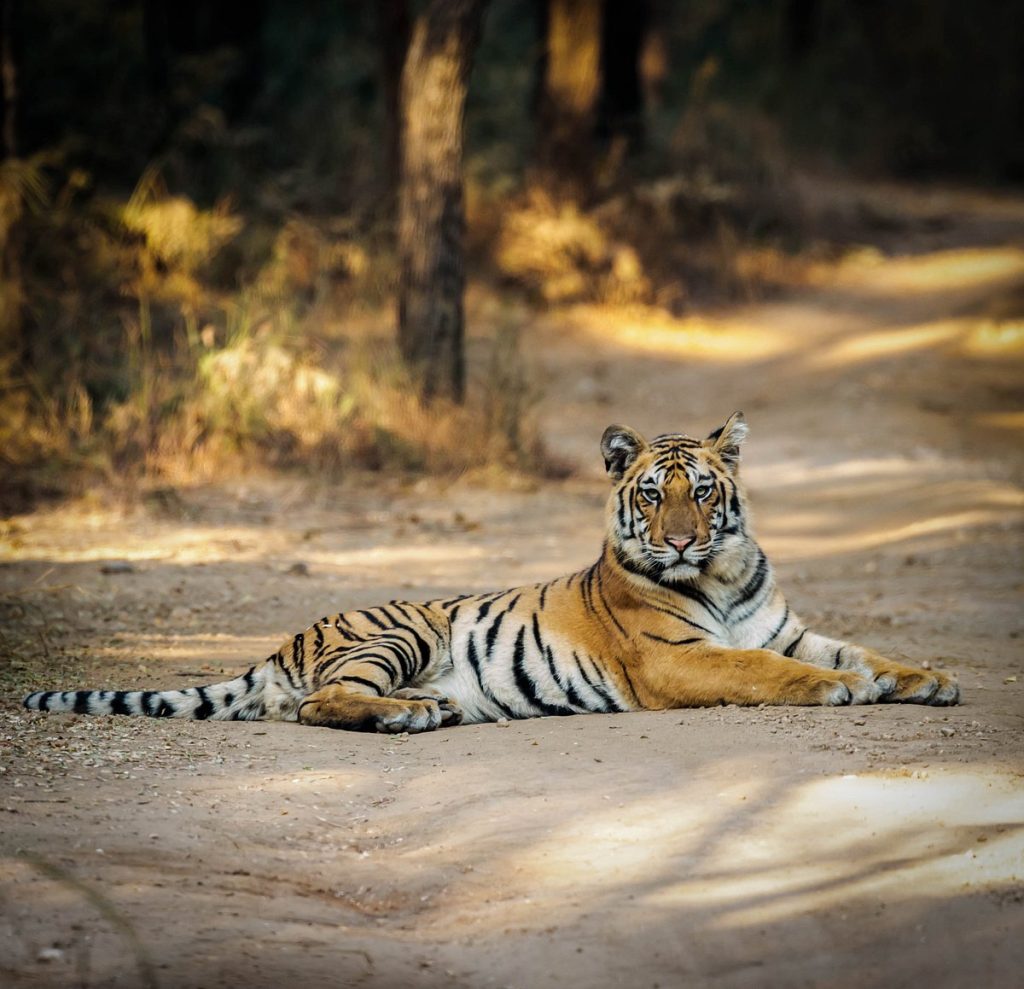
Pench National Park
The Pench Tiger Reserve—spanning across the southern boundary of Madhya Pradesh and the northern tip of Maharashtra—is one of India’s most visually striking and ecologically vital forests. It is globally immortalized as the cradle of literary legend, famed for its open canopy, dramatic teak forests, and exceptional tiger density.
The Pench Tiger Reserve—spanning across the southern boundary of Madhya Pradesh and the northern tip of Maharashtra—is one of India’s most visually striking and ecologically vital forests. It is globally immortalized as the cradle of literary legend, famed for its open canopy, dramatic teak forests, and exceptional tiger density.
The Historical Narrative of Pench
1. Literary Beginnings: The Real “Jungle Book”
Unlike many national parks that owe their fame solely to 20th-century conservation, Pench was famous in global literature long before it was protected by law.
- The Inspiration for Mowgli: In 1831, a documented report emerged detailing a young boy captured by British officers near Seoni (a district flanking the park) who had been raised entirely by a pack of wolves in the local hills.
- Kipling’s Setting: Sir Rudyard Kipling used these documented colonial accounts, along with Robert Armitage Sterndale’s natural history books on the Seonee hills, as the exact topographical template for his 1894 classic, The Jungle Book. The real-world Wainganga River, its deep gorges, and the rocky outcrops of the region are the direct inspirations for the home of Mowgli, Baloo, Bagheera, and Shere Khan.
2. Historical Texts: Ain-i-Akbari
The natural wealth of Pench is documented even further back in history. The Ain-i-Akbari, a detailed 16th-century administrative document tracking the reign of the Mughal Emperor Akbar, explicitly records the sheer abundance of wildlife, magnificent teak wood tracts, and complex hunting terrains of this exact central Indian landscape.
3. Spiritual Heritage: The Legend of Mansingh Deo
Deep within the forest stands a cultural focal point revered by the local indigenous Gond tribes. It centers around Mansingh Deo, a mythical historical figure believed to be a powerful medicine man and magician. Tribal legends claim he possessed supernatural healing powers and would famously ride into the local village markets on the back of a live tiger. Two ancient forest temples—Chhota Mansingh and Bada Mansingh—remain active inside the region today.
4. Evolutionary Milestones & Protections
The formal path from an overlooked hunting ground to a world-renowned ecological haven followed a structured historical timeline:
Sanctuary Status
1965
The central Indian forest region flanking the Pench River was officially designated as a protected Wildlife Sanctuary, halting commercial timber clearing across 449 sq. km.
Declaration of National Park
1983
Recognizing its critical bio-corridor value, a core area of 292 sq. km was carved out and legally declared Pench National Park.
Project Tiger Inclusion
1992
The territory was officially integrated under the Government of India’s “Project Tiger” program, establishing it as the nation’s 19th dedicated Tiger Reserve.
The Royal Renaming
2002
The core park was formally renamed Indira Priyadarshini Pench National Park, while the flanking sanctuary tract was officially designated as the Mowgli Pench Sanctuary to permanently cement its literary history.