
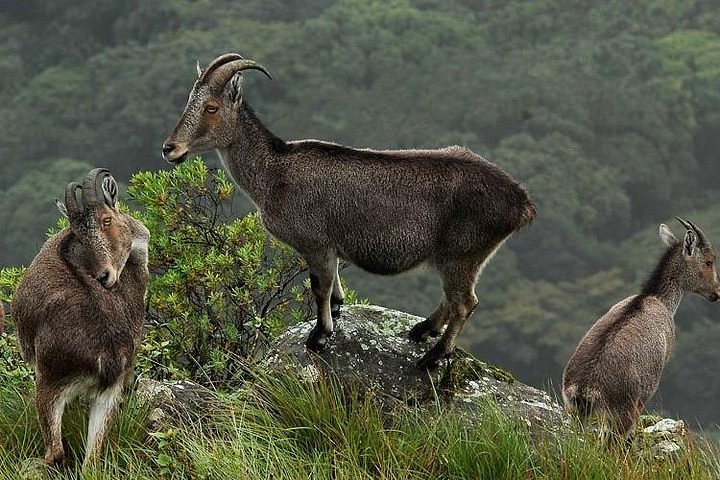
Eravikulam National Park

Eravikulam National Park

Eravikulam National Park, located roughly 15 km north of Munnar, is Kerala’s very first national park. Spread over 97 square kilometers of rolling high-altitude grasslands and Shola forests, it is internationally renowned for sheltering the world’s largest viable population of the endangered Nilgiri Tahr (a rare mountain goat). It also encompasses Anamudi (2,695 meters), the tallest peak in India south of the Himalayas.

1. Historical Context of Eravikulam

​The transformation of Eravikulam from a private colonial hunting ground to India’s top-ranked protected national park is a milestone in wildlife conservation.


  • The Raj-Era Game Preserve: In the late 19th and early 20th centuries, when the British turned Munnar into a tea empire, the high plateau of Eravikulam remained largely uncultivated due to its rugged altitude. The land was leased by the Kannan Devan Hills Produce (KDHP) Company. The British managers and elite planters operated the area as a private game preserve and hunting ground, specifically targeting the Nilgiri Tahr and panthers.
  • The High Range Game Association: Realizing that unregulated hunting by outsiders was rapidly destroying the wildlife, the resident British planters formed the High Range Game Association in 1928. Ironically, this hunters’ club became the area’s first protective shield. They appointed local tribal Muthuvans as game watchers to prevent poaching, establishing the early boundaries of wildlife management.
  • Government Takeover (1971): Following Indian independence, the Government of Kerala passed a landmark act in 1971 (The Kannan Devan Hills Produce Resumption of Lands Act), officially reclaiming uncultivated plantation lands—including the Eravikulam plateau—back into public, state control.
  • Sanctuary to National Park (1975–1978): Prompted by international concerns over the rapid extinction risk facing the Nilgiri Tahr, the state declared the area as the Eravikulam-Rajamala Wildlife Sanctuary in 1975. Recognizing its immense ecological, faunal, and floral significance, it was elevated to full National Park status in 1978.

FAQs

Can tourists hike or climb to the top of Anamudi Peak?
No. Trekking or climbing to the summit of Anamudi Peak is strictly prohibited to protect the extremely fragile high-altitude alpine ecosystem and ensure the safety of wild animal habitats. However, you can view and photograph its grand, elephant-head-shaped silhouette from the permitted paths of the Rajamalai tourism zone.
Why does the park close completely every year between February and March?
The park closes for roughly 60 days annually because it is the peak calving season (breeding/birthing time) for the Nilgiri Tahr. Keeping the park entirely closed to tourists protects the highly vulnerable newborn kids and mothers from stress and human interference.
Can I drive my own vehicle or a private taxi inside Eravikulam National Park?
No, private vehicles are strictly barred past the entrance gate at the "5th Mile" checkpost to minimize pollution and wildlife disturbance. Instead, the Kerala Forest Department operates dedicated forest safari buses that safely transport visitors from the ticket center up to the Rajamalai tourism zone. From there, visitors explore a beautifully maintained 1-2 km paved walking trail on foot.
What are the three zones of the park, and where are tourists allowed?
The park is strictly partitioned into three management sections: ​Core Area: Entirely restricted; dedicated purely to wilderness and scientific observation. ​Buffer Area: Restricted; acts as a protective shield around the core. Tourism Area (Rajamalai): The only zone open to the general public, offering guaranteed chances to view Nilgiri Tahr herds wandering near the footpaths.
What other notable wildlife can be spotted here?
Aside from the 750+ Nilgiri Tahrs, the park hosts Gaurs (Indian Bison), Nilgiri Langurs, Sambar Deer, Wild Boars, and occasional migrating herds of wild elephants. Top predators include leopards and wild dogs (dholes). It also features the magnificent Atlas Moth (one of the largest moths in the world) and rare endemic birds like the Nilgiri Pipit and the Black-and-Orange Flycatcher.
Is plastic allowed inside the national park?
Eravikulam is a strict Zero-Plastic Zone. Forest guards thoroughly inspect baggage at the entrance. Any plastic water bottles or food wrappers must be discarded or tagged before boarding the safari buses to prevent littering and accidental ingestion by wild animals.

Price From : ₹400/-

Address

Near Avaloormadam temple, thathampally po, pin code 688013, Alleppey, Kerala, India