
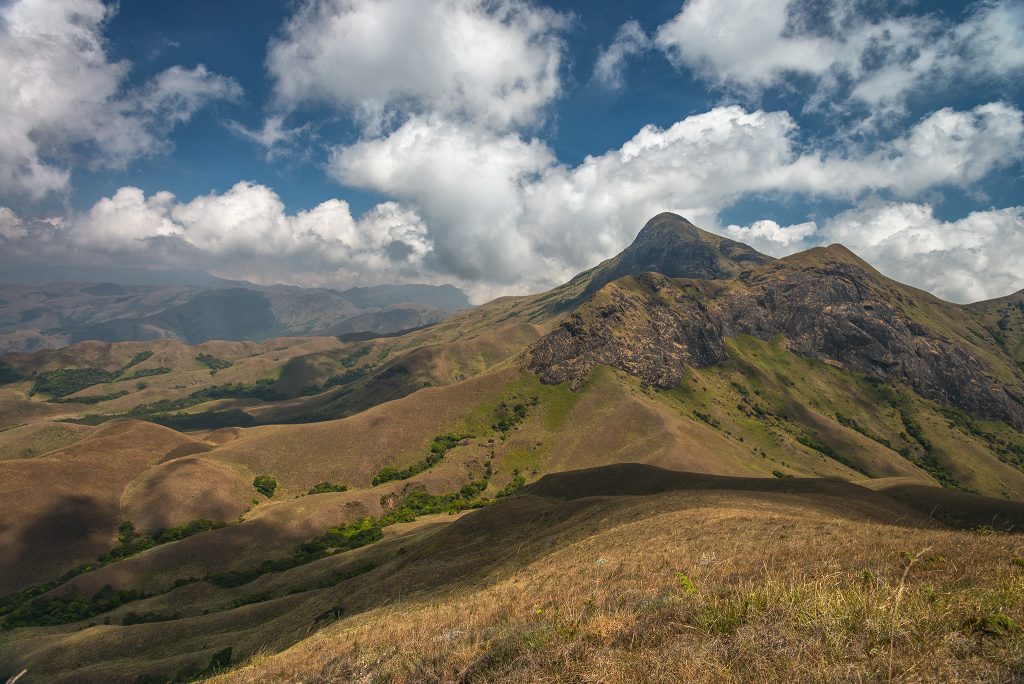
Anamudi Peak
Anamudi Peak is the crown jewel of the Western Ghats. Towering at an elevation of 2,695 meters (8,842 feet), it is the highest mountain peak in India south of the Himalayas.
The name Anamudi literally translates to “Elephant’s Forehead” in Malayalam, a direct reference to the mountain’s massive, smooth rock face that resembles the forehead of an elephant. It is located inside the borders of Eravikulam National Park at the junction of the Cardamom Hills, Anaimalai Hills, and Palani Hills.
1. Historical Context of Anamudi
Anamudi’s history spans from early tribal reverence to British exploration and its modern status as a strictly guarded sanctuary.
- The Domain of the Muthuvans: For centuries before the arrival of European explorers, Anamudi was a sacred and wild terrain known only to the indigenous Muthuvan tribe. The tribe held deep spiritual respect for the mountain and navigated its treacherous, misty slopes to forage for wild honey, herbs, and forest produce.
- The First Recorded British Ascent (1862): During the expansion of the British Empire into the High Ranges for coffee and tea cultivation, mapping the highest peaks became a top priority. The first recorded successful ascent of Anamudi was made on May 4, 1862, by General Douglas Hamilton of the Madras Army. Hamilton was an avid explorer and artist who mapped the terrain and documented its unique wildlife.
- The Frontier of the Sovereign Boundary: In the late 19th century, Anamudi served as a grand natural boundary marker. It separated the territories of the princely State of Travancore from the British-administered Madras Presidency. British surveyors used the peak as a major Triangulation Station for the Great Trigonometrical Survey of India to accurately map the southern peninsula.
- The Shift from Mountaineering to Total Conservation: Throughout the 20th century, Anamudi was a legendary bucket-list destination for hardcore trekkers, rock climbers, and botanists. However, the heavy influx of hikers began severely damaging the highly fragile alpine ecosystem. Recognizing that human footfall was destroying rare plant species and disturbing the breeding grounds of the Nilgiri Tahr, the Kerala Forest Department stepped in. By the late 1900s, all public trekking and climbing expeditions to the summit were permanently banned, turning Anamudi into a pristine, untouched fortress of biodiversity.