
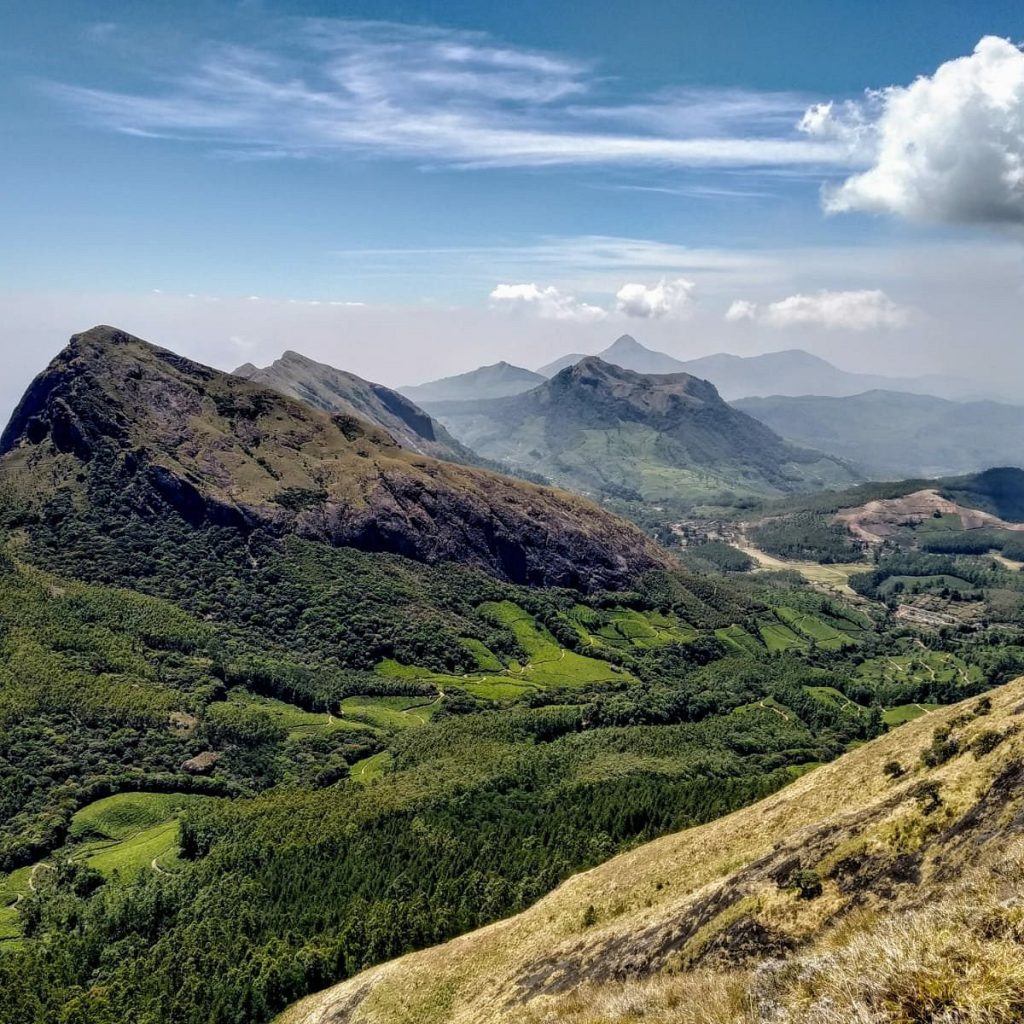
Meesapulimala
Rising to a soaring 2,640 meters (8,661 feet) above sea level, Meesapulimala is the second-highest peak in the Western Ghats and South India, surpassed only by Anamudi. Located roughly 25 kilometers from Munnar along the interstate border between Kerala (Idukki district) and Tamil Nadu (Theni district), it has transformed from a hidden geographic boundary into one of India’s most iconic eco-trekking destinations.
Historical & Cultural Context
The story of Meesapulimala is deeply intertwined with its striking geography, ancient geology, and colonial-era transformations.
- The “Tiger with a Moustache”: The name itself is highly descriptive in Malayalam and Tamil. It breaks down into Meesa (moustache), Puli (tiger/leopard), and Mala (hill/mountain). When viewed from certain low-lying southwestern angles or from the adjacent valleys, the mountain’s interconnected ridge of eight peaks dramatically resembles the face of a snarling wild cat with long, sweeping whiskers formed by the high-altitude grassy spurs.
- Ancient Precambrian Foundations: Geologically, Meesapulimala belongs to the ancient Southern Granulite Terrain. The rock formations here—primarily charnockites—are roughly 2.5 billion years old, shaped under extreme temperature and pressure deep within the earth long before being elevated by tectonic shifts millions of years ago.
- The Boundary Stone & Colonial Surveyors: For centuries, this rugged ridge served as a natural barrier between the ancient kingdoms of the Tamil plains and the hill tribes of Kerala. During the British colonial era, the peak became a critical point of calculation for the Great Trigonometrical Survey of India. Colonial planters and surveyors used the high ridges of Meesapulimala to map out land concessions, eventually leading to the establishment of the nearby Kolukkumalai Tea Estate (the highest organic tea plantation in the world) just below the mountain’s eastern slopes.
- The Shola-Grassland Ecosystem: Historically and ecologically, Meesapulimala is celebrated for its pristine “Shola” ecosystem—a unique prehistoric landscape consisting of dense patches of stunted tropical montane forests nestled inside valleys, surrounded by vast, rolling grasslands. This delicate environment is the native home of the endangered Nilgiri tahr and the vibrant red Rhododendron trees.