What does the name "Mathikettan" literally mean?
The name comes from a Tamil/Malayalam root meaning "mind confuser" or "the place where one loses their brains." Local tribal folklore dictates that the forest paths are so dense and complex that once you step beneath the canopy, you immediately lose your sense of direction and forget your way out. Scientifically, this is because the colossal, interlocking tree crowns block out direct sunlight, stripping hikers of natural navigational cues like sun positioning.
Which important rivers or streams originate from this park?
Mathikettan acts as a vital high-altitude catchment basin. Three primary mountain streams—Uchilikuthipuzha, Mathikettanpuzha, and Njandar—originate deep within these hill ranges. They flow outwards to form the main tributaries of the Panniyar River, which is essential for power generation and agriculture in the lower Idukki district.
Biodiversity & Wildlife / Why is the park called a "critical elephant strip"?
Mathikettan Shola forms a critical bottleneck corridor connecting the elephant populations moving between the Munnar Forest Division, Eravikulam, and the Anamalai ranges down to the Periyar Tiger Reserve and the Kottamalai forests in Tamil Nadu. Because of human settlements and private resorts on its fringes, migrating elephants frequently utilize the park as a safe passage zone.
What other prominent wildlife can be found inside the park?
Beyond wild Asian elephants, the park is home to:
Mammals: Gaur (Indian bison), wild dogs (dholes), leopards, sambar deer, Nilgiri langurs, and rare, elusive species like the Grizzled Giant Squirrel and the Flying Squirrel.
Avifauna & Reptiles: An exceptional density of endemic birds (like the Malabar Grey Hornbill) and king cobras, pythons, and pit vipers that thrive in the cool, humid undergrowth.
Travel & Access / Can I drive through Mathiket
No. There are no public vehicular roads running through the core of the national park. It can only be entered on foot via highly regulated, forest-department-guided eco-trekking paths. The nearest vehicular approach is from Poopara or Santhanpara off the Kochi-Madurai Highway (NH 85).
What are "Njandaar mettu" and "Uchilukuth mettu"?
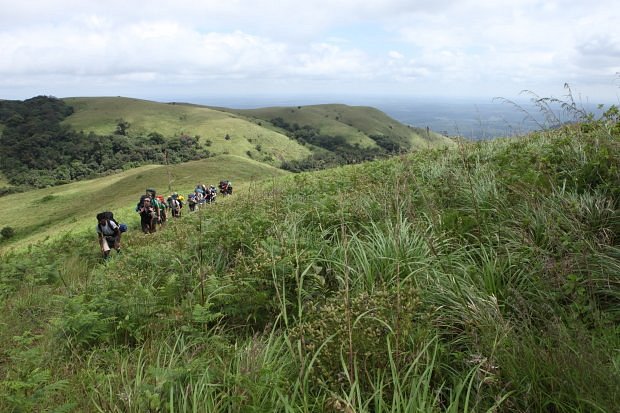
These are the two primary high-altitude forest viewing stations managed by the Forest Department inside the park limits. Reaching these ridges via guided treks provides sweeping, clear views extending across the border into the low-lying plains of the Theni district in Tamil Nadu.
What are the latest entry fees, booking procedures, and wildlife regulations for visiting Mathikettan Shola National Park?
Planning a trip inside Mathikettan Shola National Park requires a clear understanding of its strict environmental framework. Because it serves as a critical wildlife refuge, the Kerala Forest Department heavily regulates all visitor footprints.
1. Latest Entry Fees & Trekking Tariffs
The Forest Department operates day-trekking programs through local tribal Eco-Development Committees (EDCs). Tickets are structured on a per-program basis rather than a standard walk-in entry pass.
Mathikettan Shola Forest Trekking: ₹400 per person for Indian citizens / ₹750 per person for Foreign Nationals.
Inclusions: This baseline fee covers the official park permit and a mandatory native Muthavan tribal guide who escorts your group.
Camera Fees (Standard Base): Usually ₹50 to ₹100 for a digital DSLR camera; professional videography requires separate higher clearances from the Munnar Wildlife Division.
2. Booking Procedures
You cannot simply turn up and walk into the forest core independently. You must organize bookings via these official channels:
Day Treks
Offline (Spot Booking): Head directly to the Forest Ecotourism Information Centre / Checkpost near Pooppara (on the Munnar-Kumily State Highway). It is recommended to arrive early in the morning (between 7:30 AM and 9:00 AM) to secure a guide, especially during the weekend peak season.
Online Registration: You can view availability and block official trekking programs online via the Kerala Forest Ecotourism official website (ecotourism.forest.kerala.gov.in) under the Munnar Wildlife Division portal.
Forest Accommodations
If you want to stay directly inside the state forest limits, the department provides basic, managed wilderness properties:
Mathikettan Log House: Priced around ₹2,000 per night (Indian) / ₹3,000 (Foreigner).
Chundal Ethnic Hut / A-Frame Loghouse: Highly popular secluded stay priced between ₹3,060 to ₹5,000 per night depending on the specific cottage configuration.
Booking Rule: These must be booked well in advance exclusively via the Munnar Wildlife Division portal (sholaforests.in or munnarwildlife.com). Mobile networks are nearly non-existent at these properties, so download your vouchers beforehand.
3. Strict Wildlife Regulations & Code of Conduct
Mathikettan Shola has absolute zero tolerance for casual forest rule violations under the Indian Wildlife Protection Act.
Mandatory Escort Policy: Entering the national park bounds without an authorized forest guide is a serious, punishable offense. The maze-like canopy makes it exceptionally easy to get lost, and sudden wildlife interactions are a real danger.
Strict Elephant Corridor Protocols: The park is a primary migratory lane for wild Asian Elephants and Indian Bison (Gaur). Visitors must maintain absolute silence on the trail. If your guide tells you to halt, back up, or divert, you must follow their instructions immediately.
Zero Plastic & Leave No Trace: It is a strictly monitored No-Plastic Zone. You will be asked to count plastic water bottles at the checkpost and return with the exact same count. Litters face heavy fines.
Prohibited Items: Carrying alcohol, cigarettes, matchboxes, or any form of weapons is strictly illegal. Trespassing after operational daylight hours (the park tightly shuts down trail entries by 4:00 PM) will result in detention by forest patrol teams.
Leech & Wildlife Dress Code: Wear muted, earthy-colored clothing (greens, browns, khakis) to avoid startling wildlife. Ensure you carry salt, lime, or wear specialized leech gaiters, as the evergreen Shola undergrowth is heavily populated by leeches year-round.