
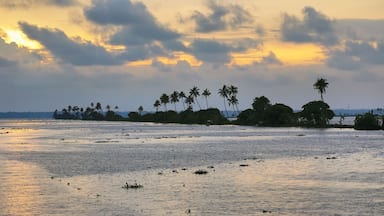
Paradise Kerala

Paradise Kerala

Kerala, famously nicknamed “God’s Own Country,” is an absolute coastal paradise. Beyond its famous backwaters and palm-fringed beaches lies a deep, multifaceted history shaped by ancient global trade, diverse cultures, and powerful social reform movements.

The Historical Chapters of Kerala

​1. The Mythological Origins

​According to Hindu legend, Kerala was pulled straight from the sea by Lord Parashurama (the sixth avatar of Vishnu). The story goes that he threw his battleaxe from Gokarna into the sea, and the waters receded to the point where it landed, creating the fertile, narrow strip of land we know today.

​2. The Ancient Spice Gateway (3000 BCE – 12th Century CE)

​Long before Europeans arrived, Kerala was the global hub for the spice trade—famed especially for its black pepper (“black gold”). The ancient port city of Muziris (near modern-day Kodungallur) was one of the most important international trading centers in the ancient world. 

  • Global Connections: Phoenicians, Egyptians, Greeks, Romans, Arabs, and Chinese all sailed to Kerala’s coasts to trade for spices, silk, and ivory.
  • The Chera Dynasty: The first major ruling empire of Kerala. They successfully managed these massive ocean-trade networks, making the region incredibly wealthy.


  • Cultural Melting Pot: Because of this open maritime trade, Kerala welcomed diverse faiths incredibly early. St. Thomas the Apostle is believed to have arrived in 52 CE, establishing one of the world’s oldest Christian communities. Jewish traders arrived around 68 CE, and Arab traders brought Islam shortly after its inception.

​3. The Colonial Era & Battles (1498 – 1947)

​The modern era of colonization began right on Kerala’s shores.

  • The Portuguese: In 1498, Portuguese explorer Vasco da Gama landed at Kappad near Calicut (Kozhikode), altering global trade routes forever.
  • The Battle of Colachel (1741): In a historic showdown, King Marthanda Varma of the Travancore Kingdom completely defeated the Dutch East India Company. This was a rare, monumental event where an Asian power decisively beat an organized European naval force.
  • The British Raj: By the late 18th century, following conflicts with Tipu Sultan of Mysore, the British took firm control over northern Kerala (Malabar), while the southern princely states of Travancore and Cochin maintained relative internal autonomy as British allies.

4. Modern Formation (1956)

​After India gained independence in 1947, the linguistic unification of Malayalam-speaking regions took place. On November 1, 1956, the modern state of Kerala was officially born by merging the Malabar district with the princely provinces of Travancore and Cochin.

FAQs

Where does the name "Kerala" come from?
The most widely accepted root is from the Malayalam word Keram, which means coconut tree. Thus, Keralam literally translates to "The Land of Coconuts." It was also epigraphically recorded as Keralaputra in 3rd-century BCE edicts by the Mauryan Emperor Ashoka.
What makes Kerala's backwaters historically and geographically unique?
The backwaters are a massive network of 5 large interconnected lakes, canals, and rivers that run parallel to the Arabian Sea coast. Historically, these were the "highways" of ancient Kerala, used to transport spices and rice on traditional cargo boats called Kettuvallams, which have now evolved into luxury houseboats.
Why is Kerala called a pioneer in social development?
Kerala has a history of powerful social reform movements led by figures like Sree Narayana Guru and Chattambi Swamikal, who fought fiercely against the caste system. Due to generations of focus on education and healthcare, Kerala became the first fully literate state in India (1991) and consistently ranks highest in India for life expectancy and gender ratio (1,084 females per 1,000 males).
What are the primary classical art forms born in Kerala?
Kerala is home to Kathakali (a highly stylized classical dance-drama known for its heavy, colorful makeup and intense facial expressions) and Mohiniyattam (the gentle, graceful dance of the enchantress). It is also the birthplace of Kalaripayattu, one of the oldest martial arts styles still practiced in the world.
Can you give me a deeper breakdown of the ancient spice trade in Kerala and how the port of Muziris functioned?
The ancient spice trade transformed Kerala from a tropical coastline into the economic engine of the ancient world. At the very center of this massive network was Muziris, a bustling, cosmopolitan port city that classical Roman writers described as “the first emporium of India.” ​Here is a look at how this ancient trade engine functioned at its peak. ​The Engine of Trade: How Muziris Functioned ​Muziris was not just a docking point; it was a highly organized transshipment hub. Its operations relied on a delicate mix of seasonal weather patterns, local geography, and sophisticated maritime logistics. ​1. Harnessing the Monsoon Winds ​The entire global trade system depended on the Monsoon winds (specifically the trade winds discovered by the Greek navigator Hippalus around 45 CE). ​The Journey Out: Roman and Arab ships would leave ports like Berenike in Egypt around July. The southwest monsoon winds blew their ships directly across the Arabian Sea to Kerala in a rapid 40 days. ​The Journey Back: Traders would spend late summer and autumn in Kerala doing business, waiting for the wind to shift. Around December, the northeast monsoon winds would carry them smoothly back to the Red Sea. ​2. The Backwater Transport Hub ​Large ocean-going Roman vessels could not easily navigate the shallow river mouths and narrow inland lagoons of Kerala. ​Giant ships anchored in the deep waters off the coast. ​Local traders met them in smaller, nimble wooden canoes and cargo boats called kettuvallams. ​These smaller boats shuttled into the interior hills via the backwaters to collect freshly harvested pepper and brought it back out to the ocean liners. 3. What Was Exchanged? ​The trade balance heavily favored Kerala. Pliny the Elder famously complained that the spice trade with India drained the Roman Empire’s treasury of over 50 million sesterces (gold and silver coins) every single year. What Muziris ExportedWhat Muziris Imported Malabar Black Pepper (The highest priority)Roman Gold & Silver Coins (Denarii) Cardamom, Cinnamon, & GingerFine Italian & Syrian Wine Malabar Spikenard (a luxury perfume ingredient)Copper, Tin, and Lead Pearls, Diamonds, and Beryl stonesGlassware and tortoiseshell Fine textiles and silksBroad-breasted hunting dogs Life in the Marketplace ​Ancient Sangam literature portrays Muziris as a vibrant, noisy multicultural city where "the beautiful ships of the Yavanas (Greeks/Romans) come, splashing the white foam of the Periyar river, arriving with gold and leaving with pepper." ​Because merchants had to wait months for the winds to change, Muziris developed permanent foreign quarters. Roman soldiers, Jewish traders, Arab merchants, and Chinese sailors lived alongside the local population. They built warehouses (pandikasalas), temples, synagogues, and early churches, laying the foundation for Kerala's famous multi-religious, tolerant social fabric. ​The Mysterious Disappearance ​For all its wealth, Muziris vanished from the maps almost overnight. ​In 1341 CE, a catastrophic monsoon flood on the Periyar River choked the river mouth with silt, completely blocking access to the ancient port. The massive geographic shift permanently closed the harbor of Muziris, but it simultaneously opened up a new natural harbor just a short distance south—creating the port city of Cochin (Kochi), which inherited the title "Queen of the Arabian Sea." ​Today, the Muziris Heritage Project around Kodungallur and Pattanam continues to unearth thousands of Roman amphora fragments, beads, and coins, slowly piecing together the physical map of India's ancient window to the world.

Price From : ₹400/-

Address

Near Avaloormadam temple, thathampally po, pin code 688013, Alleppey, Kerala, India