
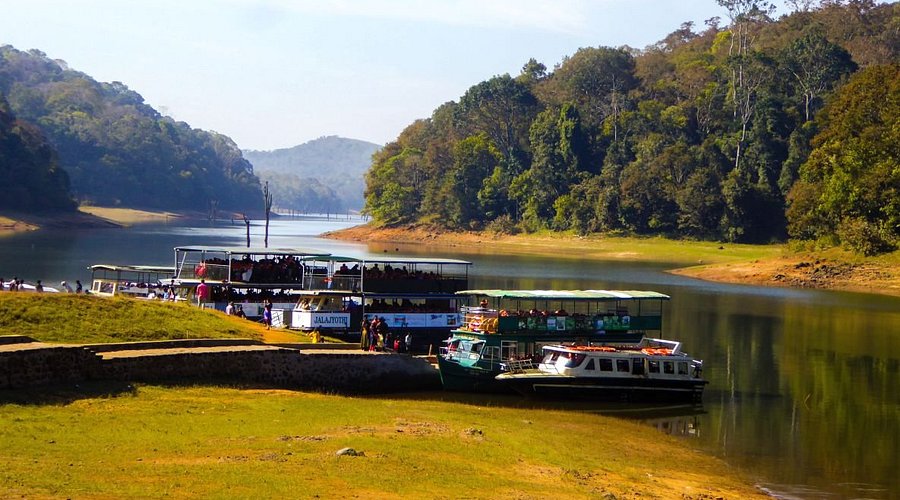
Periyar National Park

Periyar National Park

While Periyar is the heartbeat of Thekkady’s geography, its identity as a river, a lake, and a world-renowned tiger reserve carries a deep historical legacy of its own.

The Historical Heritage of Periyar

​1. The Lifeline of Kerala (Ancient History)

​The name “Periyar” translates literally to “Big River” in Malayalam. Stretching over 244 kilometers, it is the longest river in Kerala.

  • ​In ancient times, it was a crucial trade route connecting the spice-rich Western Ghats to the ancient port of Muziris, where Phoenician, Egyptian, Greek, and Roman merchants traded for black pepper and cardamom.
  • ​A massive flood in 1341 CE altered the river’s mouth, destroying Muziris but creating the natural harbor at Kochi.

​2. The Great Engineering Feat (1887–1895)

​The modern history of Periyar shifted from a free-flowing river to a structured sanctuary due to the construction of the Mullaperiyar Dam.

  • ​Engineered by British officer Pennycuick, the dam was built using limestone and surki mortar (a traditional mix of burnt clay, sugar, and lime) to withstand the massive water force.
  • ​The reservoir created by the dam flooded 26 square kilometers of low-lying forest. The iconic dead tree stumps standing out of the water today are the resilient remains of the old forest that was submerged over 130 years ago.

​3. Transition to World-Class Conservation

​What started as a way to control water quickly became a sanctuary for flora and fauna fleeing human encroachment.

  • 1934: The visionary Maharaja of Travancore, Chithira Thirumal, designated the area around the lake as the Nellikampathy Game Reserve, stopping unchecked hunting.
  • 1978: Under the Government of India’s environmental push, it officially became a core part of Project Tiger, gaining stringent legal protections against poaching and timber logging.
  • 2001: Recognizing its critical elephant populations, it was officially declared part of Project Elephant (Elephant Reserve No. 10).

FAQs

What makes Periyar's ecosystem unique compared to other national parks?
​Unlike standard dense forests where wildlife viewing depends purely on luck through thick brush, Periyar is centered around an artificial lake. Because the water source is permanent, animals—especially herds of wild elephants, gaurs, and wild boars—naturally congregate along the open banks. Taking a boat safari offers an unobstructed view of animals interacting in the open.
Are there actual tigers in Periyar Tiger Reserve, and can tourists see them?
​Yes, Periyar is home to an estimated population of about 35 to 40 Bengal Tigers. However, because it is an evergreen rainforest spanning over 925 square kilometers, tiger sightings during standard lake boat safaris are extremely rare. To increase your chances of seeing elusive carnivores or their tracks, travelers prefer the Periyar Tiger Trail—an overnight, guided trekking and camping program led by reformed poachers who know the deep interior paths perfectly.
How do I book the famous Periyar Lake boat safari, and what are the timings?
​The boat safaris are tightly regulated by the Kerala Forest Department and the Kerala Tourism Development Corporation (KTDC). ​Timings: Usually 5 trips daily, starting at around 07:30 AM, 09:30 AM, 11:15 AM, 01:45 PM, and 03:30 PM. The early morning and late afternoon slots offer the best chances for wildlife sightings. ​Booking: It is highly recommended to book online in advance through the official Periyar Tiger Reserve portal to avoid long queues at the Kumily ticket counters, as seats fill up rapidly during peak season.
What is the "Eco-Tourism" model practiced in Periyar?
​Periyar is celebrated globally for its community-based eco-tourism. The forest department employs members of the local indigenous tribes (like the Mannans and Palians) as guides, protectors, and trackers. Programs like Bamboo Rafting, Jungle Scout (night patrolling), and the Tiger Trail directly fund the local community, turning former forest exploiters into dedicated conservationists.
Are there any safety precautions to keep in mind while visiting Periyar?
​Leech Protection: If you are booking a deep jungle trek or border hike, especially right after the monsoons, wearing leech socks (canvas wraps over your socks) is highly advised. ​No Plastic: The reserve enforces a strict zero-plastic policy. Ensure you do not litter or carry single-use plastic bottles inside the sanctuary gates. ​Maintain Silence: On the boats, loud noises frighten the wildlife away from the banks. Keeping quiet maximizes sightings for everyone on board.

Price From : ₹400/-

Address

Near Avaloormadam temple, thathampally po, pin code 688013, Alleppey, Kerala, India