
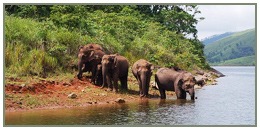
Eco Tourism

Eco Tourism

Kerala is widely regarded as the pioneer of organized eco-tourism in India. By focusing on minimal environmental impact, community involvement, and deep ecological education, the state shifted the travel industry away from commercial mass tourism toward sustainable development.

The Historical Evolution of Eco-Tourism in Kerala

​1. The Global Shift and Periyar’s Early Experiment (Mid-1990s)

​Before the 1990s, nature tourism mostly meant traditional sightseeing or big-game viewing. Following the global guidelines set by the International Ecotourism Society (TIES) in 1990, Kerala became the first Indian state to actively apply these principles on the ground.

  • ​The breakthrough came in 1996 inside the Periyar Tiger Reserve.
  • ​Faced with severe issues regarding illegal cinnamon bark peeling and poaching, the Forest Department launched the India Eco-Development Project (IEDP).
  • ​Instead of arresting local offenders, they formed Eco-Development Committees (EDCs), training former poachers to become legitimate, paid safari guides and protectors. This community-first strategy laid the blueprint for the entire country.

​2. Thenmala: India’s First Planned Eco-Tourism Destination (1999)

​While Periyar adapted an existing sanctuary, Kerala took it a step further in 1999 by creating Thenmala Eco-Tourism in the Kollam district.

  • ​This was the first planned eco-tourism destination in India, managed by the dedicated Thenmala Ecotourism Promotion Council (TEPC).
  • ​Located right in the foothills of the Western Ghats, Thenmala was systematically mapped into three distinct, low-impact tourist zones: the Culture Zone (showcasing local food and arts), the Leisure Zone (peaceful forest boardwalks), and the Adventure Zone (mountain biking and rock climbing).

​3. Institutionalization & Global Recognition (2000s–Present)

​Following Thenmala’s success, the Kerala Tourism Department institutionalized these practices by creating a dedicated Eco-Tourism Directorate.

  • ​Over 60 community-based destinations were developed across the state, including Gavi, Parambikulam, and Silent Valley.
  • ​Because of this long-term commitment, National Geographic Traveler honored Kerala as one of the “50 Greatest Destinations of a Lifetime,” specifically praising its focus on sustainable, community-backed green travel.

FAQs

What exactly makes a travel program "Eco-Tourism" rather than standard tourism?
​Standard tourism is consumer-centric; it prioritizes traveler comfort and commercial profit, often leading to heavy building infrastructure, high waste generation, and minimal local benefit. ​Eco-tourism adheres strictly to a triple bottom line: Conservation (protecting the local ecosystem), Community (ensuring all tourist revenue directly employs and empowers local residents), and Education (teaching travelers how to minimize their carbon and environmental footprints).
What are the top eco-tourism destinations in Kerala today?
​Thenmala (Kollam): Best for structured forest boardwalks, butterfly safaris, and light adventure sports. ​Gavi (Pathanamthitta): A pristine, high-altitude forest outpost famous for deep-woods trekking, canoeing, and spotting the rare Nilgiri tahr. ​Parambikulam Tiger Reserve (Palakkad): Highly organized bamboo rafting and island nest camping completely run by the local Kadar tribe. ​Eravikulam National Park (Munnar): Focused on protecting the endangered Nilgiri Tahr while providing strictly controlled mountain trail access.
How does eco-tourism directly help local tribal communities?
​Before these programs existed, tribal communities living inside forest fringes often lacked access to steady income, leading to exploitation by timber and poaching syndicates. Today, through Forest Development Agencies, they are the primary stakeholders. They earn direct, stable wages as forest guides, drivers, naturalists, and cooks. Furthermore, a fixed percentage of every entry ticket goes into a community fund used for local healthcare, schools, and infrastructure.
Are there strict capacity rules for these green destinations?
​Yes, this is called Carrying Capacity Management. To prevent overcrowding from disturbing wildlife or damaging fragile terrain, places like Gavi and Periyar place a hard cap on the number of vehicles and visitors allowed inside each day. This is why advance online booking via official forest portals is mandatory for almost all premium eco-trekking and bamboo rafting programs.
What is the "Green Palm" certification used in Kerala's hospitality sector?
​To keep private resorts and homestays accountable, Kerala introduced environmental auditing systems like the Green Palm Certification. Accommodations are rated based on their active sustainability practices, including solar energy usage, rainwater harvesting systems, zero single-use plastic policies, sewage treatment plants, and sourcing at least 80% of their food ingredients from local organic farmers.

Price From : ₹400/-

Address

Near Avaloormadam temple, thathampally po, pin code 688013, Alleppey, Kerala, India