Is the Hyderabad Metro connected to the airport?
Not yet, but it is the highest priority right now. Under the approved Phase II expansion, the Airport Express corridor will connect the eastern and western parts of the city directly to Rajiv Gandhi International Airport (RGIA) in Shamshabad. Until it is operational (expected around 2030–2031), travelers rely on the Pushpak AC Airport Liners (buses) or app-based cabs via the smooth Outer Ring Road.
What are the best areas for corporate travelers and expats to stay?
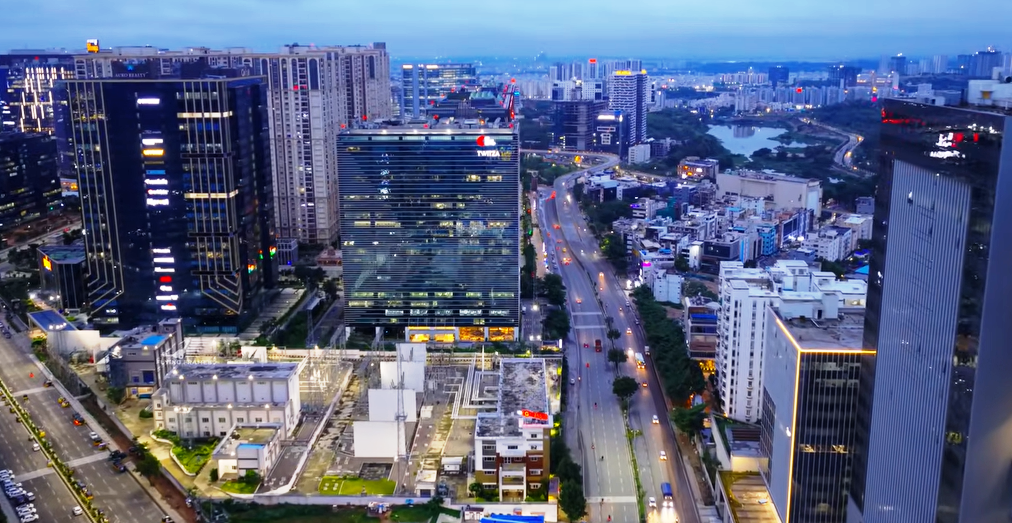
If you are visiting for tech or corporate business, HITEC City, Gachibowli, and the Financial District are the most convenient, offering premium hotels and immediate access to major office parks. For a more central, luxurious, and culturally vibrant stay with access to high-end dining, Banjara Hills and Jubilee Hills are the top choices.
What makes Kokapet and Tellapur so popular right now?
These western suburbs are currently the hottest real estate and infrastructure micro-markets in Hyderabad. Because the central IT corridors (HITEC City) are saturated, massive multinational office towers and ultra-luxury gated residential communities are shifting to Kokapet (Neopolis) and Tellapur. They offer wider roads, better urban planning, and upcoming direct Metro Phase II connectivity.
How is the local public transport within the city?
Beyond the Metro (which is highly efficient for north-south and east-west core travel), the city relies on the TSRTC bus network and the local MMTS (Multi-Modal Transport System) suburban train network. For last-mile connectivity, auto-rickshaws and app-based aggregators (Uber, Ola, Rapido) are available 24/7.
What is the "Future City" or "Fourth City" project I keep hearing about?
Historically, Hyderabad was known as the "Twin Cities" (Hyderabad and Secunderabad), which later expanded into a "Tri-City" with the development of Cyberabad (HITEC City). The government is now planning a "Fourth City" (Future City) on the southern outskirts near the airport. It is envisioned as a massive, net-zero urban development focused heavily on Artificial Intelligence, advanced tech manufacturing, and world-class transit systems.
What are the top historical and cultural tourist places to visit in Hyderabad for a 2-day trip?
A 2-day historical and cultural itinerary in Hyderabad allows you to perfectly split your time between the older, majestic Nizami core and the rugged medieval fort structures on the city's western edges.
Here is the recommended route alongside the must-visit landmarks.
Day 1: The Heart of the Old City (Nizami Heritage)
Charminar
The ultimate signature monument of Hyderabad, built in 1591 by Sultan Muhammad Quli Qutb Shah to mark the end of a devastating plague.
The Vibe: An imposing four-story structure featuring grand arches and minarets that overlooks bustling bazaars. You can climb up the narrow steps for a panoramic view of the surrounding historic grid.
Key Highlights: Admire the intricate stucco decorations, visit the tiny mosque on the top floor, and walk right next door to see the grand Makkah Masjid.
Chowmahalla Palace
Located just a short walk or auto-ride from the Charminar, this was the official seat of the Asaf Jahi dynasty and the residence of the Nizams of Hyderabad.
The Vibe: Opulent Persian-style palaces set amidst expansive, manicured lawns and fountains, radiating royal grandeur.
Key Highlights: The magnificent Khilwat Mubarak (Grand Durbar Hall) with its massive Belgian crystal chandeliers, a stunning collection of vintage royal cars, and galleries showcasing weapon armor, royal attire, and priceless old photographs.
Salar Jung Museum
Situated on the southern bank of the Musi River, this is one of India's three National Museums, housing the incredible private art collection of the Salar Jung family.
The Vibe: A treasure trove of global history featuring art, sculptures, carvings, and textiles spanning across civilizations.
Key Highlights: The famous Veiled Rebecca marble statue, the 19th-century musical bracket clock where a mechanical toy figure strikes the hour, and an extensive collection of royal weaponry and jade artifacts.
Day 2: The Medieval Era & Royal Tombs
Golconda Fort
A massive, rugged citadel that served as the capital of the early Qutb Shahi kingdom, renowned for its brilliant engineering, diamond trade history, and acoustic marvels.
The Vibe: A sprawling mountain fortress surrounded by crenellated granite walls, offering a deep dive into medieval military defense strategies.
Key Highlights: Experience the legendary acoustic system at the Bala Hissar gate (where a clap at the entrance can be clearly heard at the hilltop pavilion a kilometer away), explore old granaries, and stay back for the evening Sound & Light show detailing the fort's fall to Aurangzeb.
Qutub Shahi Tombs
Located closely to the outer fort walls, this peaceful necropolis contains the intricately carved domed mausoleums dedicated to the seven Qutb Shahi rulers who built Hyderabad.
The Vibe: A serene, poetically landscaped heritage park where ancient Islamic, Persian, and Hindu architectural styles seamlessly blend together.
Key Highlights: Marvel at the grand tomb of Muhammad Quli Qutb Shah, walk through the old stepwells (baolis) being meticulously restored, and visit the mortuary bath complex.
Helpful Planning Tips
Closed Days: Keep in mind that Chowmahalla Palace and the Salar Jung Museum are both closed on Fridays. Plan your trip days accordingly so you don't miss out on these sites.
Clothing: When visiting Makkah Masjid next to the Charminar, ensure you dress conservatively. Women are required to cover their heads with a scarf.
How does T-Hub and the startup ecosystem function in Hyderabad, and what facilities do they offer?
T-Hub (Technology Hub), located in the Raidurg IT corridor of Hyderabad, is India's premier innovation intermediary and holds the title of the world's largest innovation campus. Spanning over 582,000 square feet, T-Hub 2.0 operates as a massive public-private partnership between the Government of Telangana, premier academic institutions (IIIT-H, ISB, NALSAR), and the private sector.
Rather than acting as just a standard co-working office, T-Hub functions as a "full-stack innovation ecosystem" designed to accelerate a startup's journey from an early idea to global scale.
How the Ecosystem Functions
T-Hub’s model is built on a "triple helix" framework that deliberately forces daily collisions between four key pillars: Startups, Corporates, Investors, and Government/Academia.
Startup Innovation (Incubation & Acceleration): T-Hub runs stage-specific, cohort-based flagship programs. Startups enter for 6 to 18 months to refine their products and business models.
Corporate Innovation: Global corporations (such as Boeing, Honda, and Kotak) partner with T-Hub to set up custom accelerator programs. This allows large enterprises to scout niche technologies, while giving startups a direct track to pitch for enterprise-level pilots and contracts
Investor Integration: An entire floor of the T-Hub facility is dedicated strictly to Venture Capital (VC) firms, angel networks, and private equity partners, ensuring that founders have constant, physical proximity to capital.
Key Programs Offered
Lab32: T-Hub’s flagship market-readiness program designed to help early-stage startups establish product-market fit and scale their go-to-market strategies.
T-Angel: A rigorous, investment-readiness program that mentors founders on fundraising mechanics, financial compliance, and directly connects them to curated angel networks.
T-Bridge: An internationalization program that provides "soft-landing" facilities, connecting Indian startups with global markets (such as the US, UK, Japan, and Singapore) while helping foreign startups enter India
Core Infrastructure & Specialist Facilities on Campus
The building itself is a LEED Platinum-certified, futuristic architectural marvel engineered specifically for tech creation:
1. Advanced Technology Labs & Infrastructure
MATH (Machine Learning and Artificial Intelligence Technology Hub): Developed in partnership with the Department of Science and Technology (DST), MATH is India's largest specialized AI/ML Centre of Excellence. It provides startups with virtual and physical incubation alongside high-performance AI/ML compute infrastructure to train advanced data models.
Google for Startups Hub: The first state-integrated Google facility of its kind in India, providing on-campus startups with direct access to Google’s advanced cloud infrastructure, AI technologies, specialized global mentorship, and tech training.
DeepTech & Rapid Prototyping Labs: Specialized infrastructure setups focused on hardware and deep-tech sectors, including dedicated programs for SpaceTech (supporting famous local alumni like Skyroot and Dhruva Space), Semiconductors, Sustainability, and Mobility.
2. Physical & Operational Facilities
Fully Managed Workspace: Best-in-class co-working environments offering flexible hot desks, dedicated desks, and private enclosed team cabins for teams of all sizes.
Event Spaces & Auditoriums: Flexible, high-tech event venues, amphitheaters, and meeting rooms built to host hackathons, pitch days, product launches, and massive corporate networking mixers.
T-Edge (Legal & Business Concierge): An in-house, dedicated service panel that provides startups with subsidized legal assistance, Intellectual Property (IPR) filing support, accounting, HR advisory, and compliance management.
Value Partner Network: Handshakes with core tech vendors providing over $100K+ in free credits across essential services like AWS, Azure, digital marketing toolkits, and payment rails.