
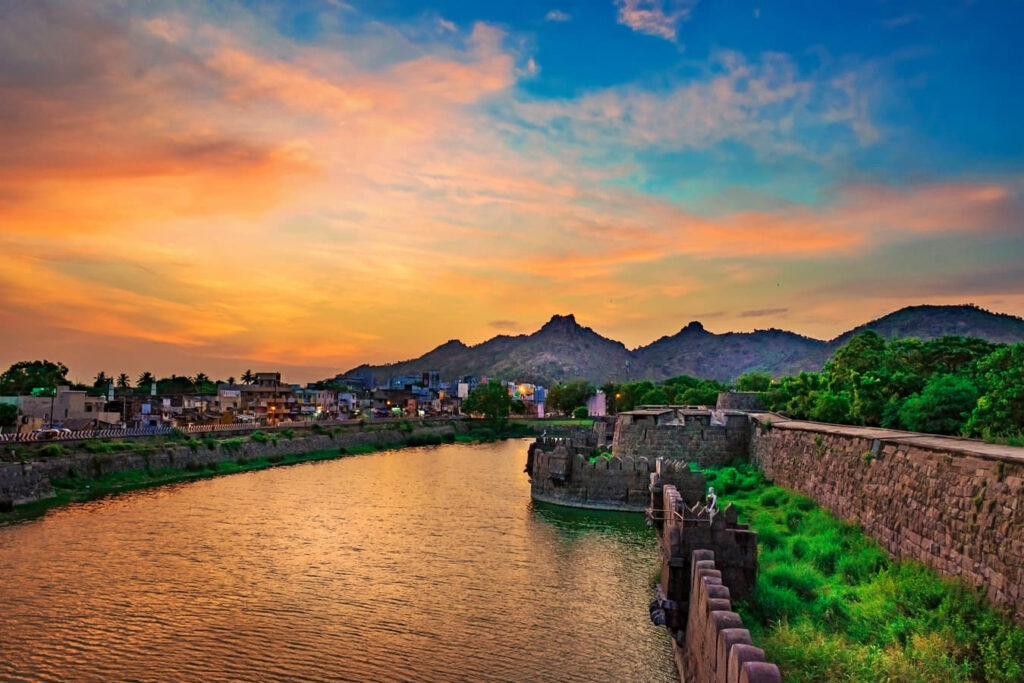
Vellore – In Tamilnadu
Vellore, located on the banks of the Palar River in northern Tamil Nadu, is a historic city that has evolved into one of South India’s premier educational and medical hubs.
Historical Significance
Vellore’s history spans over several centuries, serving as a strategic seat of power for major South Indian dynasties, including the Pallavas, Cholas, Vijayanagara Empire, Nayaks, Bijapur Sultanate, Marathas, and the British.
Vellore Fort (16th Century): Built by the Vijayanagara chieftain Chinna Bommi Nayak, this massive granite fort is famous for its military architecture and wide moat. It houses the ornate Jalakanteswarar Temple, a church, and a mosque inside its ramparts.
The Sepoy Mutiny of 1806: Half a century before the 1857 Revolt, Indian soldiers stationed at Vellore Fort staged the Vellore Mutiny on July 10, 1806, protesting British military dress codes and religious infringement. It was the first major large-scale mutiny against the East India Company.
Royal Captivity: The fort served as a high-security prison for notable royal captives, including Tipu Sultan’s family after the Fall of Seringapatam (1799) and Sri Lanka’s last monarch, King Sri Vikrama Rajasinha (1798–1815).
Infrastructure & Key Facilities
Vellore combines heritage with modern urban infrastructure, driven by world-class medical and academic institutions.
Healthcare & Education Hub
Christian Medical College (CMC): Established by Dr. Ida S. Scudder in 1900, CMC Vellore is one of India’s leading multi-specialty research institutes and hospitals, attracting hundreds of thousands of medical tourists globally each year.
Vellore Institute of Technology (VIT): A premier private university ranked high for engineering and technology studies in India.
Government Medical Institutions: The Government Vellore Medical College and Hospital (MDU) serves as a key public regional healthcare facility.
Transport & Connectivity
Rail: Katpadi Junction (KPD), located ~5 km from the city center, is a major railway junction connecting Chennai, Bengaluru, Trivandrum, and Delhi.
Road: Vellore lies directly on the NH 48 corridor connecting Chennai (~135 km) and Bengaluru (~210 km), providing frequent bus and express road connectivity.
Air: The nearest major international airports are Chennai (MAA) and Bengaluru (BLR).
Industrial & Smart City Growth
Leather & Manufacturing: The Vellore-Ranipet-Ambur belt is known as the “Leather Hub of South India,” contributing a significant share to India’s leather exports.
Smart City Initiatives: Upgrades include revamped drainage systems, intelligent traffic management, solar energy installations, and recreational parks surrounding the fort area.
Frequently Asked Questions (FAQs)
What is the best time to visit Vellore?
The best time to visit is from November to February during winter, when temperatures range between 18^circtext{C} and 28^circtext{C}. Summers (April to June) can get hot, often exceeding 40^circtext{C}.
What are the main tourist attractions in Vellore?
Vellore Fort & Jalakanteswarar Temple (16th-century granite fort and temple inside).
Sripuram Golden Temple (Thirumalaikodi): A temple gilded with over 1,500 kg of pure gold foil, located 9 km from the city center.
State Government Museum: Located inside the fort, housing ancient sculptures and weapons from the Vijayanagara era.
Amirthi Zoological Park: A forest park and waterfall spot situated ~25 km south of the city.
How far is Vellore from Chennai and Bengaluru?
From Chennai: ~135 km (approx. 2.5 to 3 hours by road or rail).
From Bengaluru: ~210 km (approx. 3.5 to 4 hours by road).