
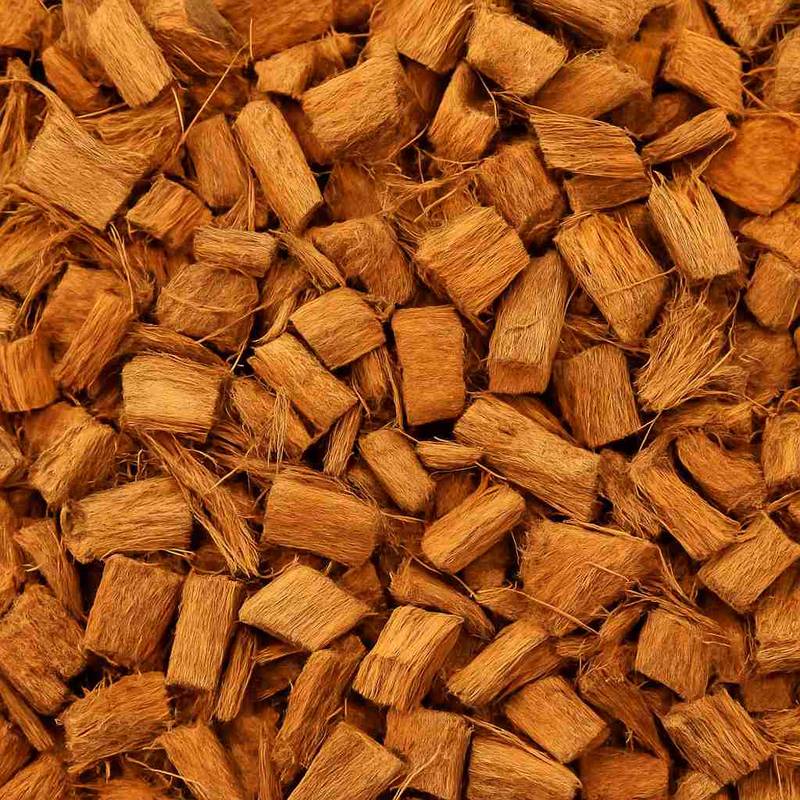
Coconut husk chips – (often called coco husk chips or coco coir chips)
Coconut husk chips (often called coco husk chips or coco coir chips) are coarse, cubical pieces of chopped coconut husk. They are widely used as a premium, sustainable growing medium and mulch. Unlike fine coco peat, husk chips retain a chunky, fibrous structure that creates large air pockets, offering optimal aeration and drainage for orchids, high-value crops, and landscaping.
1. Product Details & Technical Specifications
ParameterSpecification / Grade Details
Common SizesS-Grade: 6–10 mm | M-Grade: 10–15 mm | L-Grade: 15–20 mm | Chunks: 20–30 mm
Electrical Conductivity (EC)Washed/Low EC: < 0.5–1.0 mS/cm (ideal for sensitive roots like orchids)
Unwashed/High EC: > 2.0 mS/cm (used for landscaping or ground cover)
pH RangeSlightly acidic to neutral (5.5 to 6.8)
Air-Fill PorosityVery high (30%–45%), preventing soil compaction and root rot.
Decomposition RateExtremely slow (lasts 3 to 5 years in potting media before breaking down).
Supply FormatsCompressed 5 kg blocks, 50-liter bags, mini briquettes, or loose bulk packaging.
2. Key Applications & Benefits
Orchid & Epiphyte Growing Medium: Acts as a long-lasting, sustainable replacement for pine bark or fir bark.
Soil Amendment for Potting Mixes: Mixed into standard soil or coco peat (20%–30% ratio) to boost root aeration and prevent compaction.
Decorative & Weed-Suppressing Mulch: Spread over garden beds to suppress weed growth, regulate soil temperature, and retain moisture.
Reptile & Animal Bedding: Absorbs moisture and odor while providing a dust-free, non-toxic substrate.
3. Infrastructure & Processing Facilities
To convert raw, salty coconut husks into export-quality horticultural chips, processing units in major coconut-producing belts (such as Kerala and Tamil Nadu) rely on specialized processing infrastructure:
Raw Material Sourcing & Chipping
Automatic Rotary Husk Cutters: Heavy-duty motorized decortication and chip-slicing machines cut raw coconut husks into uniform sizes without pulverizing the natural fibers.
Multi-Stage Mechanical Rotary Screens (Sifters): Separate the cut chips by size (mini, medium, large, and extra-large) while sifting out excess fine dust/coco peat.
Washing, Buffering & Drying Infrastructure
Desalination & Washing Bays: High-volume water treatment systems wash out natural sodium and potassium salts from raw husks to bring down the Electrical Conductivity (EC).
Calcium Nitrate Buffering Tanks: Displaces bound sodium and potassium ions with calcium and magnesium to stabilize the nutrient-holding capacity for sensitive plants.
Concrete Sun-Drying Yards & Poly-Houses: Expansive paved concrete yards (often exceeding 100,000 sq. ft.) for solar drying, accompanied by poly-houses for moisture control during monsoon seasons.
Compressing & Packaging Lines
Hydraulic Pressing Machines: Compress dried chips at high pressure into 5 kg blocks (expanding up to 50–60 liters upon hydration) or briquettes to reduce shipping volume.
Automated De-stoning & Metal Detection: Pass-through magnetic sweepers and destoners ensure the chips are free from sand, stones, or metallic contaminants before packing.
4. Frequently Asked Questions (FAQs)
1. What is the main difference between Coco Peat and Coco Husk Chips?
Coco Peat (Coir Pith): Fine, spongy dust material extracted from the husk. It acts like a sponge, holding massive amounts of water, but has low aeration when wet.
Coco Husk Chips: Chunky, cut pieces of the outer husk containing both fiber and pith. They hold moderate water while maximizing airflow and drainage.
2. Why is it important to choose “Washed” or “Buffered” husk chips?
Unprocessed raw coconut husks naturally contain high levels of sodium and potassium from sea air and coastal soils. Using unwashed chips can burn tender plant roots. Washed/Buffered chips have been treated to lower the salt content (Low EC), making them completely safe for immediate planting.
3. How do you prepare compressed coco husk chip blocks for use?
Place the compressed block in a large container, add water (approximately 20–25 liters per 5 kg block), and let it sit for 15–20 minutes. The block will absorb the water and expand up to 5 to 6 times its compressed volume, unraveling into loose, ready-to-use chips.
4. How long do coconut husk chips last before degrading?
Because of their high lignin content, coco husk chips decompose very slowly. They maintain their structural shape and air porosity in garden beds or orchid pots for 3 to 5 years, outlasting traditional pine bark mulches.