
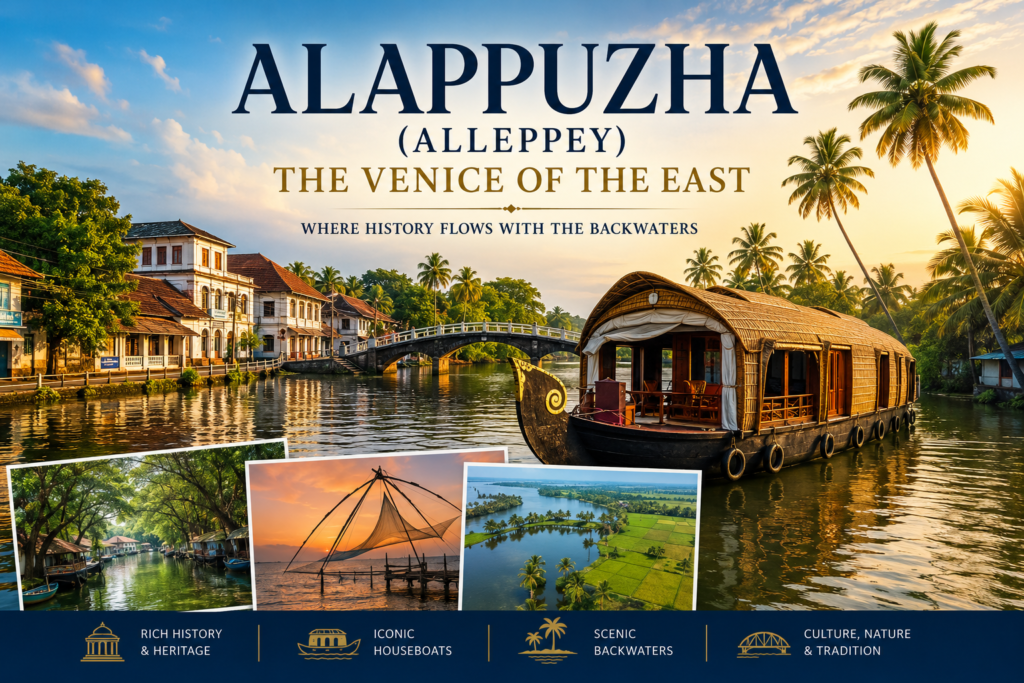
Alappuzha, historically known as Alleppey, is one of Kerala’s most iconic destinations, where an intricate network of backwaters, canals, lakes, and lagoons has shaped its history, culture, and economy for centuries. Nestled between the Arabian Sea and the majestic Vembanad Lake, Alappuzha is celebrated for its tranquil waterways, traditional houseboats, vibrant coir industry, and rich maritime heritage. Today, it stands as one of India’s most sought-after tourist destinations, offering visitors a perfect blend of history, nature, and culture.
The Birth of Alappuzha
Although the fertile Kuttanad region has been inhabited since the Sangam period (300 BCE–300 CE) and played a significant role in the ancient spice trade with Greece and Rome, the modern town of Alappuzha was established during the 18th century under the visionary leadership of Raja Kesavadas.
Raja Kesavadas – The Visionary Founder
During the 1760s, Raja Kesavadas, the Diwan (Prime Minister) of the Kingdom of Travancore, envisioned Alappuzha as a thriving port city that would strengthen international trade in spices, coir, timber, and agricultural products while reducing the kingdom’s dependence on neighboring ports.
Engineering a Canal City
To bring this vision to life, Raja Kesavadas developed an extensive network of man-made canals connecting the inland backwaters to the Arabian Sea. Roads were constructed alongside these waterways, creating an efficient transportation system that greatly enhanced trade and communication throughout the region.
A Flourishing Commercial Hub
To encourage economic growth, merchants and traders from Gujarat, Rajasthan, Surat, Mumbai, and Kutch were invited to establish businesses in Alappuzha. Their arrival transformed the town into one of South India’s busiest trading centers and significantly boosted its commercial importance.
The “Venice of the East”
In the early 20th century, Lord Curzon, then Viceroy of India, visited Alappuzha and was captivated by its picturesque canals, charming bridges, and serene waterways. Struck by its resemblance to the famous Italian city, he referred to Alappuzha as the “Venice of the East,” a title that continues to define its global identity.
Kerala’s Historic Water Highway
The backwaters of Alappuzha form an extensive network of interconnected lakes, rivers, canals, and lagoons that have served as Kerala’s primary transportation system for centuries.
Long before the development of roads and railways, these waterways connected remote villages with major trading ports. Farmers transported rice harvested from the below-sea-level paddy fields of Kuttanad, along with coconuts, spices, coir products, and other agricultural goods, using traditional country boats that navigated these natural waterways.
Today, these historic backwaters have evolved into one of Kerala’s most treasured tourist attractions, offering visitors unforgettable cruises through lush coconut groves, peaceful villages, and breathtaking landscapes.
The Story of Kerala’s Famous Houseboats
One of Alappuzha’s most celebrated attractions is its luxurious houseboats, which evolved from traditional cargo vessels known as Kettuvallams.
The Traditional Kettuvallam
The word Kettuvallam comes from the Malayalam words “Kettu” (to tie) and “Vallam” (boat).
These remarkable boats were masterpieces of traditional engineering, built entirely without nails or screws. Skilled craftsmen joined sturdy jackfruit wood planks using strong coir ropes made from coconut fibers, demonstrating Kerala’s exceptional indigenous boat-building techniques.
The wooden hulls were waterproofed using natural resin extracted from cashew nut shells, while bamboo poles and woven palm leaves formed durable roofs that protected cargo from tropical rain and heat.
Many Kettuvallams stretched nearly 100 feet in length and could carry up to 30 tons of cargo, transporting rice, spices, coconuts, coir, and other agricultural products between the villages of Kuttanad and the bustling port of Alappuzha.
From Cargo Boats to Alleppey Luxury Houseboats
With the expansion of modern roads, railways, and motorized transportation during the mid-20th century, the traditional water-based cargo trade gradually declined, leaving many Kettuvallams abandoned.
Recognizing their historical and cultural significance, Kerala’s tourism industry and local entrepreneurs restored these magnificent vessels and transformed them into luxurious floating accommodations.
While preserving the traditional bamboo and wooden exterior, the interiors were redesigned with modern amenities, including:
- Spacious air-conditioned bedrooms
- Attached bathrooms
- Comfortable dining areas
- Fully equipped kitchens
- Open sun decks
- Premium hospitality services
Today, these beautifully restored houseboats offer one of the world’s most unique eco-tourism experiences. Visitors can glide through Kerala’s tranquil backwaters, savor authentic local cuisine, witness breathtaking sunsets, observe vibrant birdlife, and experience the timeless charm of village life—all from the comfort of a floating home.
A Timeless Destination
Alappuzha is more than just a scenic destination; it is a living testament to Kerala’s rich maritime history, engineering ingenuity, and cultural heritage. From its historic canals and bustling trading legacy to its world-famous houseboats and serene backwaters, every corner of Alappuzha tells a story of innovation, resilience, and natural beauty.
Whether you’re seeking relaxation, cultural exploration, or an unforgettable journey through Kerala’s waterways, Alappuzha truly lives up to its reputation as the “Venice of the East.”
Overview of Alleppey Luxury Houseboats
Luxury houseboats in Alleppey (Alappuzha) offer an upscale, private cruise experience through Kerala’s famous backwaters. Modern luxury boats are built using traditional Kettuvallam architecture combined with contemporary interiors, high-end amenities, and dedicated hospitality.
Key Amenities & Features
- Full-Time Air Conditioning: Unlike Deluxe boats (where AC operates only at night), Luxury and Ultra-Luxury houseboats provide 24/7 climate control in all enclosed areas (bedrooms, glass-walled living, and dining spaces).
- Exclusive Luxury Configurations: Ranging from 1-bedroom private honeymoon boats up to multi-bedroom layouts for groups.
- Special Onboard Facilities: Select ultra-luxury variants feature private upper decks, Jacuzzis, shower panels, glass walls for panoramic views, and conference/lounge setups.
- Gourmet Dining: Premium Kerala cuisine cooked fresh on board by a dedicated chef, along with options for customized menus (North Indian, Jain, Continental, or fresh seafood prepared to order).
- Dedicated Crew: Every boat comes with a personal captain, chef, and deck helper.
Popular Cruise Itineraries
- Alleppey Round Cruise: Covers Punnamada Lake, Kuttanad paddy fields, narrow village canals, and Vembanad Lake.
- Alleppey to Kumarakom Route: Crosses the expansive Vembanad Lake towards Kumarakom bird sanctuary—a top choice for couples and relaxation.
- Alleppey to Thottappally / Alumkadavu: Longer, serene routes exploring deep countryside backwaters.
Frequently Asked Questions (FAQs)
1. What is the difference between Deluxe, Premium, and Luxury Houseboats?
- Deluxe: Air conditioning operates during fixed hours (typically 9:00 PM to 6:00 AM) with standard local meal plans.
- Premium & Luxury: Offer 24/7 air conditioning, premium wooden/glass interior finishing, upgraded food menus, private balconies, upper decks, and superior service standards.
2. What are the standard check-in and check-out timings for an overnight stay?
- Overnight Cruise: Check-in is around 12:00 PM (noon). The boat cruises until 5:30 PM, anchors overnight near the bank, resumes cruising at 8:00 AM the next morning, and checks out by 9:00 AM.
- Day Cruise: Operates from 11:00 AM to 5:00 PM.
3. Why does the boat anchor in the evening?
Government safety and maritime regulations prohibit engine-powered boat movement between 5:30 PM and 7:30 AM. This rule protects fishermen setting up fishing nets in the backwaters overnight.
4. Are meals included in the houseboat package?
Yes, overnight packages include lunch, evening tea/snacks, dinner, and breakfast. Day cruise packages include lunch and evening snacks. Special menu preferences (Vegetarian, Jain, Non-Veg, or customized dishes) can be arranged prior to departure.
5. Is a houseboat stay private or shared?
Luxury houseboats are booked on an exclusive/private basis. You do not share the boat with other tourist groups; only your party and the dedicated crew are on board.
6. Is it safe for children and senior citizens?
Yes. Houseboats are equipped with safety railings, life jackets, fire extinguishers, first-aid kits, and trained crew members certified in safety protocols.
7. How far in advance should a luxury houseboat be booked?
Pre-booking 2 to 4 weeks in advance is highly recommended, especially during the peak travel season (October to February) and holidays, to secure the preferred boat category and configuration.
Overview of Alleppey Houseboats
Alleppey (Alappuzha) houseboats are built using traditional Kettuvallam boat-making techniques, using tied wooden planks without a single nail. Today, these vessels operate as floating hotels, providing private, scenic cruises through Kerala’s backwaters, lakes, and palm-fringed village canals.
Categories & Features
Houseboats range from 1-bedroom private options for couples to large multi-bedroom layouts (up to 10+ bedrooms) for groups.
- Deluxe Houseboats:
- Air-conditioning operates inside the bedrooms during fixed hours (typically 9:00 PM to 6:00 AM).
- Traditional furnishings with attached private bathrooms.
- standard Kerala meal plans prepared fresh on board.
- Premium Houseboats:
- Full-time (24/7) air conditioning in bedrooms.
- Upgraded interiors, glass-walled dining/lounge areas, and comfortable deck seating.
- Expanded dining choices (veg, non-veg, and customized seafood).
- Luxury & Ultra-Luxury Houseboats:
- Full-time air conditioning throughout the entire boat (bedrooms, living area, and dining space).
- Premium designer interiors, expansive upper decks, glass walls, and optional modern add-ons like Jacuzzis or shower panels.
- Multi-course dining with personal chef service and flexible meal plans.
- Check-in: 11:30 AM – 12:00 PM (Noon)
- Afternoon Cruise: 12:00 PM to 1:30 PM, followed by lunch.
- Evening Cruise: 2:30 PM to 5:30 PM.
- Overnight Mooring: Anchored at the riverbank from 5:30 PM until morning.
- Morning Cruise & Check-out: 8:00 AM to 9:00 AM cruise, check-out at 9:00 AM.
- Meals Included: Welcome drink, Lunch, Evening Tea & Snacks, Dinner, and Breakfast.
- Timing: 11:00 AM to 5:00 PM.
- Meals Included: Welcome drink, Lunch, and Evening Tea with snacks.
- Alleppey Round Cruise: Covers Punnamada Lake, Kuttanad paddy fields, narrow village canals, and open lake waters.
- Alleppey to Kumarakom: Crosses the expansive Vembanad Lake towards the bird sanctuary and backwater resorts.
- Alleppey to Thottappally / Alumkadavu: Longer, peaceful countryside routes ideal for extended backwater exploration.
Overview of Kerala Boathouses (Kettuvallams)
Kerala boathouses—traditionally known as Kettuvallams—are converted wooden rice barges crafted using ancient boat-making techniques where planks of jackwood are tied together with coir ropes without using a single nail. Today, these vessels operate as floating resorts offering private, immersive cruises along Kerala’s palm-fringed backwaters.
Categories & Onboard Amenities
Boathouses operate across various bedroom configurations, ranging from single-bedroom private boats for honeymooners up to 10-bedroom layouts for large family or corporate groups.
- Deluxe Boathouses:
- Air-conditioning operates inside the bedrooms during fixed night hours (typically 9:00 PM to 6:00 AM).
- Traditional wooden interiors with attached Western-style bathrooms.
- Freshly prepared traditional Kerala meal plans served onboard.
- Premium Boathouses:
- Full-time (24/7) air conditioning inside the bedrooms.
- Superior furnishings, glass-walled dining lounges, and open deck seating.
- Enhanced menus featuring traditional delicacies such as Karimeen (Pearl Spot fish) and prawns.
- Luxury & Ultra-Luxury Boathouses:
- Full-time air conditioning covering all enclosed areas (bedrooms, dining hall, and living lounge).
- Premium designer interiors, expansive upper decks, glass walls, and optional amenities such as Jacuzzis or shower panels.
- Multi-cuisine personalized dining prepared by a personal chef onboard.
- Check-in: 11:30 AM – 12:00 PM (Noon).
- Afternoon Cruise: 12:00 PM to 1:30 PM (lunch break), followed by scenic cruising from 2:30 PM to 5:30 PM.
- Overnight Mooring: Anchored along the quiet village riverbanks from 5:30 PM until morning.
- Morning Cruise & Check-out: 8:00 AM to 9:00 AM morning ride, followed by check-out at 9:00 AM.
- Meals Included: Welcome drink, Lunch, Evening Tea & Snacks, Dinner, and Breakfast.
- Timing: 11:00 AM to 5:00 PM.
- Meals Included: Welcome drink, Lunch, and Evening Tea with snacks.
- Alleppey (Alappuzha): The primary hub for backwater tourism, known for its expansive lakes (Punnamada, Vembanad) and interconnected village canals.
- Kumarakom: Located on the eastern shore of Vembanad Lake, offering scenic luxury resorts, bird sanctuary views, and wide water channels.
- Kollam (Quilon): Offers longer, tranquil 8-hour historic cruises connecting Kollam to Alleppey.
Overview of Alleppey Backwater Boathouses
An Alleppey backwater boathouse (traditionally known as a Kettuvallam) is a specially designed floating vessel constructed using wooden planks of jackwood tied together with coir knots, crafted entirely without nails. Operating along the backwater canals, rivers, and lakes of Alappuzha, these boathouses function as fully equipped private floating accommodations.
Categories & Onboard Facilities
Boathouses come in various configurations (from 1-bedroom private boats up to 10-bedroom vessels for larger groups), divided into three primary categories:
| Category | Air Conditioning (AC) Policy | Amenities & Experience |
|---|---|---|
| Deluxe | Night-time only (typically 9:00 PM – 6:00 AM) | Traditional wooden interiors, attached private washroom, standard Kerala meal plan. |
| Premium | Full-time / 24 Hours | Upgraded interiors, glass-walled dining area, enhanced menu selections. |
| Luxury / Ultra-Luxury | Full-time / 24 Hours (All enclosed areas) | Designer wood/glass interiors, upper decks, multi-cuisine personal chef, premium fixtures (e.g., Jacuzzi options). |
Cruise Options & Timings
- Overnight Cruise (Standard – 21 Hours):
- Check-in: 11:30 AM – 12:00 PM (Noon)
- Day Cruise: 12:00 PM to 1:30 PM (lunch break), resuming 2:30 PM to 5:30 PM
- Evening Anchor: 5:30 PM until morning
- Morning Cruise & Check-out: 8:00 AM to 9:00 AM cruise, checking out by 9:00 AM – 9:30 AM
- Meals Included: Welcome drink, Lunch, Evening Tea & Snacks, Dinner, and Breakfast.
- Day Cruise (5–6 Hours):
- Timing: 11:00 AM to 5:00 PM
- Meals Included: Welcome drink, Lunch, and Evening Tea with snacks.
- Alleppey Round Cruise: Navigates Punnamada Lake, Kuttanad paddy fields below sea level, narrow village canals, and open waters.
- Alleppey to Kumarakom Route: Crosses the expansive Vembanad Lake towards Kumarakom’s bird sanctuary and luxury lakeside resorts.
- Alleppey to Thottappally / Alumkadavu Route: Extended, quiet routes taking in deep rural backwater scenery.
Overview of Shikara Boats vs. Motorboats in Alleppey
Shikara boats and motorboats offer two popular, open-deck alternatives to full-sized houseboats for exploring the backwaters of Alleppey (Alappuzha). They are ideal for day trips, short hourly tours, and navigating shallow, narrow village canals where large houseboats cannot enter.
Key Comparisons & Features
| Feature | Shikara Boat | Motorboat |
|---|---|---|
| Design & Seating | Traditional wooden hull with cushion seating, bamboo roofing, and open sides. | Open-deck engine boat with row/bench seats and an overhead canopy. |
| Canal Access | High access to narrow, shallow village channels and quiet backwaters. | Limited to medium and wide backwater channels and open lakes. |
| Capacity | 2 to 15 passengers (varies by boat size). | 10 to 50+ passengers (ideal for larger groups/budget travel). |
| Speed & Vibe | Slow, silent, and peaceful; designed for relaxing sightseeing. | Faster and louder engine movement; focused on efficient point-to-point transit. |
| Typical Duration | 2 to 5 hours (popular for sunrise/sunset rides). | 1 to 4 hours. |
| Pricing Model | Charged hourly for the private boat (ranges approx. ₹600 – ₹1,200/hr depending on group size). | Charged hourly for private hire or per head on shared public/government boats. |
Popular Backwater Routes & Highlights
- Narrow Canal Tour (Shikara Special): Navigates Kainakary, Chennamkary, and Venattukad village interiors. Offers close-up views of local backwater life, duck farming, traditional coir making, and submerged paddy fields (Kuttanad).
- Sunrise & Sunset Cruises: Best done on a Shikara boat.
- Sunrise (6:00 AM – 9:00 AM): Calm waters, cool weather, and early morning bird watching.
- Sunset (3:30 PM – 6:30 PM): Views across Punnamada Lake and open backwater stretches.
- Vembanad Lake Circuit: Motorboats and larger Shikaras easily cross open waters towards major landmarks like Pathiramanal Island.
Frequently Asked Questions (FAQs)
1. What is the main difference between a Houseboat and a Shikara/Motorboat?
- Houseboats are large, multi-room floating hotels with bedrooms, private bathrooms, and a chef who prepares full meals.
- Shikaras & Motorboats are open-deck day boats designed purely for cruising and sightseeing (no bedrooms or overnight facilities).
2. Why choose a Shikara boat over a large houseboat?
- Canal Access: Shikaras can glide under low bridges and travel through narrow village canals that large houseboats cannot reach.
- Cost-Effective: Ideal for short 2–4 hour trips at a fraction of the cost of a full-day houseboat rental.
- Peaceful Experience: Shikaras use small, quiet engines, offering a calm and serene cruise.
3. Are food and snacks included on Shikara or motorboat rides?
Food is generally not included in hourly rentals. However, the boatman can pause the trip at lakeside tea shops or seafood joints along the bank, where passengers can try local Kerala snacks, fresh tender coconut water, or freshly cooked backwater fish (Karimeen).
4. Are life jackets and safety gear provided on board?
Yes. All licensed Shikaras and motorboats are required by Kerala maritime regulations to provide safety gear, including adult and child life jackets, life buoys, and first-aid kits onboard.
5. What is the best time of day to take a Shikara ride?
- Early Morning (6:00 AM to 9:00 AM): Best for pleasant weather, bird sighting, and calm water reflections.
- Late Afternoon (4:00 PM to 6:30 PM): Ideal for sunset views across open lakes.
6. Do Shikara and motorboats operate in rainy/monsoon weather?
Yes, they operate throughout the year. Shikaras feature water-resistant canvas/bamboo covers to keep passengers dry during light or moderate showers. Rides may be briefly paused only during heavy windstorms or severe downpours.
Overview of 1-Day Alleppey Road Sightseeing Trip
A road-based sightseeing trip in Alleppey (Alappuzha) allows travelers to explore the region’s historic temples, colonial architecture, backwater viewpoints, coastal beaches, and unique agricultural landscapes by car, auto-rickshaw, or private vehicle without requiring an overnight houseboat stay.
Suggested 1-Day Itinerary (By Road)
[ Morning ] Ambalapuzha Temple ➔ Kuttanad AC Road Drive
[ Mid-day ] Revi Karunakaran Museum ➔ Floating Market / Jetty Spot
[ Afternoon ] St. Andrew’s Forane Church (Arthunkal)
[ Evening ] Marari Beach / Alappuzha Lighthouse & Beach Sunset
1. Morning: Culture & Backwater Landscapes (8:30 AM – 11:30 AM)
- Ambalapuzha Sri Krishna Temple: Located 14 km south of Alleppey town on the NH 66 corridor. Built in traditional Kerala architectural style, it is renowned for its historic murals and famous Ambalapuzha Palpayasam (sweet milk pudding).
- Kuttanad Scenic Drive (AC Road / Expressway): Drive along the Alappuzha–Changanassery (AC) Road connecting Alleppey to Kuttanad. This drive offers scenic roadside views of vast emerald paddy fields cultivated below sea level, bridges spanning backwater canals, and local rural life.
2. Mid-Day: Heritage & Art Museum (11:30 AM – 2:00 PM)
- Revi Karunakaran Memorial Museum (RKK Museum): Situated in the heart of Alleppey town, this private collection features rare Swarovski crystals, ivory carvings, Tanjore paintings, vintage furniture, and Kerala murals.
- Mullakkal Market & Street Walk: Explore the bustling town market corridor near Mullakkal Temple to browse traditional Kerala handlooms, spices, and brass items.
3. Afternoon: Historical Coastal Landmarks (2:30 PM – 4:30 PM)
- Arthunkal St. Andrew’s Forane Church: Located ~20 km north of Alleppey town along the coastal road. Built by Portuguese missionaries in the 16th century, this historic basilica stands right next to the sea and features classic European-style stone architecture.
4. Evening: Lighthouse & Sunset (4:30 PM – 6:30 PM)
- Alappuzha Lighthouse & Maritime Museum: Built in 1862, it is one of the oldest operational lighthouses on the western coast of Kerala. Visitors can climb to the top for a panoramic view of the coastline and surrounding town.
- Alappuzha Beach & Sea Bridge Ruins: Conclude the day with a sunset walk along the sea shore, viewing the historic 160-year-old wooden sea pier ruins stretching into the Arabian Sea. Alternatively, head to nearby Marari Beach (~12 km north) for a quieter, coconut-palm-lined beach setting.
Frequently Asked Questions (FAQs)
1. Can you experience the backwaters of Alleppey purely by road?
Yes. Prominent road routes like the Alappuzha–Changanassery (AC) Road and roads passing through Kainakary, Champakulam, and Kavalam run right alongside open backwater canals and Kuttanad paddy fields. You can view backwaters, village bridges, and floating boats directly from the road network.
2. What is the best mode of transport for a day road trip in Alleppey?
A private car, rental cab, or auto-rickshaw (for local town spots) is ideal. Roads connecting key spots are well-paved, though narrow bridges and coastal village roads require careful navigation.
3. What is the recommended start time for a 1-day sightseeing trip?
Starting between 8:00 AM and 8:30 AM is ideal. This allows you to avoid peak afternoon heat, visit temples during morning opening hours, and ensure enough time to reach the lighthouse and beach before sunset.
4. Are there parking facilities available near major sightseeing spots?
Yes, all major attractions—including Ambalapuzha Temple, RKK Museum, Arthunkal Church, Alappuzha Beach, and Marari Beach—have dedicated or roadside parking areas for private vehicles and tourist cars.
5. Can a short 1-hour boat ride be combined with this road trip?
Yes. If you wish to combine road sightseeing with a quick water experience, you can pause at public government boat jetties (like Muhamma Jetty or Finishing Point) for a brief 1-hour Shikara or public ferry ride without disturbing the rest of the road itinerary.
6. What is the best time of year for a road tour in Alleppey?
The winter months from October to March offer pleasant, dry weather ideal for outdoor road sightseeing and beach walks. Monsoons (June to September) offer lush greenery, though sudden heavy rain showers may require flexibility in the schedule.