
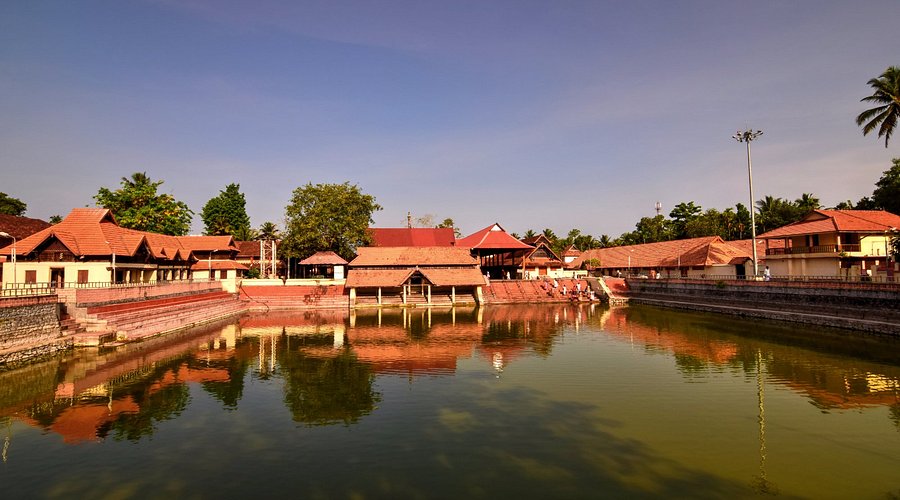
Ambalappuzha Sri Krishna Swamy Temple
The Ambalappuzha Sri Krishna Swamy Temple is one of the most revered and historic temples in Kerala. Often referred to as the “Dwarka of the South,” this ancient shrine is globally famous for its architectural elegance, its unique historical connection to the Guruvayur Temple, and its legendary sweet milk offering, the Ambalappuzha Palpayasam.
Historical & Legendary Origins
The temple has a rich history that tightly weaves together regional royalty, art, and divine folklore:
The Royal Construction: The temple was built between the 15th and 17th centuries CE by the local ruler Chembakasserry Pooradam Thirunal Devanarayanan Thampuran. The deity enshrined here is Lord Krishna in his Parthasarathy form (the divine charioteer of Arjuna), sculpted out of black granite, holding a whip in his right hand and a sacred conch (Shankhu) in his left.
The Guruvayur Connection (1789): During the military raids of Tipu Sultan in Malabar in 1789, the sacred idol of Lord Krishna from the world-famous Guruvayur Temple was secretly brought down to Ambalappuzha for safekeeping. It was hidden and worshipped securely inside this temple for roughly 12 years before being safely re-installed back at Guruvayur.
Birthplace of Ottamthullal: The temple is culturally monumental as the cradle of Ottamthullal, a famous satirical performing art form of Kerala. The legendary Malayalam poet Kalakkaththu Kunchan Nambiar first created and performed this art form right here on the temple premises after being mockingly sidelined during a Chakyar Koothu performance. The historic Mizhavu (copper drum) he played is still preserved inside the temple complex.
The Legend of the Famous Ambalappuzha Palpayasam
The temple’s unique Palpayasam (a rich, slow-cooked sweet rice pudding made exclusively of milk, sugar, and rice) is legendary. Unlike typical payasam, it has a distinct pale pinkish-gold hue and an irreplaceable flavor achieved through hours of slow condensation in massive brass vessels.
The Chess Game Myth: According to lore, Lord Krishna disguised himself as a sage and challenged the chess-loving King of Chembakasserry to a game of Chaturanga. The sage’s requested prize seemed humble: a single grain of rice on the first square of the chessboard, doubling on each subsequent square (1, 2, 4, 8, 16…).
The King lost. Upon filling the board, he quickly realized the math behind the geometric progression: the final square required trillions of tons of rice, completely exhausting the royal granaries. The sage then revealed his true form as Lord Krishna and kindly told the indebted King he could repay the debt over time by serving sweet Palpayasam for free to all pilgrims visiting the temple every single day—a tradition strictly upheld to this very day.