
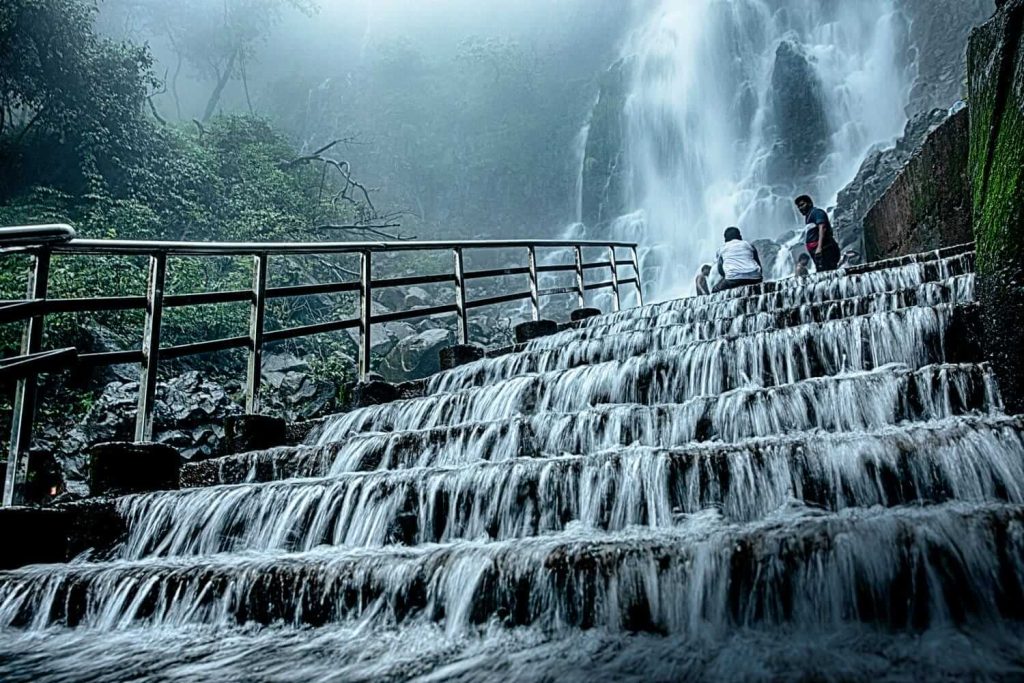
Amboli

Amboli

Positioned on the edge of the southern ridge of the Sahyadri range in the Sindhudurg district, Amboli is the last hill station of Maharashtra before the highlands slope down into the plains of Goa.
​Recognized globally by environmentalists as a precious ecological hotspot, this quiet town receives an astronomical average of 7,500 mm of rain annually, earning it the official title of “The Cherrapunji of Maharashtra.”

The History of Amboli

​Amboli’s history is a transition from a strategic mountain pass guarded by Maratha clans to a refreshing monsoon sanctuary developed by the British.

​1. The Gateway for the Sawantwadi Kingdom

​Long before it was a tourist destination, the Amboli Ghat pass was a crucial trade and military transit route. It linked the ancient coastal ports of Konkan (like Vengurla) to the thriving inland trade hubs of the Deccan Plateau, like Belgaum.

​By the 16th century, the region fell under the rule of the Sawant Bhonsle dynasty of the princely Sawantwadi State. The royal family fell in love with Amboli’s cool climate and dense forest canopy. They chose it as their official summer capital and built a lavish summer palace. Though the palace stands in ruins today, its laterite stone structures and grand staircases hint at its past glory.

​2. The British Staging Post (1880s)

​In the 19th century, British authorities recognized the immense strategic and tactical value of the Amboli Ghat road for moving military logistics between the coast and central India.

​Around 1880, Colonel Westrop, a British political agent, formally spearheaded the development of Amboli into a full-fledged hill station and sanatorium. The British Army utilized Amboli as a key staging post to station and supply garrisons moving toward Southern India. They built colonial bungalows, cleared pathways to panoramic edge points, and promoted its pristine air as a cure for colonial officers suffering from the coastal heat.

​3. Transition to a Biodiversity Heritage Site

​In 2021, Amboli received a historic administrative upgrade when the Government of Maharashtra officially declared it a Biodiversity Heritage Site. This was driven by the discovery of unique, endemic species in its ancient forests—including the rare Amboli Bush Frog, the Amboli Toad, and a stunning golden freshwater fish species named Schistura hiranyakeshi.

FAQs

Why is Amboli called the "Cherrapunji of Maharashtra"?
​Because of its massive, torrential rainfall. Due to its unique geographic position where the moisture-heavy monsoon winds from the Arabian Sea directly hit the tall wall of the Western Ghats, Amboli gets bombarded with roughly 7.5 meters (7,500 mm) of rain every year, making it one of the wettest inhabited places in India.
What is the spiritual significance of the Hiranyakeshi Temple?
​Located inside a deep valley in Amboli, the ancient Hiranyakeshi Temple is dedicated to Goddess Parvati (known locally as Hiranyakeshi, meaning "the one with golden hair"). The temple is built directly at the mouth of a sacred, natural rock cave. It is highly revered because it marks the exact origin point of the Hiranyakeshi River, where clear mountain water naturally gushes out from the underground cavern.
What unique natural phenomena can I see at Kavlesaad Point?
​Kavlesaad Point (or Kavleshet) is a giant, sheer cliff edge that drops off thousands of feet into a deep valley. During the heavy monsoons, it exhibits two incredible phenomena: ​Reverse Waterfall: The upward aerodynamic wind currents blowing through the valley are so incredibly strong that they force the cascading waterfalls to blow backward, spraying water up into the sky. ​Acoustic Echo: The massive horseshoe shape of the valley creates a perfect acoustic chamber, echoing sounds clearly across the mountain ridge.
How do I reach Amboli from Goa or Mumbai?
​By Train: The nearest railhead is Sawantwadi Road Railway Station, located just 30 km away on the Konkan Railway network. From the station, local cabs can drop you up the ghat into Amboli within 45 minutes. ​By Road: Amboli is highly accessible. It sits just 90 km north of Panaji (Goa) via a gorgeous driving route, about 65 km from Belgaum, and roughly 490 km south of Mumbai via National Highway 66. ​By Air: The closest domestic airport is in Belgaum (~68 km), followed by the Manohar International Airport in Mopa, North Goa (~75 km).
Is it safe to drive up the Amboli Ghat during peak monsoon?
​Yes, but you must practice extreme caution. During July and August, heavy downpours can cause visibility to drop to near-zero within minutes due to sudden, dense blankets of low-flying mountain fog. The roads also run heavy with streams of water. It is highly recommended to complete your drive up the winding ghat sections during daylight hours and avoid high speeds.

Price From : ₹4500/-

Address

Near Avaloormadam temple, thathampally po, pin code 688013, Alleppey, Kerala, India