
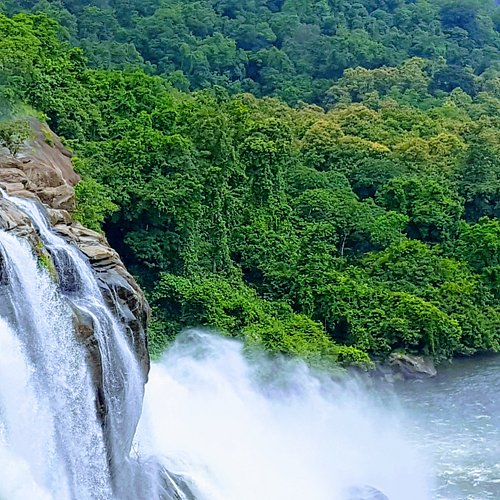
Athirappilly Waterfalls
Athirappilly Waterfalls, majestically nicknamed the “Niagara of India,” is the largest and most spectacular waterfall in Kerala. Standing at an impressive height of over 80 feet, this perennial cascade is formed by the Chalakudy River, which surges down from the upper reaches of the Anamudi mountains in the Western Ghats before cutting through the dense Sholayar forest ranges.
Historical & Ecological Significance
1. The Ecological Lifeline
Unlike many historical tourist spots shaped by human architecture or royal battles, Athirappilly’s history is rooted in its pristine, undisturbed ecology. The waterfall forms a crucial part of the Vazhachal Forest Division, a globally recognized biodiversity hotspot.
- The Hornbill Haven: It is one of the very few places in the entire Western Ghats where all four South Indian species of Hornbills (Great Hornbill, Malabar Pie, Malabar Grey, and Indian Grey Hornbill) actively nest and thrive side by side.
- Aquatic & Wildlife Corridors: The river ecosystem supports over 85 distinct species of freshwater fish (with nearly 35 being entirely endemic to the region). The surrounding dense riparian forests also serve as a critical migratory corridor for Asian elephants traversing between the parched eastern slopes and the lush western coast.
2. The Hydroelectric Battle (Modern History)
Athirappilly holds a significant place in the history of Indian environmental activism. In 1994, the Kerala State Electricity Board (KSEB) proposed a massive 163-megawatt hydroelectric dam project just 5 kilometers upstream from the falls.
- The Struggle: The proposal triggered a multi-decade-long legal and social tug-of-war between industrial planners and environmentalists/local indigenous tribes (Kadar community).
- The Result: Activists argued that a dam would permanently dry up the iconic falls, alter the unique microclimate, and subvert the rich local biodiversity. Thanks to sustained public pushback and environmental court interventions, the project was repeatedly stalled, cementing Athirappilly as a symbol of successful community-led conservation in South India.
3. The Cinematic Revolution
In contemporary pop culture history, Athirappilly has evolved into India’s most sought-after silver-screen backdrop. Master director Mani Ratnam introduced the visual scale of these falls to global audiences via masterpieces like Dil Se (the song “Jiya Jale”), Iruvar, and Raavan. Most notably, the breathtaking, mythic waterfalls of Mahishmati featured in the blockbuster Baahubali franchise were heavily modeled on and partially filmed right here at Athirappilly.