
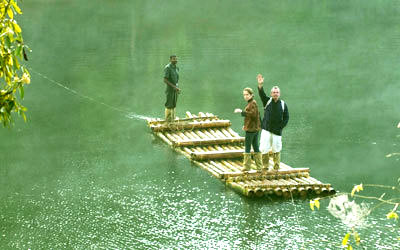
Bamboo rafting in Thekkady
Bamboo rafting in Thekkady is one of the most immersive, eco-friendly water safaris in India. It uniquely combines a rigorous forest trek with a silent, non-motorized cruise across the catchment area of the Periyar Lake, allowing travelers to reach remote corners of the sanctuary that standard motorized boats cannot access.
The Historical Journey of Bamboo Rafting in Thekkady
1. Indigenous Roots and Tribal Craft
Long before bamboo rafting became a structured tourism activity, it was a traditional way of life for the indigenous tribal communities of the Periyar valley, particularly the Mannan tribe.
- The Mannans used large, native reeds harvested from the dense bamboo breaks (Bambusa arundinacea) along the riverbanks to lash together floatation platforms.
- These rafts were used to navigate the deep mountain rivers and the lake waters for fishing and transporting forest goods. Because the rafts were rowed or poled by hand, they moved in absolute silence, allowing the tribes to glide past wild animals without disturbing them.
2. The Dawn of the Eco-Tourism Model (Early 2000s)
Following the immense global success of the Periyar Tiger Trail program in 1998, the Kerala Forest Department sought to expand its community-based eco-tourism lineup.
- In the early 2000s, authorities officially institutionalized bamboo rafting.
- Instead of hiring commercial contractors, the department engaged the native tribal youth—who possessed generational knowledge of raft building, water currents, and animal behavior—to construct and captain the rafts. This provided a sustainable, highly dignified source of income for the indigenous communities while eliminating illegal forest exploitation.
3. A Model for Quiet Conservation
Unlike the large, loud motorized public boats introduced by the KTDC in the mid-20th century, bamboo rafting was intentionally designed to have a zero-carbon footprint. By keeping group sizes exceptionally small and avoiding engines, the program ensures that the fragile, lake-facing meadows remain undisturbed, preserving critical grazing corridors for wild elephants and gaur.