
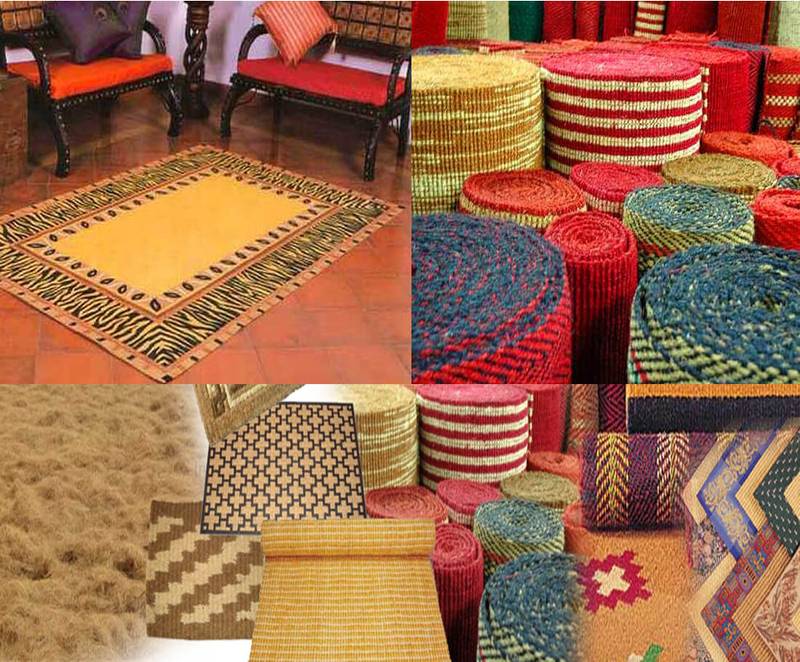
Coir Product Categories from Kerala – Coir Kerala
Known as the “Golden Fiber of Kerala,” coir—derived from the fibrous husk of the coconut—forms the backbone of one of Kerala’s oldest traditional cottage industries. Kerala accounts for a major share of India’s coir production and exports, centered primarily in Alappuzha (Alleppey), often referred to as the Coir Capital of India.
1. Key Coir Product Categories from Kerala
Product CategoryDescription & Common UsesKey Features
Coir Doormats & MattingsHandloom, powerloom, tufted PVC-backed, rubber-moulded, and stencil-printed mats.High abrasion resistance, heavy-duty dirt scraping, 100% natural fiber.
Coir Geotextiles (Mesh/Netting)Woven coir nets used for soil erosion control, riverbank stabilization, and road construction.100% biodegradable (lasts 2–5 years), holds moisture to support plant growth.
Coir Pith / CocopeatCompressed 5 kg blocks, grow bags, discs, and briquettes made from the spongy byproduct of fiber extraction.Exceptional water-retention (up to 8x its weight), ideal soil-less medium for horticulture.
Rubberized Coir ProductsCoir fibers sprayed with natural rubber latex to create mattresses, bus seats, and cushions.Breathable, flame-retardant, high resilience, orthopedically supportive.
Coir Yarn & RopeHand-spun or mechanized white and brown coir yarn.Used in hop cultivation, marine netting, handicrafts, and weaving base fabrics.
Garden & Deco ProductsHanging basket liners, seed-starter pots, tree wraps, and coco-mulch mats.Plastic-free gardening alternative; degrades naturally into organic plant manure.
2. Infrastructure & Government Research Facilities in Kerala
Kerala boasts a specialized research and industrial infrastructure network dedicated to modernizing coir production, product diversification, and quality standards:
Institutional & Research Hubs
Coir Board HQ (Kochi): The statutory body established by the Government of India to promote, develop, and export coir products nationwide.
Central Coir Research Institute (CCRI, Kalavoor, Alappuzha): Established in 1959, CCRI is the apex R&D body conducting research in fiber extraction, eco-friendly dyeing, powerloom design, jacquard weaving, and chemical testing.
National Coir Research & Management Institute (NCRMI, Thiruvananthapuram): State-level R&D agency focusing on geotechnical engineering applications (coir geotextiles), microbiology, and innovative product development.
Kerala State Coir Corporation (KSCC) & Coirfed: Apex co-operatives managing procurement, state-of-the-art manufacturing factories, and international marketing.
Manufacturing & Processing Infrastructure
Automatic Defibering Units: Mechanized de-husking and fiber extraction plants that process raw green and dry coconut husks without chemical pollution.
PVC-Tufted & Rubber Moulding Plants: Specialized industrial lines located around Alappuzha and Cherthala that produce vinyl-backed cut mats for global export.
Common Facility Centers (CFCs): Government-supported cluster hubs offering small weavers access to shared machinery for dyeing, shearing, printing, and testing.
3. Frequently Asked Questions (FAQs)
1. What is the difference between white coir and brown coir?
White Coir: Extracted from unripened green coconut husks after retting (soaking) in brackish water. It is finer, softer, and highly flexible, making it ideal for high-grade yarn, ropes, and fishing nets.
Brown Coir: Extracted from fully mature brown coconut husks. It is thicker, coarser, and possesses higher strength, making it ideal for doormats, brushes, mattresses, and geotextiles.
2. How do coir geotextiles prevent soil erosion compared to synthetic nets?
Coir geotextiles are 100% natural and biodegradable. When laid over steep slopes or embankment slopes, they absorb rainwater impact, retain soil moisture, and slow down surface runoff. Over their 2-to-5-year lifespan, vegetation roots take firm hold; as the coir gradually breaks down, it turns into nutrient-rich organic matter for the soil.
3. Why is cocopeat considered a superior growing medium for hydroponics?
Cocopeat (coir pith) has high porosity and air-fill capacity, allowing plant roots to breathe while holding up to 800% of its dry weight in water. Unlike traditional soil, it is naturally resistant to soil-borne pathogens and fungi, neutral in pH (5.5–6.5), and re-wettable.
4. How long do natural coir doormats last in high-traffic areas?
A standard high-density natural coir mat lasts 2 to 5 years under regular residential use. For commercial high-traffic entrances, PVC-backed tufted coir mats or rubber-moulded mats are recommended, as the synthetic/latex backing prevents edge shedding and holds the fibers firmly in place.
5. What certifications are required for exporting coir products from Kerala?
Exporters must register with the Coir Board of India. Essential export documents and quality standards include:
Phytosanitary & Fumigation Certificates (mandatory for shipping coconut derivatives internationally).
ISO 9001:2015 Quality Management standards.
REACH compliance (for European Union markets).
ASTM / BIS testing standards for geotextile tensile strength.