
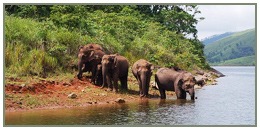
Eco Tourism
Kerala is widely regarded as the pioneer of organized eco-tourism in India. By focusing on minimal environmental impact, community involvement, and deep ecological education, the state shifted the travel industry away from commercial mass tourism toward sustainable development.
The Historical Evolution of Eco-Tourism in Kerala
1. The Global Shift and Periyar’s Early Experiment (Mid-1990s)
Before the 1990s, nature tourism mostly meant traditional sightseeing or big-game viewing. Following the global guidelines set by the International Ecotourism Society (TIES) in 1990, Kerala became the first Indian state to actively apply these principles on the ground.
- The breakthrough came in 1996 inside the Periyar Tiger Reserve.
- Faced with severe issues regarding illegal cinnamon bark peeling and poaching, the Forest Department launched the India Eco-Development Project (IEDP).
- Instead of arresting local offenders, they formed Eco-Development Committees (EDCs), training former poachers to become legitimate, paid safari guides and protectors. This community-first strategy laid the blueprint for the entire country.
2. Thenmala: India’s First Planned Eco-Tourism Destination (1999)
While Periyar adapted an existing sanctuary, Kerala took it a step further in 1999 by creating Thenmala Eco-Tourism in the Kollam district.
- This was the first planned eco-tourism destination in India, managed by the dedicated Thenmala Ecotourism Promotion Council (TEPC).
- Located right in the foothills of the Western Ghats, Thenmala was systematically mapped into three distinct, low-impact tourist zones: the Culture Zone (showcasing local food and arts), the Leisure Zone (peaceful forest boardwalks), and the Adventure Zone (mountain biking and rock climbing).
3. Institutionalization & Global Recognition (2000s–Present)
Following Thenmala’s success, the Kerala Tourism Department institutionalized these practices by creating a dedicated Eco-Tourism Directorate.
- Over 60 community-based destinations were developed across the state, including Gavi, Parambikulam, and Silent Valley.
- Because of this long-term commitment, National Geographic Traveler honored Kerala as one of the “50 Greatest Destinations of a Lifetime,” specifically praising its focus on sustainable, community-backed green travel.