
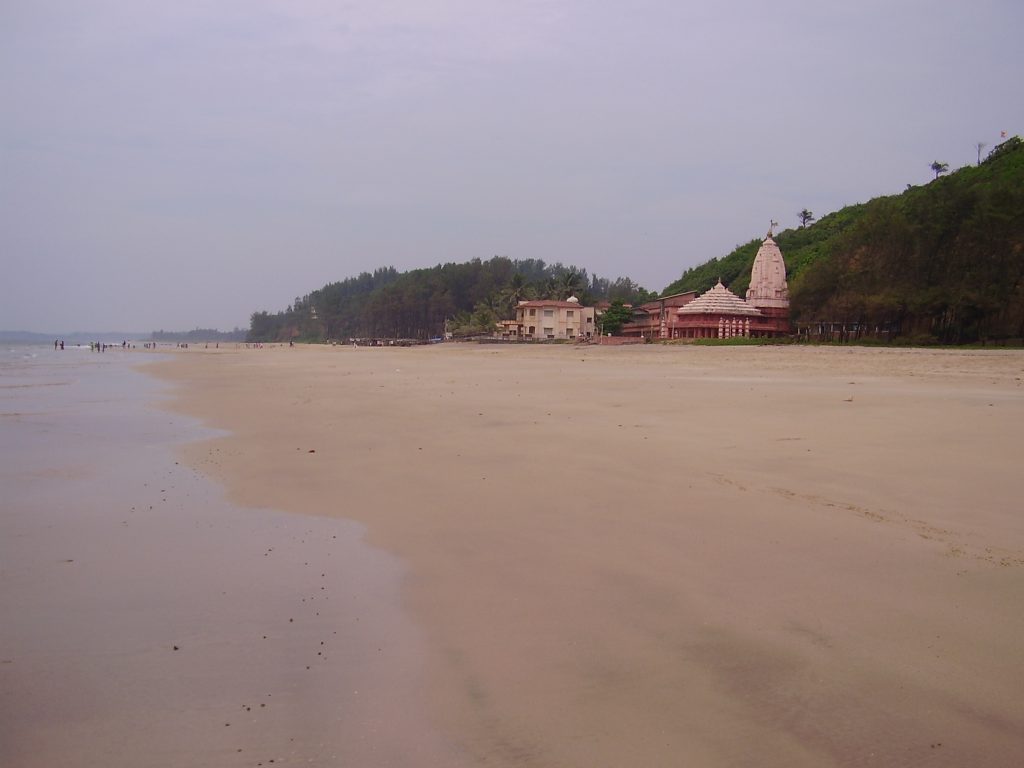
Ganpatipule
Ganpatipule, situated along the scenic Konkan coast in the Ratnagiri district of Maharashtra, is a rare destination where profound spiritual heritage perfectly blends with pristine coastal beauty. Unlike Alibaug, which served as a bustling naval base, or Panhala, which was a military fort, Ganpatipule’s history is anchored entirely around a legendary, 400-year-old seaside temple.
The History of Ganpatipule: The Western Sentinel
1. The Divine Vision of Balbhatji Bhide (16th Century)
According to historical records and local lore, the origins of Ganpatipule date back to the late Mughal era, roughly 400 to 500 years ago. At the time, the area at the base of the hill was a dense Kevadavan (a forest of fragrant screw-pine or Kewra trees).
A devout Brahmin named Balbhatji Bhide lived there and managed the village. Facing a severe personal calamity, Bhide gave up food and water, retreating into the dense Kewra forest to meditate and pray to Lord Ganesha. During his intense penance, he had a vivid dream vision of Ganesha, who told him that he had manifested at the hill in a Nirakar (formless/void) state to protect his devotees and relieve their troubles.
Around the same time, a local cowherd noticed that one of his cows—which normally didn’t yield milk—would stand over a particular rock on the hillside and allow her milk to flow naturally onto it. When Bhide cleared the forest brush at that exact spot, he discovered a naturally formed stone shaped like Lord Ganesha, perfectly matching his vision. He constructed a humble grass-topped shrine over the idol and began the first formal rituals.
2. Etymology: Ganesha on the Sand Dunes
The unique name “Ganpatipule” is a combination of two words:
- Ganpati: The Lord of the Ganas (armies of Shiva).
- Pule: A local Marathi term for sand dunes. Literally translated, the name honors the deity that emerged right from the coastal sand dunes. Another local folklore suggests that the deity originally resided in the nearby village of Gule but moved to the sand dunes (Pule) after taking gentle offense to a remark made by a local woman.
3. Royal Patrons: From Shivaji Maharaj to the Peshwas
Over the centuries, the humble grass shrine grew into a major pilgrimage hub under the patronage of the Maratha Empire:
- Chhatrapati Shivaji Maharaj’s Era: Annaji Datto, one of the trusted ministers and secretaries in Shivaji Maharaj’s cabinet, replaced the thatched grass roof with a solid, beautifully crafted stone dome.
- The Peshwa Rule: The Peshwas expanded the temple significantly. Sardar Govindpant Bundele built a large Sabhamandap (congregation auditorium). Ramabai Peshwe (wife of Madhavrao Peshwa) arranged for solid stone structures to accommodate visiting pilgrims, and the Peshwa court instituted a Nandadeep (an eternal, continuously lit oil lamp) that remains a core tradition.
- Later Enhancements: The local Kolhapur princely state added a gold-plated spire (Kalash) to the top of the dome. Between 1998 and 2003, the temple complex was fully modernized and reconstructed using Agra Red Sandstone, designed specifically to give it the grand appearance of being carved out of a single mountain rock.
4. Cultural & Mythological Significance
In ancient scriptures like the Mudgala Purana, the Ganpatipule deity is designated as the Paschim Dwar-Devata (the Western Sentinel God of India). While almost all traditional Hindu temple deities face the rising sun in the east, the Swayambhu Ganpati uniquely faces west, looking directly out over the Arabian Sea as if guarding India’s maritime frontiers.