
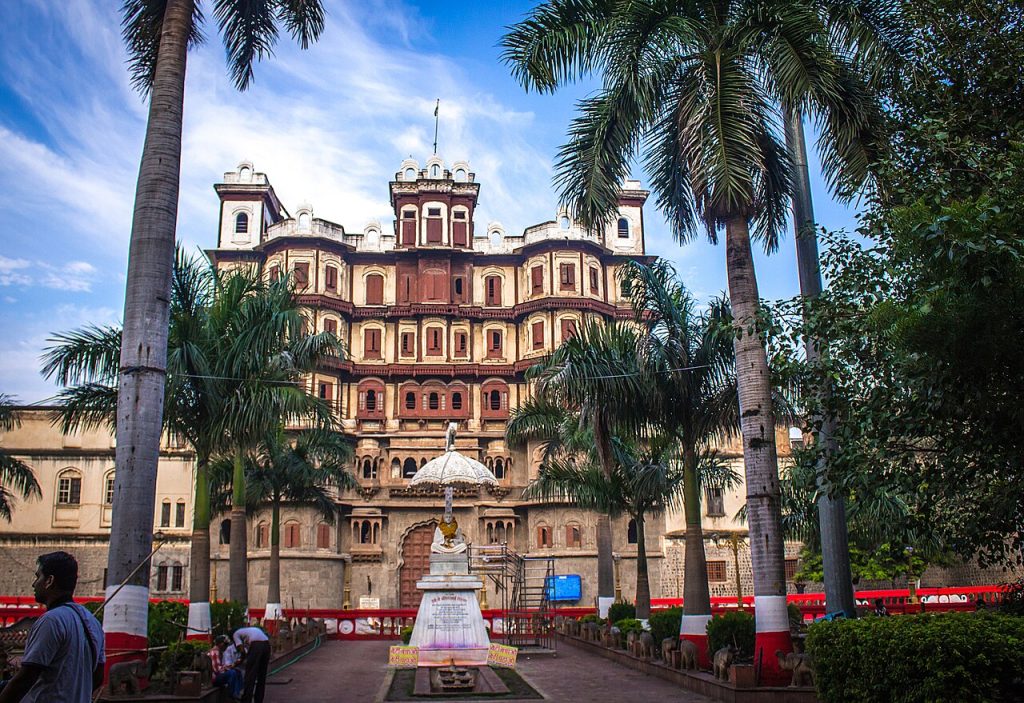
Indore
Indore, famously recognized as the commercial capital of Madhya Pradesh and celebrated globally today as India’s cleanest city, has a vibrant historical trajectory. Its evolution spans from a 17th-century trading hub on the Narmada-Tapi trade route to the majestic seat of the Maratha Holkar Dynasty.
The Historical Narrative of Indore
1. Early Roots and Strategic Origins (17th – Early 18th Century)
Indore’s initial growth was driven entirely by trade.
- In the early 1700s, local landowners led by Rao Nandlal Chaudhary (Zamindar of Kampel) established a secure settlement near the confluence of the Khan and Saraswati rivers.
- Attracted by safety and its strategic location on the Deccan-to-Delhi trade route, merchants flocked here.
- The town took its name from the Indreshwar Temple (a 1741 temple dedicated to Lord Shiva), which gradually transitioned linguistically from Indrapur to Indur, and eventually to Indore.
2. The Rise of the Holkar Dynasty (1732 onwards)
Indore’s golden era began on July 29, 1732, when the Maratha Peshwa Baji Rao I granted the Malwa region to his exceptional military commander, Malhar Rao Holkar, the founder of the Holkar Dynasty.
- Malhar Rao established his base here and began constructing the iconic Rajwada Palace in 1747, officially shifting the region’s geopolitical gravity to Indore.
3. The Golden Era of Rani Ahilyabai Holkar (1767–1795)
Following the passing of Malhar Rao and his son, leadership fell to his daughter-in-law, Devi Ahilyabai Holkar. She is revered as one of the most just, visionary, and compassionate rulers in Indian history.
- The Administrator: While she shifted the administrative capital to Maheshwar on the banks of the Narmada River, Indore remained a booming financial nerve center under her peaceful reign.
- The Builder: She was a prolific patron of culture and religion, reconstructing legendary temples destroyed across India, including the famous Kashi Vishwanath Temple in Varanasi and shrines in Dwarka, Somnath, and Puri.
4. British Protectorate and Industrialization
During the Second and Third Anglo-Maratha Wars, Maharaja Yashwantrao Holkar I (often hailed as the “Napoleon of India” for his fierce military tactics) fought bravely against the British East India Company.
However, following the Treaty of Mandsaur in 1818, Indore became a princely state under British protection, and the capital officially shifted permanently back to Indore. Under later rulers like Tukojirao II and Shivajirao, the city pioneered infrastructure:
- The arrival of the railway lines in the 1870s.
- The establishment of massive textile mills, earning Indore the moniker “The Manchester of Central India.”
5. Accession to Independent India
Following India’s independence, Maharaja Yashwantrao Holkar II signed the Instrument of Accession, merging the princely state into the Indian Union. Indore initially served as the summer capital of the temporary state of Madhya Bharat before being integrated into the newly drawn state of Madhya Pradesh in 1956.