
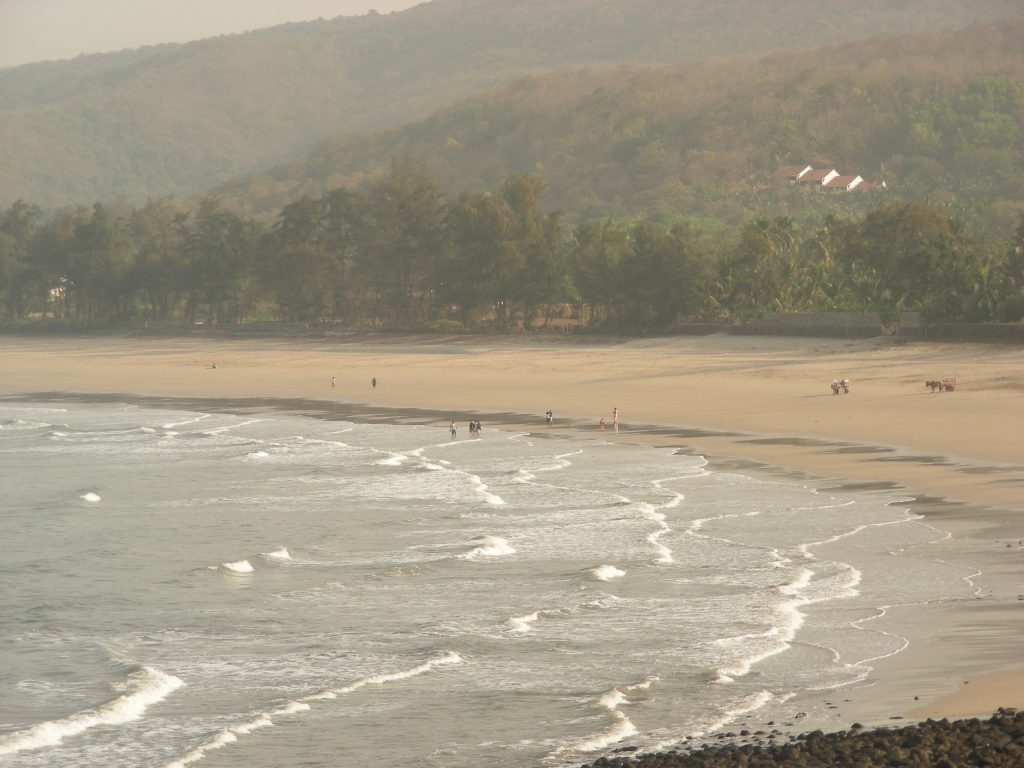
Kashid
Further up the North Konkan coast from Diveagar sits Kashid, a beautiful 3 km stretch of brilliant white sand wedged between two rocky hillocks in the Raigad district of Maharashtra.
While Kashid itself is primarily celebrated today as a serene beachfront paradise, its history is deeply anchored in the heavy naval conflicts of the surrounding region, serving as a buffer zone between the Marathas, the Portuguese, and the African Siddis.
Historical Background
Kashid’s past is intimately linked to the massive fortifications built just a short drive to its north and south, making it a witness to centuries of maritime power struggles.
1. The Strategic Buffer Zone
In the 16th and 17th centuries, the Konkan coast was a highly volatile frontier. European powers, local sultans, and regional empires fought brutally for control of sea trade routes.
Because Kashid sits right between Revdanda (a Portuguese stronghold to the north) and Murud-Janjira (the undefeated island fort of the Siddis to the south), its coast served as a vital lookout point and buffer territory. The Maratha navy under Chhatrapati Shivaji Maharaj closely monitored these waters to prevent foreign forces from establishing naval bases on the mainland.
2. Proximity to the Invincible Murud-Janjira (20 km South)
You cannot talk about Kashid’s history without mentioning its neighbor, Murud-Janjira Fort. Originally built as a small wooden structure by local Koli (fisherman) chiefs in the late 15th century to protect themselves from pirates, it was captured and heavily fortified into an impregnable stone sea fortress by the Siddi Dynasty (descendants of African traders and sailors).
The Marathas, the British, and the Portuguese all launched massive military campaigns to conquer Janjira, but failed. Kashid’s shores frequently saw the movement of Maratha troops attempting to stage attacks against the Siddis.
3. The Portuguese Influence at Korlai (15 km North)
Just north of Kashid lies the Korlai Fort, built by the Portuguese in 1521 with the permission of the Nizam Shahi Sultan of Ahmednagar. The Portuguese strategically used this hill fort to defend the mouth of the Kundalika River. The fort witnessed intense battles when the Marathas later attempted to push the Portuguese out of the region. This colonial presence deeply influenced the culture and language of the villages immediately surrounding Kashid.
4. Conservation Heritage: The Phansad Forests
In the hills rising directly behind Kashid beach lies the Phansad Wildlife Sanctuary. Historically, this vast, dense forest served as the private hunting ground for the Nawabs of Janjira. Because it was strictly reserved for royal recreation, the ecosystem was heavily protected from logging and farming. This royal preservation is the sole reason Kashid is backed by a pristine, undisturbed green canopy today instead of heavy industrialization.