
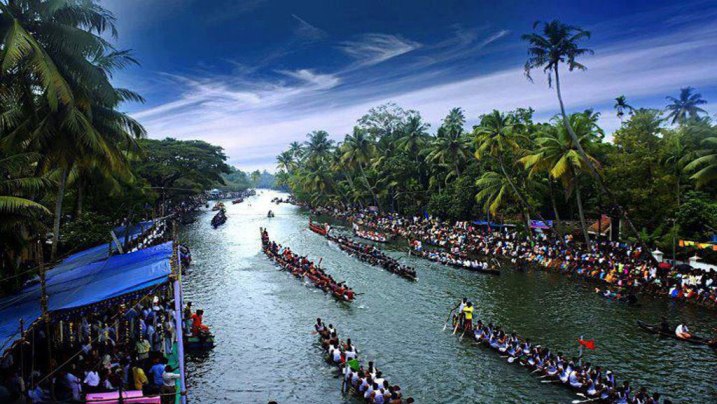
Kerala Boat Race
The traditional boat races of Kerala, collectively known as Vallam Kali (literally “boat game”), are among the world’s largest team sports. Driven by the thunderous rhythm of oars striking the water in unison and the hauntingly energetic choruses of Vanchipattu (boat songs), these races showcase an intense fusion of physical endurance, community pride, and historical tradition.
The Historical Legacy of Kerala Boat Races
While today’s boat races are grand celebrations of culture, their origin is rooted in medieval warfare.
1. The Navy of the Backwaters (13th – 14th Century)
During the early feudal wars between the kingdoms of Kayamkulam, Chembakassery (Ambalapuzha), and Vadakkumkoor, the backwaters served as a battlefield. King Devanarayana of Chembakassery suffered heavy losses at sea because his standard war vessels were too slow.
He commissioned a legendary master carpenter to build a new type of military craft. The result was the Chundan Vallam (Snake Boat). It was uniquely engineered for stealth and speed: sleek, narrow, over 100 feet long, and capable of holding more than 100 soldiers. The raised rear hull mimicked the hooded posture of a striking cobra, allowing the boat to slide over the water with minimal friction. This revolutionary design gave the king a decisive advantage, and the craft soon became the pride of the backwater navies.
2. The Sacred Origins: Champakulam and Aranmula
Not all historical boat races started out as military endeavors; many were deeply religious pageants.
- Champakulam Moolam Boat Race: This is the oldest recorded traditional boat race in Kerala. It commemorates the historic day in 1599 AD when the sacred idol of Lord Krishna was brought by water from Kurichi to the Ambalapuzha Sree Krishna Temple. The local community welcomed the procession with an enthusiastic flotilla of decorated boats—a tradition kept alive for over four centuries.
- Aranmula Uthrattathi Boat Race: Held during the Onam festival on the Pamba River, this event is treated entirely as a ritual offering rather than a competitive sport. The boats (Palliyodams) belong directly to the local temples, and the rowers dress in traditional white attire, singing praises to Lord Krishna.
3. The Modern Era: The Champions Boat League (CBL)
In 1952, the modern, competitive era of the sport was solidified when India’s first Prime Minister, Jawaharlal Nehru, inaugurated what would become the Nehru Trophy Boat Race at Punnamada Lake in Alappuzha. Decades later, to further professionalize the sport and boost international visibility, the Tourism Department launched the Champions Boat League (CBL). Modeled after professional sports leagues, the CBL features teams competing in a grand multi-week tournament across different backwater venues, elevating the age-old tradition into a highly competitive, internationally recognized spectacle.