
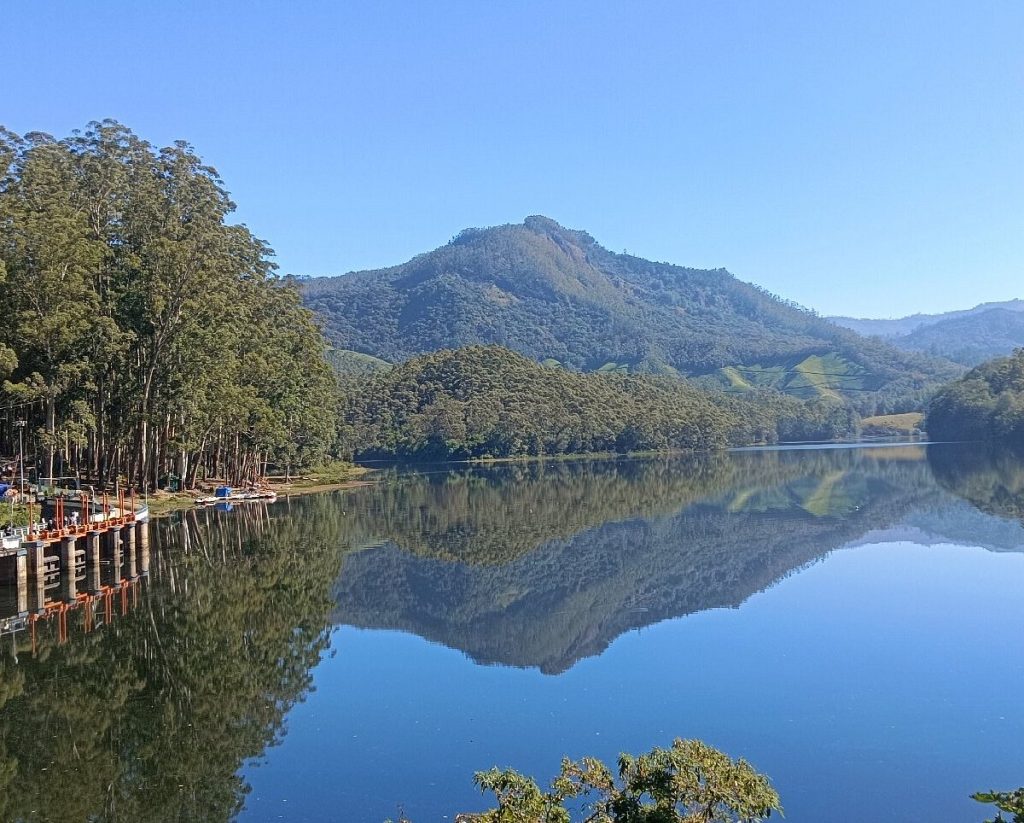
Kundala Lake
The Kundala region (including Kundala Lake, the Dam, and the valley) is the third critical component that forms the identity of Munnar. It is named after the Kundala River, the third mountain stream that meets the Mudrapuzha and Nallathanni in the town center to create the geographical layout of Munnar (“Three Rivers”).
Located about 20 to 26 km from Munnar town on the way to Top Station, Kundala sits at an altitude of roughly 1,700 meters above sea level and carries a fascinating legacy of colonial engineering, a forgotten railway, and majestic natural phenomena.
1. Historical Context of Kundala
Kundala is a prime example of early 20th-century British resourcefulness, transitioning from a heavy logistics corridor to a pioneering clean-energy hub.
- The India-First Monorail Marvel (1902–1908): In the late 19th century, transporting tea chests from the remote mountain valleys of Munnar down to the ports of Tamil Nadu was incredibly difficult. In 1902, the Kannan Devan Hills Produce (KDHP) Company built the Kundala Valley Railway, which was the very first monorail system in India.
-
- The System: It utilized the British “Ewing System,” where a small wheel ran on a single iron track while a larger outrigger wheel balanced the load on the road surface. Surprisingly, these early monorail carts weren’t steam-powered; they were pulled by teams of bullocks from Munnar, through Mattupetty and Kundala, all the way to Top Station.
.
- The Steam Upgrade (1908–1924): Realizing the limitations of animal power on steep mountain inclines, engineers upgraded the monorail in 1908 into a 2-foot narrow-gauge light steam railway. Small steam locomotives chugged right past the Kundala valley, moving tons of premium tea toward the aerial ropeways at Top Station.
- Wiped Off the Map by the 1924 Flood: Just like the rest of Munnar’s early infrastructure, the Kundala Valley Railway met a tragic end during the catastrophic Great Flood of 1924. The intense cloudbursts caused landslides that literally tore the tracks off the hillsides. The destruction was so total that rebuilding the line was deemed economically impossible. The British abandoned the railway forever, shifting to an intricate network of aerial ropeways.
- Asia’s First Arch Dam (1946): Decades after the flood, the Kundala valley was selected for another massive engineering feat. In 1946, construction was completed on the Kundala Dam (officially named the Sethuparvathipuram Dam or Sethu Parvati Dam, in honor of the Maharani of the Travancore Kingdom). Built across the Muthirapuzha river system as part of the landmark Pallivasal Hydroelectric Project, it is widely recognized as Asia’s first masonry arch dam. The resulting reservoir created the stunning Kundala Lake that tourists visit today.