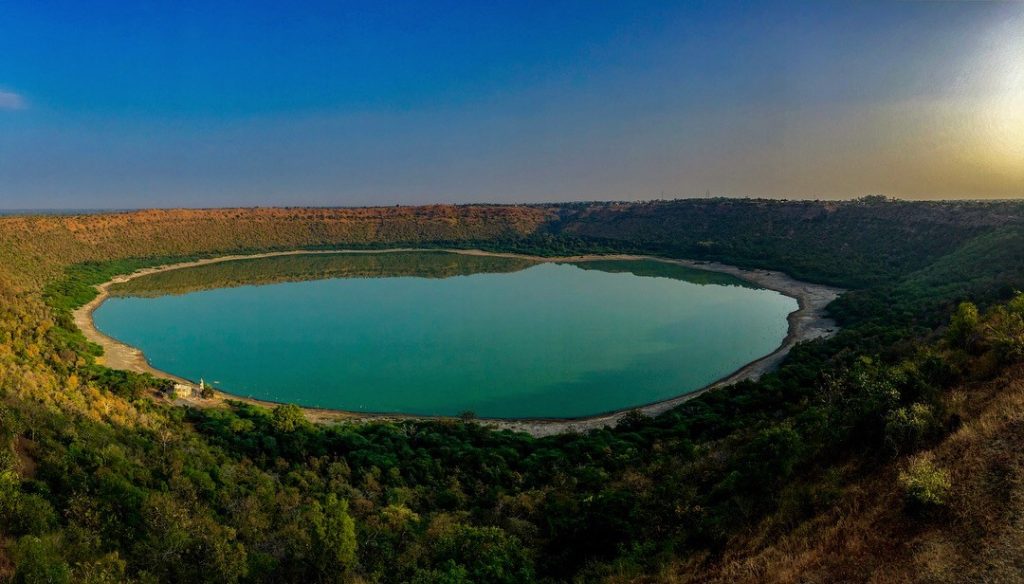
Where is Lonar located and how can I reach it?
Lonar is located in the Buldhana district of the Vidarbha region in Maharashtra.
By Air: The nearest airport is Aurangabad (Chhatrapati Sambhajinagar), located about 140 km away.
By Rail: The closest railway stations are Malkapur (approx. 100 km) or Jalna (approx. 90 km). Frequent state transport buses and private taxis ply to Lonar from these cities.
Is trekking down into the crater safe?
Yes, it is safe, but it is physically demanding. To reach the lake, you must hike down a steep, rocky forest trail carved into the crater rim, which takes about 30 minutes.
Caution: The surrounding rim is a protected sanctuary home to monkeys, reptiles, and over 160 bird species. Wear sturdy trekking shoes, carry plenty of drinking water, and never attempt to swim in the lake, as the mud along the edge is highly sinkable and marshy.
When is the best time to visit Lonar?
The winter months from November to February offer the most comfortable weather for trekking down the crater and exploring the temples. The monsoons (June to September) turn the crater rim beautiful and green, but the trails down can become slick and muddy.
Why is the water in Lonar Lake so special, and why does it change color?
The lake has no outlets, causing minerals to concentrate over thousands of years. It features a unique, dual chemistry—it is highly alkaline (pH up to 10.5) and hyper-saline. In June 2020, the lake suddenly turned a vivid pink color overnight. Scientists later determined this was caused by a massive bloom of Haloarchaea—salt-loving microbes that produce a red pigment, triggered by high salinity and warm weather.
Why are space agencies like NASA interested in Lonar?
Basalt rock covers a massive portion of the surface of Mars and the Moon. Because Lonar is the only major impact crater on Earth carved out of volcanic basalt, scientists study its geology, shock-metamorphosed minerals, and unique micro-organisms to understand impact craters on Mars and look for clues about alien life.
Create a detailed 1-day itinerary for Lonar covering the crater trek, the ancient temples, and local logistics ?
An optimized 1-day itinerary for exploring Lonar Lake balances the cool morning hours required for the physically demanding crater descent with an afternoon dedicated to architectural appreciation and local logistics.
Phase 1: The Morning Crater Trek & Ancient Ruins
06:30 AM – 07:00 AM: Base Setup & Logistics
Start your day early at the crater rim. If you are staying at the MTDC Resort Lonar or a local lodge nearby, ensure you wear lightweight clothing, pack a heavy supply of drinking water (at least 2 liters per person), and wear sturdy trekking shoes with excellent traction.
07:00 AM – 07:45 AM: The Descent into the Meteor Crater
Begin your hike down into the crater via the trail near the Gaimukh Temple (where a perennial natural freshwater spring flows into a stone tank). The path down is a steep, forested canopy descent over uneven basalt rocks. The morning hours keep the temperature cool and maximize your chances of spotting migratory birds, langurs, and peacocks.
07:45 AM – 10:00 AM: Exploring the Hypersaline Lake Periphery
Once on the crater floor, walk along the designated paths circling the alkaline green waters. Take time to explore the half-submerged, ruined 12th-century Hemadpanti stone shrines hiding in the dense jungle foliage, such as the Kamalja Devi Temple and the Shankar Ganesh Temple.
Safety Note: Stay strictly on established paths. Do not step directly onto the dark marshy mud near the water's edge, as it is highly sinkable.
10:00 AM – 11:00 AM: The Climb Back Up
Trek back up to the crater rim before the midday sun peaks. The uphill climb takes roughly 45 minutes and requires a slow, steady pace.
Phase 2: Midday Rest & Traditional Vidarbha Lunch
11:30 AM – 01:30 PM: Hydrate, Freshen Up & Eat
Return to your accommodation to change out of your dusty trekking gear. Head out to a local restaurant or your resort dining hall to indulge in a traditional Vidarbha-style meal. Look for local specialties like Varadi Thali featuring spicy curries, Poli (flatbread), or Zunka Bhakri.
Phase 3: Afternoon Architectural Masterpieces
02:00 PM – 03:30 PM: Marveling at the Daityasudan Temple
Head into the center of Lonar town to visit the historic Daityasudan Temple.
* Highlights: Since the sun is high, this is the perfect time to marvel at the intricate exterior stone carvings of this 13th-century Vaishnavite temple. Walk slowly around the outer walls to inspect the masterfully interlocking stone joints (built without mortar) and the detailed depictions of Hindu deities, epics, and mythical creatures.
03:45 PM – 05:00 PM: Sunset at the Dhar Temple & Crater Viewpoint
Conclude your sightseeing at the Dhar Temple or the main MTDC viewing deck on the southern rim. Watching the changing colors of the sky reflect off the massive circular lake from above offers an incredible vantage point to conceptualize the sheer scale of the prehistoric meteor impact.
Essential Local Logistics
Internal Commute: Lonar is a small, walkable town, but shared or private auto-rickshaws are readily available to ferry you between the crater entry points, the town center, and the Daityasudan Temple for a minimal fare.
Guides: Hiring a local certified naturalist guide at the Gaimukh entry point is highly recommended. They can point out unique shock-metamorphosed minerals (like maskelynite glass) and navigate the dense jungle ruins safely.
Cash Availability: Carry adequate cash. Network connectivity on the crater floor is non-existent, making digital UPI or card payments impossible while trekking inside.
Provide an in-depth breakdown of the geological and biological anomalies of Lonar Lake, including magnetic fields and micro-organisms?
The hyper-velocity meteor impact that occurred at Lonar roughly 52,000 years ago generated extreme temperatures and pressures that permanently altered the local basalt bedrock. This cosmic origin created an ecosystem characterized by unique geological and biological anomalies that continue to challenge standard terrestrial science.
1. Geological and Physical Anomalies
The Basaltic Rarity
Most meteor impact craters discovered on Earth are located in plutonic granitic rock (such as the Barringer Crater in Arizona). Lonar is the world’s premier impact crater formed entirely within volcanic basaltic rock (the Deccan Traps). Because basaltic rock closely mirrors the surface composition of Mars and the Moon, Lonar is heavily studied to model impact mechanics on other planets.
Shock Metamorphosis & Maskelynite
The sheer kinetic energy of the meteor impact subjected the local minerals to extreme pressures exceeding 30 \text{ to } 40 \text{ GPa} (300,000 \text{ to } 400,000 times Earth's atmospheric pressure). This sudden shock wave permanently altered the internal crystal structures of the local rocks without completely melting them:
Maskelynite: The impact transformed the rock's natural plagioclase feldspar mineral into a rare, isotropic glass known as maskelynite. On Earth, maskelynite is almost exclusively found within recovered meteorites or at planetary impact sites, providing definitive proof of Lonar's cosmic origin.
Shatter Cones and Micro-fractures: The basalt surrounding the rim features distinct conical fractures (shat-ter cones) that propagate downward, mapping the path of the ancient shockwave.
Magnetic Field Distortions
Geophysical surveys inside the crater reveal severe anomalies in the local magnetic field. The intense heat of the impact partially demagnetized the basaltic rock directly beneath the point of collision. As the melted rock cooled down rapidly in the presence of Earth's magnetic field, it locked in a highly erratic remanent magnetization. Compasses and precise magnetic sensors used near the lake bed frequently show skewed or unstable readings compared to the flat Deccan plains outside the rim.
2. Chemical and Biological Anomalies
The Dual-Chemistry Water Matrix
Lonar Lake features a landlocked water body with no external drainage outlets, causing high levels of evaporation over millennia. This has created a dual-chemical anomaly where the water is concurrently hyper-saline and hyper-alkaline. The water pH consistently hovers between 9.5 \text{ and } 10.5, giving it a distinctly soapy feel, high concentrations of carbonate-bicarbonate salts, and an incredibly harsh environment for standard aquatic life.
Extremophilic Micro-organisms
Despite the hostile chemical conditions and low oxygen levels at the lake floor, Lonar hosts a thriving ecosystem of extremophiles—micro-organisms evolved to survive conditions lethal to most life forms:
Haloalkaliphilic Bacteria: The lake is populated by specialized bacteria (such as Natronomona, Halomonas, and Alkalibacillus) that require both high salt concentrations and high alkaline pH levels to survive. They utilize specialized cell walls to keep their internal cellular pH close to neutral.
The Pink Phenomenon (Haloarchaea): In June 2020, the lake suddenly changed color from its standard green to a bright pink. Microscopic analysis proved that because of a prolonged dry spell, water levels dropped, causing salinity and alkalinity to spike. This triggered a massive population bloom of Haloarchaea (specifically Halorubrum species). These ancient microbes produce carotenoid pigments (similar to the chemicals that make carrots orange) to protect themselves from intense solar radiation, turning the entire lake pink.
Unique Methanogens: The deep, dark mud at the bottom of the lake is completely anaerobic (oxygen-free). Here, unique strains of methane-producing Archaea thrive by consuming carbon dioxide and hydrogen, providing scientists with an excellent analog for the types of microbial life that could theoretically exist in Martian sub-surfaces.
The Microbial Mystery: Many of the microbial strains isolated from the lake bed possess highly unique metabolic pathways. Biochemical and pharmaceutical research firms actively study these enzymes because they remain completely stable and functional in highly alkaline or chemical conditions where standard enzymes would immediately denature (break down).