
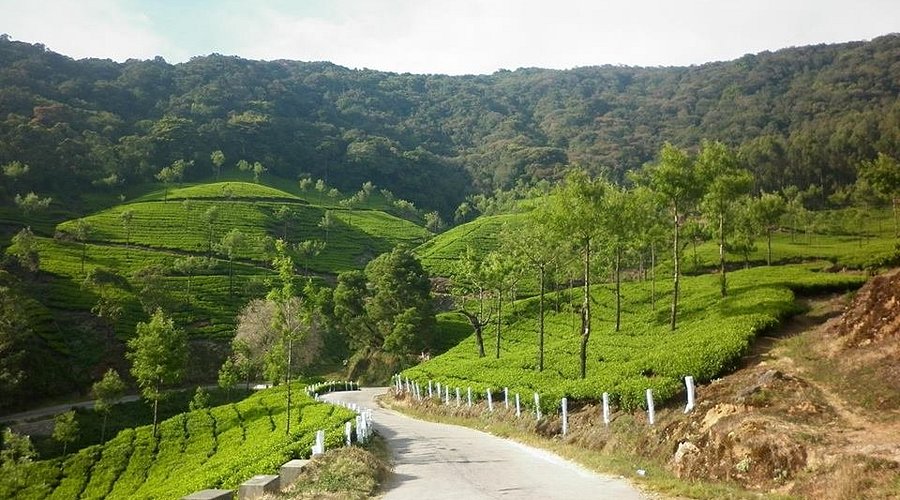
Marayoor

Marayoor

Located about 40 km north of Munnar, Marayoor (also spelled Marayur) is a geographical and cultural marvel. Unlike the endless, bright green tea carpets of central Munnar, Marayoor sits tucked away in the rain-shadow region of the Western Ghats. This creates a completely unique, drier scrub-forest climate that smells faintly of wild herbs and sweet wood.
​Marayoor translates to the “Village of the Maravars” (an ancient tribal warrior community), and it is widely celebrated for its pre-historic archaeology, its sprawling sugarcane farms, and for being the only place in Kerala with a natural sandalwood forest.

1. Historical Context of Marayoor

​Marayoor feels like an open-air museum. Its history is a fascinating timeline that stretches from the dawn of human civilization to medieval migrations.

  • The Prehistoric Stone Age (10,000 BCE – 1000 BCE): Long before modern kingdoms emerged, prehistoric hunter-gatherers thrived in the caves and rock shelters of the Pambar River valley. Marayoor is home to legendary Rock Paintings at sites like Ezhuthu Guha (literally “The Cave of Writings”), Attala, and Manala. Here, archaeologists have mapped over 90 ancient painted motifs, featuring abstract geometric designs, human figures, and animals like deer and tigers drawn with natural red ochre and white pigments.
  • The Megalithic Iron Age & The Muniyaras: Marayoor boasts one of the largest concentrations of Dolmens in South India, locally called Muniyaras. Dating back between 3,000 to 5,000 years, these are above-ground tombs built by ancient tribal societies.
    • The Design: The dolmens are stone boxes built using four massive, upright slabs of rough-hewn granite as walls, topped with a heavy fifth slab known as a capstone acting as a roof.
    • The Belief System: Anthropologists view these structures as humanity’s earliest proof of a belief in the afterlife and reincarnation. The dead were placed inside in a sitting position, and many dolmens have a precision-crafted “man-hole” cut into a side wall—historically believed to allow the soul to travel freely between the physical remains and the spirit world.
  • The “Anju Nadu” Migration (18th Century): In modern history, Marayoor’s cultural layout changed during the late 1700s. When the Madurai kingdom in neighboring Tamil Nadu faced heavy military invasions, thousands of people fled across the mountains into these safe valleys. They established five distinct, self-sustaining agricultural villages (Anju Nadu meaning “Five Lands”): Kanthalloor, Keezhanthur, Karayur, Marayoor, and Kottakudi. This unique history explains why the local language spoken here is a fascinating, rhythmic blend of Tamil and Malayalam.

FAQs

Why does the word "Muniyara" mean "Sage's Room" if they are actually graves?
The name comes from local folklore. Centuries after the prehistoric architects disappeared, later generations discovered these mysterious, small stone rooms hidden on the bare rocky hilltops. Because the structures resembled tiny meditation cells, locals assumed they were built as shelters where ancient wandering Munis (sages or ascetics) sat in deep meditation to attain nirvana.
Can tourists walk freely inside the Sandalwood Forest?
No, casual walking or wandering inside the core forest is strictly banned. Because Marayoor sandalwood is incredibly high in santalol (the premium essential oil that makes it world-famous), it is incredibly valuable—often called "liquid gold." To prevent illegal logging and smuggling, the forest is heavily fortified with fencing, and the Kerala Forest Department numbers, geotags, and guards every single one of the 65,000+ trees. However, you can safely drive through the forest zone and visit the official Government Sandalwood Depot in town to see how the wood is safely processed.
What makes "Marayoor Sarkara" (Jaggery) so famous?
It is widely considered one of the highest-quality varieties of solid molasses (jaggery) in India. Because Marayoor sits in a rain-shadow valley, it receives brilliant, consistent sunlight and has a specific soil pH value perfect for sugarcane farming. The jaggery is made entirely by hand in traditional, open-air cottage units (Naattupura Marunthukada), where sugarcane juice is boiled down down to a thick paste and rolled into dark brown balls. It is completely organic, free of artificial chemical clarifiers, and has an exceptionally high sugar content.
Where exactly are the main Muniyara Dolmens located, and is there an entry fee?
The largest, most accessible group of dolmens sits on the rocky slopes of a hillock called Murugan Mala in Kovilkadavu village, roughly 1.5 to 2 km from Marayoor town. There is a minimal entry fee managed by local tourism authorities. The best time to visit is late afternoon (4:00 PM to 5:30 PM) when the sun sets behind the Western Ghats, casting a golden light across the ancient stone slabs.
How do I travel from Munnar town to Marayoor?
Marayoor is located roughly 40 to 42 km north of Munnar town along the Munnar-Udumalpet highway. The drive takes about 1.5 hours by taxi, private car, or KSRTC bus. The route is highly scenic, passing right past the entrance of Eravikulam National Park and climbing over the "8th Mile" high point before descending into the warm, fragrant Marayoor valley.

Price From : ₹400/-

Address

Near Avaloormadam temple, thathampally po, pin code 688013, Alleppey, Kerala, India