
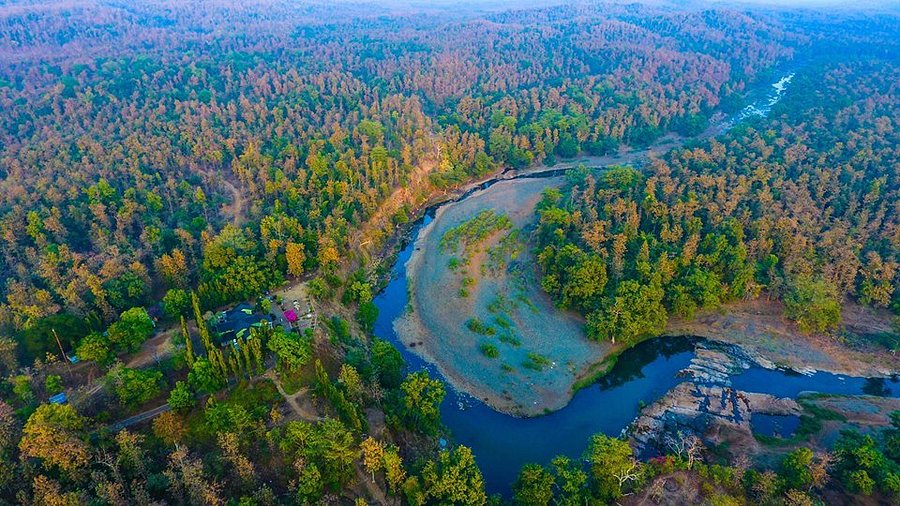
Melghat Tiger Reserve

Melghat Tiger Reserve

The Melghat Tiger Reserve (MTR)—nestled along the rugged Gavilgarh hill range (a southern offshoot of the Satpura mountains) in the Amravati, Akola, and Buldhana districts of Maharashtra—holds a prestigious spot in India’s conservation history. Spanning an expansive area of over 2,768 square kilometers, its name literally translates to the “meeting of the ghats (valleys)” because of its endless labyrinth of jagged cliffs, deep ravines, and rolling hills.

The Historical Narrative of Melghat

​1. The Pioneer of Project Tiger (1974)

​Melghat’s most significant historical milestone is its status as a foundational pillar of modern Indian wildlife protection. Following the shocking national tiger census of 1972, which revealed that only about 1,800 wild tigers remained in India, Prime Minister Indira Gandhi launched Project Tiger in 1973.

  • ​Melghat was selected as one of the first nine tiger reserves notified in India during the 1973–74 initial phase.
  • ​Officially coming into existence on February 22, 1974, it became the very first tiger reserve declared in the state of Maharashtra.

​2. Tribal Heritage: The Korku Connection

​The human history of Melghat is deeply entwined with its indigenous tribes, predominantly the Korku tribe, alongside the Nihals and Gaolis.

  • ​Unlike many tribal communities that shifted entirely away from the forests, the Korku people have coexisted with Melghat’s wilderness for centuries.
  • ​Their culture is fundamentally structured around nature; Korku clans (gotras) are traditionally named after local forest flora (such as Jamunkar after the Jamun tree, or Semalkar after the Semal tree). They possess an vast, ancient repository of indigenous ethnobotanical and medicinal knowledge.

​3. Fortresses in the Forest: Narnala and Gavilgarh

​Melghat is unique because its deep valleys hold imposing medieval military monuments that underscore its strategic historical location between northern and southern India:

  • Narnala Fort (Shahnur Fort): Perched at an elevation of 912 meters on the reserve’s southern edge, this complex hill fortress was originally established in the 10th century A.D. by Gond Kings. It was later heavily modified and fortified by the Khalji dynasty and the Mughals. Local legend says that its central lake possesses healing properties and that white tigers once roamed alongside the resident medieval Sufi saints.
  • Gavilgarh Fort: Located near the Chikhaldara plateau, this imposing fort played a massive role during the Second Anglo-Maratha War (1803), where it was the site of a historic siege before falling to the British under Arthur Wellesley (later the Duke of Wellington).

​4. Conservation Evolutionary Timeline

Wildlife Sanctuary Origins
1967
A core section of the unique Satpura dry deciduous ecosystem was first put under legal protection as the Melghat Wildlife Sanctuary.
First Tiger Reserve of Maharashtra
1974
The territory was formally designated as a Project Tiger Reserve, spanning an initial footprint of 1,571.74 sq. km.
Carving the Gugamal National Park
1987
To ensure absolute, inviolate protection for core wildlife breeding, an area of 361.28 sq. km within the reserve was strictly isolated and declared Gugamal National Park.

Massive Buffer Expansion
2010
The Maharashtra state government formally expanded the reserve’s footprint by adding a 1,268.03 sq. km unified buffer zone, bringing total protection to over 2,700 sq. km.

FAQs

Where is Melghat Tiger Reserve located, and how do I reach it?
It is located in the northernmost part of the Amravati district in Maharashtra, directly bordering Madhya Pradesh. ​By Air: The closest international airport is in Nagpur (~235–250 km away). ​By Rail: The nearest major railhead is Badnera/Amravati (~110 km away).
What are the main tourism centers within the reserve?
Melghat's massive landscape is accessed via four distinct hubs: Semadoh (the main commercial center), Kolkas (famed for its eco-tourism complex on the Sipna River), Harisal (India's first digitally integrated village), and Shahnur (the primary base camp for Akola-side safaris and Narnala Fort).
What makes Melghat different from Tadoba or Pench regarding safari style?
While Tadoba and Pench are mostly flat plains dominated by open gypsy tracks, Melghat is highly mountainous and rugged. Because of this terrain, it offers highly diverse adventure eco-tourism options beyond vehicle safaris, including night machan stays, extensive forest trekking routes, river crossing, and kayaking. Private high-clearance SUVs are also permitted under strict forest guidelines.
Can I visit Melghat during the monsoon season?
Yes! Unlike most core tiger reserves in India that shut down completely from July to October, Melghat actively encourages monsoon tourism. The region’s deep "khoras" (valleys) and dramatic waterfalls are considered exceptionally beautiful during the rains. The forest department even hosts specialized Monsoon Treks. However, for maximum big cat visibility, the dry summer months (March to June) remain ideal.
Which critically endangered species is Melghat famous for saving?
Melghat is a globally vital sanctuary for the Forest Owlet (Athene blewitti). Long considered entirely extinct for over a century, this small, distinct owl was rediscovered in the wild and has a highly protected, stable breeding population within the dry deciduous teak tracts of Melghat.
What rivers flow through the reserve?
Melghat serves as a crucial natural catchment area. It is crossed by five major northern rivers that drain into the Tapti River: the Khandu, Khapra, Sipna, Gadga, and Dolar. The southern slopes feed into the Purna river system via the Chandrabhaga, Wan, and Adnani rivers.
How can I book forest rest houses, cottages, and safaris in the Kolkas and Semadoh ranges of Melghat?
Booking accommodations and safaris for the rustic and beautiful Semadoh and Kolkas eco-tourism ranges of Melghat is highly centralized. The process is straightforward if you use the designated official channels. ​1. Where to Book (The Official Portals) ​The Maharashtra Forest Department manages Melghat’s tourism operations through two distinct online systems depending on whether you are booking a stay or a safari ride. ​For Forest Rest Houses & Cottages (Accommodation) ​Official Booking Website: ​Alternative State Portal: accommodation. ​Booking Advance: Online reservation opens 30 to 45 days in advance. Due to the limited number of rooms available in deep-forest hubs like Kolkas, weekends during peak seasons fill up quickly. ​For Jungle Safaris (Vehicles & Permits) ​Official Booking Website: ​Selection Instruction: Under the "Eco-Tourist Place" dropdown menu, select Gugamal National Park (Melghat Tiger Reserve) to view the slots for the Semadoh and Kolkas entry gates. ​2. Accommodation Profiles: Semadoh vs. Kolkas ​Both complexes sit right along the tranquil Sipna River, but they offer slightly different forest atmospheres. ​Semadoh Jungle Camp ​Semadoh functions as the central ecotourism gateway of the main core block. It has an on-site wildlife museum and a localized cafeteria/mess facility. ​Inventory: 10 newly renovated forest cottages (twin-sharing setup) and 4 large dormitories designed to accommodate bigger trekking groups (up to 60 beds total). ​Vibe: Slightly livelier, well-connected by the state highway, and functions as the primary orientation center for the region's wilderness operations. ​Kolkas Eco-Tourism Centre ​Situated roughly 13 km further deep into the forest from Semadoh toward Harisal, Kolkas is globally famous for its stunning, elevated British-era rest house that looks down over a sweeping bend of the Sipna River valley. Inventory: 7 eco-cottages (twin-sharing), 2 premium Forest Rest House (FRH) rooms, and an 18-bed dormitory facility. ​Vibe: Intimate, exceptionally quiet, surrounded by high teak canopies, and perfect for wilderness lovers looking to completely unplug. ​3. Safari and Adventure Booking Procedures ​Melghat behaves differently than highly commercialized parks. The layout of activities follows these specific guidelines: ​Day Safaris: You can lock in your entry permits online via the safaribooking portal. Safaris operate in regular morning and afternoon windows. Like Tadoba, a maximum of 6 tourists plus a certified guide are permitted per vehicle. On-the-Spot/Spot Booking: If online tickets are unavailable, you can check directly at the forest range offices in Semadoh or the main Nature Interpretation Center in Chikhaldara for vacant local slots. ​Adventure Activities: Activities unique to Melghat—such as night machan stays, guided river crossing, kayaking, and extensive wilderness trekking routes—are usually coordinated and paid for directly on-site through the Semadoh or Harisal eco-development committees to ensure revenues directly support local tribal communities. ​Help & Technical Support ​If you run into portal login issues or need to verify room availability manually, the Melghat Tiger Reserve administration provides direct helplines: ​Official Office Address: Conservator of Forests & Field Director, Melghat Tiger Reserve, Camp Road, Amravati, MH.

Price From : ₹4500/-

Address

Near Avaloormadam temple, thathampally po, pin code 688013, Alleppey, Kerala, India