
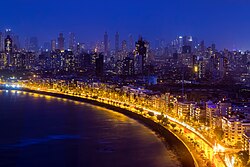
Mumbai

Mumbai

Mumbai, often called the “City of Dreams” or the “Maximum City,” is India’s financial powerhouse and the heart of the Bollywood film industry. But long before the skyscrapers and traffic jams, this megacity was just an archipelago of seven marshy fishing islands with a history shaped by ancient empires, Portuguese colonists, and British visionaries.

Chronological History

​Mumbai’s history is uniquely defined by its geography—a story of human engineering literally building a city out of the sea.


The Seven Islands & Ancient Caves
Pre-16th Century
Originally inhabited by the Koli (fishing) community, the archipelago was ruled by various indigenous dynasties, including the Mauryas and Silharas. During this era, stunning rock-cut architecture like the Elephanta Caves and Kanheri Caves were carved out of basalt by Hindu and Buddhist monks.
Portuguese Rule & The Royal Dowry
1534 – 1661 CE
The Sultan of Gujarat ceded the islands to the Portuguese, who named the area Bom Bahia (“Good Bay”). In 1661, the islands were famously handed over to the British Crown as part of the marriage dowry when Portuguese Princess Catherine of Braganza married England’s King Charles II. The Crown then leased it to the East India Company for a mere 10 pounds of gold a year!
The Great Reclamation
1784 – 1845 CE
Through a massive engineering feat known as the Hornby Vellard project, the sea walls were built to drain the marshes. This officially fused the seven separate islands (Isle of Bombay, Parel, Mazagaon, Mahim, Colaba, Worli, and Old Woman’s Island) into the single landmass we know today.

Railways, Cotton, & The Suez Canal
1853 – 1869 CE
In 1853, Asia’s very first railway line ran between Bombay and Thane. The outbreak of the American Civil War (which disrupted global cotton supplies) and the opening of the Suez Canal in 1869 triggered a massive economic boom, cementing the city as the “Gateway to India.”
Freedom Struggle & Renaming
1942 – 1995 CE
The city was the epicenter of the Indian independence movement; Mahatma Gandhi launched the Quit India Movement here in 1942 at the Gowalia Tank Maidan. In 1995, the Maharashtra government officially restored the city’s name from Bombay to Mumbai, honoring the local patron goddess, Mumbadevi.

Iconic Historical Sites to Visit

  • Gateway of India: Built to commemorate the 1911 royal visit of King George V and Queen Mary. Ironically, the last British troops to leave India after independence marched through this very archway in 1948. It is a prime example of Indo-Saracenic architecture.
  • Chhatrapati Shivaji Maharaj Terminus (CSMT): A UNESCO World Heritage Site formerly known as Victoria Terminus. It is an awe-inspiring masterpiece of Victorian Gothic Revival architecture, complete with gargoyles, stained glass, and pointed arches.
  • Elephanta Caves: Located on a forested island about an hour’s ferry ride from the Gateway of India. These 6th-century rock-cut temples are dedicated to Lord Shiva, featuring the famous Trimurti (a massive three-faced sculpture).
  • Haji Ali Dargah: Built in 1431, this beautiful Indo-Islamic shrine and tomb of a wealthy merchant-turned-saint sits on an islet off the coast of Worli. It is connected to the mainland by a narrow causeway that gets submerged during high tide.

FAQs

Are Mumbai and Bombay the same place?
Yes! The city was officially renamed Mumbai in 1995 to shed its colonial legacy. "Mumbai" is derived from Maha Amba (the patron goddess Mumbadevi) and Aai (meaning "mother" in Marathi). However, you will still hear locals, businesses, and legacy institutions (like the Bombay High Court or Bombay Stock Exchange) use the old name.
What is the architectural style of South Mumbai?
During the late 19th century, the British embarked on a massive building spree. South Mumbai features the world's second-largest collection of Art Deco buildings (after Miami), sitting right alongside monumental Victorian Neo-Gothic structures. This unique blending earned the ensemble a UNESCO World Heritage designation.
I only have one day for history. Where should I go?
Stick strictly to the Fort and Colaba districts in South Mumbai. You can walk or take short taxi rides between the Gateway of India, the Taj Mahal Palace Hotel, the Prince of Wales Museum (CSMVS), and CSMT railway station.
What is the defining local street food I have to try?
You cannot leave Mumbai without eating a Vada Pav. Born in the 1960s to feed bustling mill workers, it consists of a deep-fried, spiced mashed potato dumpling (vada) sandwiched in a soft bread bun (pav), slathered with fiery dry garlic and green chutneys. It is the undisputed culinary pulse of the city!
What is the best time of year to visit Mumbai to avoid the monsoon season?
The best time of year to visit Mumbai to completely avoid the monsoon season—and enjoy the most comfortable weather for sightseeing—is from November to February. ​Here is a breakdown of what to expect during the year so you can plan your trip perfectly: ​☀️ The Best Window: November to February (Winter) ​Weather: This is Mumbai's "winter," though it feels more like a pleasant, mild summer. Temperatures range from a comfortable 18^\circ\text{C} (64^\circ\text{F}) at night to 30^\circ\text{C} (86^\circ\text{F}) during the day. ​Why visit now: The humidity drops significantly, and the air is clear. It is the perfect time for walking tours around the historic South Mumbai districts, catching a ferry to the Elephanta Caves, or sitting outside on Marine Drive. ​🌡️ The Shoulder Season: March to May (Summer) ​Weather: Temperatures climb quickly up to 35^\circ\text{C} (95^\circ\text{F}) or higher, but the real challenge is the intense, sticky humidity that builds up right before the rains arrive. ​Why visit now: If you don't mind the heat, you can find great deals on hotels. Sightseeing is best done in the early mornings, late evenings, or inside air-conditioned museums and malls during the afternoon. ​🌧️ The Monsoon Season: June to October (To be avoided) ​Weather: The southwest monsoon strikes Mumbai with massive force, peaking heavily in June, July, and August. The city experiences relentless torrential downpours, frequent waterlogging, and high winds. ​Why avoid it: While the monsoons can be romantic and turn the surrounding Western Ghats mountains lush green, heavy downpours frequently disrupt local trains, flights, and road traffic. Heritage spots like the Elephanta Caves ferries completely shut down during rough sea conditions. The rains begin to recede in September and October, but the weather remains highly humid and unpredictable. ​💡 Travel Tip: ​If you want to experience Mumbai's incredible cultural energy right after the monsoon, aim for late August or September. This period aligns with Ganesh Chaturthi, the city's largest and most vibrant 10-day public festival. While you might encounter occasional passing showers, the city's electric atmosphere during the celebrations is unforgettable.

Price From : ₹4500/-

Address

Near Avaloormadam temple, thathampally po, pin code 688013, Alleppey, Kerala, India