
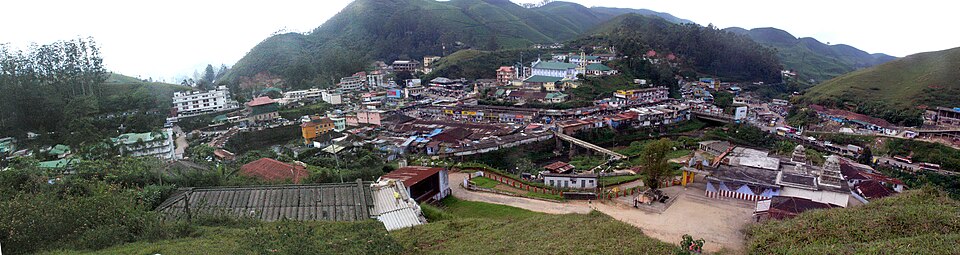
Munnar Town
Perched at an average elevation of 1,600 meters (5,249 feet) in the Western Ghats, Munnar Town is the vibrant, bustling epicenter of the high ranges. Serving as the primary gateway for all regional transit, trade, and tourism, it balances a lively, high-altitude marketplace with the serene, century-old colonial aesthetics of its surrounding valleys.
Historical Context
The evolution of Munnar from an isolated mountain wilderness into one of the world’s premier hill stations is a story of three rivers, corporate engineering, and survival.
1. The Confluence & The Custodians
The name Munnar literally translates to “Three Rivers” in Malayalam (Moonu – Three, Aaru – River), marking the geographic confluence where the Muthirapuzha, Nallathanni, and Kundala mountain streams meet.
Long before external surveyors mapped the hills, the vast shola forests and grasslands were the ancestral territory of the Muthuvan tribal community. Living as semi-nomadic gatherers and shifting cultivators, they knew the mountain terrains intimately. In fact, oral tradition notes that the entire mountain range—Kannan Devan Hills—was named after two prominent Muthuvan men, Kannan and Devan, who guided the first European surveyors into these rugged hills.
2. The Munro Concession & The Tea Empire
Munnar’s modern plantation era began in the 1870s when John Daniel Munro, a British Resident of the Travancore Kingdom, visited the region to settle a border dispute. Completely captivated by the region’s climate, Munro negotiated the First Pooniat Concession in 1877, leasing roughly 136,000 acres of land from Rohini Thirunal Kerala Varma Valiya Raja of the Poonjar Royal Family.
While initial European planting efforts experimented wildly with coffee, cinchona (for harvesting quinine), and sisal, it was planter A.H. Sharp who planted the first successful tea saplings in 1880. By 1895, the Scottish trading house James Finlay & Co. consolidated 33 independent estates under the Kannan Devan Hills Produce Company (KDHP), systematically constructing the roads, factories, ropeways, and worker settlements that birthed modern Munnar town.
3. The Great Flood of ’99 (1924)
The ultimate test of Munnar’s infrastructure came during the catastrophic monsoon of 1924 (known locally as the Great Flood of ’99 based on the Malayalam calendar). Torrential landslides and flooding virtually redrew the landscape, wiping out the fledgling township, its bridges, and its pioneering monorail network. Against steep odds, the plantation workforce rebuilt the town from scratch, modernizing the layout into the structural grid seen today. Post-independence, the Tata Group stepped into collaboration with Finlay in 1964, eventually transitioning the estate operations into the employee-shareholder framework managed by KDHP today.