
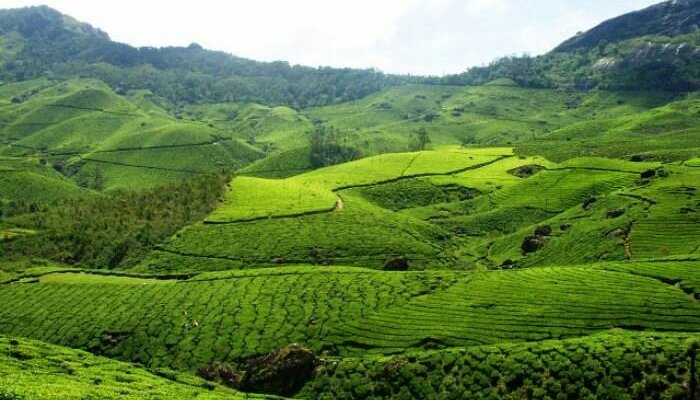
Munnar
Munnar, often referred to as the “Kashmir of South India,” is located at the confluence of three mountain streams: Mudrapuzha, Nallathanni, and Kundala. Below is a comprehensive guide to the must-visit places in Munnar, its rich historical background, and frequently asked questions for travelers.
1. Major Places to Visit in Munnar
- Eravikulam National Park & Anamudi Peak: Kerala’s first national park and a UNESCO World Heritage site. It is the natural habitat of the endangered mountain goat, the Nilgiri Tahr. Towering inside the park is Anamudi Peak (2,695 meters), the highest peak in South India.
- Top Station: Situated about 32 km from Munnar town on the Kerala-Tamil Nadu border, it sits at an altitude of 6,000 feet. It offers panoramic views of the Western Ghats and the valley of Theni below.
- Mattupetty Dam & Lake: Located 13 km from town, this concrete gravity dam is surrounded by lush tea gardens and forests. It is highly popular for speedboat cruises and its proximity to the Indo-Swiss Livestock Project (a specialized dairy farm).
- Kundala Dam & Lake: Famous for being Asia’s first Arch Dam. The surrounding area features pristine pine forests, and visitors can hire traditional Kashmiri-style Shikara boats or pedal boats.
- Tata Tea Museum (KDHP Museum): Located at the Nallathanni Estate, this is a central hub for history buffs. It houses old machinery, photographs, and artifacts that track the evolution of Munnar from a wild forest to a global tea hub.
- Marayoor & Kanthalloor: Located roughly 40 km north of Munnar, Marayoor is the only place in Kerala with a natural growth of Sandalwood forests. It is also famous for its pre-historic Stone Age dolmens (Muniyaras) and rock paintings.
- Echo Point: Located on the way to Top Station, this scenic spot sits at the confluence of three mountain ranges and a lake, naturally echoing any sound made near the water.
- Kolukkumalai Tea Estate: Accessible via a rugged jeep safari, this estate sits at nearly 7,900 feet, making it the world’s highest operating orthodox tea plantation.
2. Historical Context of Munnar
The history of Munnar transitions from a secluded tribal sanctuary to a bustling colonial plantation empire:
- The Early Inhabitants: Before any external discovery, these high ranges were inhabited by indigenous communities, primarily the Muthuvan tribe. In fact, local tradition states that the Kannan Devan hills were named after two tribal guides, Kannan and Devan, who led the earliest surveyors through the dense terrain.
- The British “Discovery” (1870s): John Daniel Munro, a British Resident of the Travancore Kingdom, visited the hills in the 1870s to settle a border dispute. Captivated by the landscape, he realized its potential for agricultural plantations.
- The Poonjar Concession (1877): Since the hills were the sovereign land (jenmam) of the Poonjar Royal Family, Munro met with the royal head, Rohini Thirunal Kerala Varma Valiya Raja. In July 1877, a historic lease agreement was signed, granting roughly 136,600 acres of the Kannan Devan hills to Munro for a nominal annual rent.
- The Shift to Tea: Initially, early planters experimented with coffee, cardamom, cinchona, and sisal. However, after disease and climate issues ruined early crops, European planter A.H. Sharp successfully planted tea in 1880 at the Parvathy Estate (now part of Seven Mallay). In 1895, a major Scottish trading house, James Finlay & Co., bought out the independent estates and systematized commercial tea production.
- Industrial Infrastructure & Engineering: Between 1895 and 1925, Munnar became an engineering marvel. The planters built roads, a dedicated monorail/railway system (Kundala Valley Railway), high-altitude aerial ropeways, and India’s first major hydroelectric power station at Pallivasal (1900).
- The Great Flood of 1924: Munnar’s landscape changed forever during the disastrous monsoon of 1924. Massive landslides and floods swept away the entire railway system, destroyed factories, and claimed many lives. The original road connecting Munnar to Kochi was completely obliterated. The British rebuilt the infrastructure, discarding the railway and building the modern road via Neriyamangalam and Adimaly that travelers use today.
- The Tata Era: In 1964, the Tata Group partnered with Finlay, eventually leading to the creation of Tata Tea in 1983. In 2005, the ownership was restructured, and the plantations were handed over to the worker-shareholder-led Kannan Devan Hills Produce (KDHP) Company, which manages most of Munnar today.