
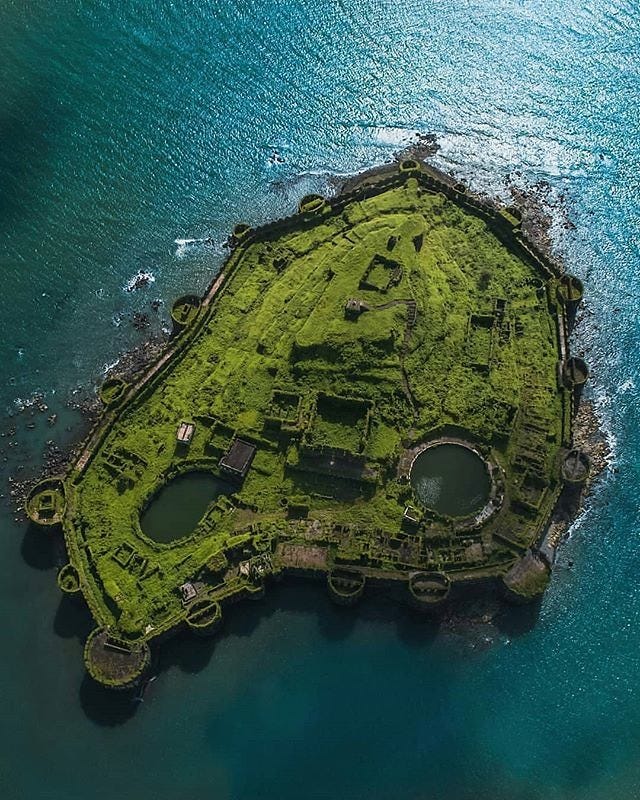
Murud
Murud, located in the Raigad district of Maharashtra, holds a legendary status along the Konkan coast. While it is a popular beach destination today, its history is dominated by one of the most remarkable engineering and military marvels in Indian history: Murud-Janjira Fort, a fortress that remained completely unconquered for centuries.
Historical Background
The history of Murud is fundamentally the history of the Siddis—an ethnic group of African descent—and their centuries-long stand against the most powerful empires in India.
1. The Fishermen’s Defense (15th Century)
Originally, the island off the coast of Murud was a small wooden fortification called a Medhekot. It was built by a local Koli (fisherman) chief, Ram Patil, to protect his community from coastal pirates. However, the Sultan of Ahmadnagar wanted control over the location and sent his commander, Piram Khan, to capture it. Khan and his men disguised themselves as merchants, smuggled weapons inside liquor barrels, surprised the Koli garrison, and seized the island.
2. The Rise of the Siddi Stronghold
The Sultanate appointed the Siddis—originally sailors, traders, and soldiers from the Horn of Africa (Abyssinia) who had risen to powerful military positions in India—as governors of the island.
Between 1567 and 1571, Fahim Khan started constructing a massive, permanent stone fortress over the ruins of the wooden structure. This new fortress was named Janjira (derived from the Arabic word Jazeera, meaning island). The Siddis eventually declared independence from the decaying sultanates and established the sovereign Janjira State.
3. The Unconquered Shield
What makes Murud-Janjira legendary is its defensive record. It is regarded as the only fort on India’s western coast that remained completely undefeated despite facing continuous, aggressive assaults from:
- The Maratha Empire: Chhatrapati Shivaji Maharaj tried to scale its walls multiple times. Recognizing its strategic threat, he even built a counter-fort called Padmadurg on a nearby island just to monitor Janjira. Shivaji’s son, Chhatrapati Sambhaji Maharaj, went so far as to attempt building a 2-km-long underwater stone causeway to connect the mainland directly to the fort—a monumental engineering project that was ultimately disrupted by heavy storms and tactical updates.
- European Powers: The Portuguese, the Dutch, and the British Royal Navy all launched heavy naval blockades against the fort, but none could breach its massive walls.
4. Integration with India (1948)
The Siddi dynasty ruled Murud-Janjira continuously for over 350 years. Even during British colonial rule, Janjira remained an independent princely state. It was only after India gained independence that the last ruling Nawab, Sidi Muhammad Khan II, officially signed the instrument of accession, integrating Murud into the Indian Union in 1948.