
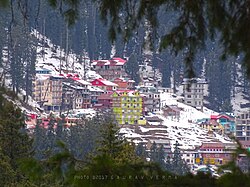
Narkanda Tour tinerary And Infrastructure Facilities
Located about 63 km ahead of Shimla along the historic Hindustan–Tibet Road (NH-5), Narkanda (altitude ~2,708 m / 8,884 ft) is famous for its dense deodar forests, apple orchards, winter skiing slopes, and 360-degree panoramic views of the Greater Himalayas.
Day 1: Arrival & Local Exploration
Base camp setup
Morning/Afternoon: Drive from Shimla (2.5 hours) or Chandigarh (6–7 hours) via NH-5. Check into your hotel or orchard resort.
Late Afternoon: Take a relaxed walk through the Narkanda town market. Sample local Himachali dishes like Siddu at local eateries.
Evening: Enjoy a quiet sunset with views of the snow-capped ranges
Day 2: Hatu Peak, Jau Baug & Tani Jubbar Lake
Sightseeing & Nature Trails
Morning: Head up to Hatu Peak (3,400 m), the highest point in the region. You can either trek (7 km each way through pine forests) or hire a local cab via the narrow winding road. Pay respects at the wooden-carved Hatu Mata Temple.
Afternoon: Walk down to the verdant meadows of Jau Baug for a quiet picnic. Later, drive to Tani Jubbar Lake (12 km from town), a tranquil lake surrounded by spruce trees and a shrine to Nag Devta.
Evening: Return to Narkanda market for souvenirs, handwoven shawls, and fruit jams.
Day 3: Thanedar Apple Orchards & Departure
Heritage & Return
Morning: Visit Thanedar & Kotgarh (15 km from Narkanda), the historic cradle of Himachal’s apple industry. Tour the famed Stokes Farm to learn about apple cultivation.
Afternoon: Check out and begin your return journey toward Shimla/Chandigarh or extend your trip toward Kinnaur Valley.
Infrastructure & Facilities in Narkanda
| Facility Category | Availability & Status Details |
|---|---|
| Roads & Transport | Well-connected via the 4-lane Highway till Shimla, then smooth 2-lane NH-5 to Narkanda. HRTC buses and private taxis operate daily from Shimla and Kalka. |
| Accommodation | Ranging from state-run options (HPTDC Hotel The Hatu) to luxury ski resorts, glamping sites, and heritage orchard homestays. |
| Winter Sports | HPTDC Skiing Center offers beginner-to-intermediate ski courses during January–February, complete with equipment rentals and certified coaches. |
| Telecom & Internet | Reliable 4G/5G mobile connectivity across major networks (Jio, Airtel, BSNL, Vi) in town and main tourist spots. |
| Banking & Fuel | Multiple ATMs (SBI, UCO) and a petrol pump are located on the main highway in Narkanda town. Digital payments (UPI) are widely accepted. |
| Healthcare | Basic medical assistance is available at the local Civil Dispensary / Community Health Centre; major hospitals are located in Shimla (63 km). |
Frequently Asked Questions (FAQs)
Q1: When is the best time to visit Narkanda?
- For Snow & Skiing: January to March (temperatures range from -10°C to 5°C).
- For Pleasant Weather & Blossoms: April to June (10°C to 25°C).
- For Apple Harvesting Season: August to October.
Q2: Is Narkanda suitable for beginner skiing?
A: Yes. Narkanda’s Dhumri slopes have gentle gradients that make them safer and less crowded than Solang Valley (Manali). Short 3-day to 7-day ski training modules are conducted by HPTDC during peak winter.
Q3: How do I reach Narkanda from Delhi?
- By Road: Self-drive or overnight Volvo bus via Delhi \rightarrow Chandigarh \rightarrow Shimla \rightarrow Narkanda (~405 km / 9–10 hours).
- By Train: Kalka Shatabdi to Kalka, followed by the UNESCO Heritage Kalka–Shimla Toy Train or a taxi to Shimla/Narkanda.
- By Air: Nearest airport is Jubbarhatti (Shimla, 155 km) or Chandigarh International Airport (175 km).
Q4: Can I visit Narkanda as a gateway to Kinnaur and Spiti?
A: Yes, Narkanda serves as the ideal first-night acclimatization halt on the Shimla–Kinnaur–Spiti circuit (NH-5) before driving further toward Rampur, Sangla, and Kalpa.
Create a detailed 7-day road trip itinerary starting from Delhi covering Narkanda, Sangla, Chitkul, and Kalpa.
This trip takes you along the famous Hindustan–Tibet Road (NH-5), featuring pine forests, apple orchards, river valleys, and close-up views of the sacred Kinnaur Kailash range.
Trip Summary
- Total Distance: ~1,250 km (round trip)
- Best Time to Visit: April to June (pleasant/blossoms) or September to October (clear skies/apple harvest). (Avoid peak monsoon months like July–August due to landslides).
- Vehicle Preference: SUV or high-ground-clearance vehicle for mountain roads.
Day-by-Day Itinerary
Day 1: Delhi to Narkanda
- Distance / Time: ~400 km | 9–10 hours
- Route: Delhi \rightarrow Murthal \rightarrow Chandigarh \rightarrow Shimla Bypass \rightarrow Narkanda
- Schedule:
- Depart early from Delhi (around 4:00 AM–5:00 AM) to skip early-morning city traffic.
- Stop at Murthal for a paratha breakfast.
- Drive past Chandigarh and follow the Himalayan Expressway toward Shimla. Bypass main Shimla town and head straight along NH-5.
- Arrive in Narkanda by late afternoon or early evening.
Night Stay: Narkanda
Day 2: Narkanda to Kalpa
- Distance / Time: ~160 km | 6–7 hours
- Route: Narkanda \rightarrow Rampur Bushahr \rightarrow Jeori \rightarrow Karcham \rightarrow Reckong Peo \rightarrow Kalpa
- Schedule:
- Morning: Drive 7 km up to Hatu Peak (3,400 m) to visit the Hatu Mata Temple and enjoy panoramic Himalayan views.
- Check out and drive along the Sutlej River valley toward Rampur.
- Witness the engineering marvel of the Tranda Cliff / Taranda Dhank (roads carved directly out of sheer cliff faces).
- Ascend from Reckong Peo up to Kalpa, a quiet village facing the majestic Kinnaur Kailash range.
- Highlights: Golden sunset over the 79-foot natural rock Shivling of Kinnaur Kailash.
- Night Stay: Kalpa
Day 3: Kalpa Local Exploration
- Distance: Local driving (~20 km)
- Schedule:
- Morning: Catch the sunrise over the snow-capped peaks. Visit the ancient Hu-Bu-Lan-Kar Monastery and the Narayan-Nagini Temple nestled among traditional wooden houses.
- Afternoon: Drive up to Roghi Village and stop at the famous Suicide Point for dramatic views of the valley floor below.
Take a walk through local apple and apricot orchards.
- Evening: Visit the main market at Reckong Peo to purchase authentic Kinnauri shawls, handicraft items, or dry fru
- Night Stay: Kalpa
Day 4: Kalpa to Sangla & Chitkul
- Distance / Time: ~65 km | 3–4 hours
- Route: Kalpa \rightarrow Karcham \rightarrow Sangla \rightarrow Rakcham \rightarrow Chitkul
- Schedule:
- Drive down to Karcham Dam and enter the Baspa Valley (Sangla Valley).
Stop briefly at Sangla to explore the 15th-century Kamru Fort.
Continue through the scenic pine forests of Rakcham village to reach Chitkul (2,900 m)—the last inhabited village near the Indo-Tibetan border on this trail.
Walk down to the clear waters of the Baspa River and eat at the “Hindustan ka Aakhri D aba”.
Night Stay: Chitkul (or Rakcham / Sangla for riverside camping)
Day 5: Chitkul to Sarahan
- Distance / Time: ~115 km | 5 hours
- Route: Chitkul \rightarrow Sangla \rightarrow Karcham \rightarrow Jeori \rightarrow Sarahan
- Schedule:
- Morning: Enjoy a serene morning walk along the riverbanks or hike toward the Nagasti ITBP post.
- Begin your return drive out of Baspa Valley toward Jeori, then climb 17 km up to Sarahan.
- Late Afternoon: Visit the Bhimakali Temple, a 800-year-old architectural landmark made of alternate layers of timber and ston
- Night Stay: Sarahan
Day 6: Sarahan to Shimla / Chail
- Distance / Time: ~170 km | 6–7 hours
- Route: Sarahan \rightarrow Rampur \rightarrow Narkanda \rightarrow Kufri \rightarrow Shimla/Chail
- Schedule:
- Attend the morning prayer at Bhimakali Temple.
- Drive through Rampur and Narkanda.
- Stop near Fagu or Kufri for lunch.
- Check into your stay in Shimla or nearby quiet halts like Chail or Cheog.
- Evening: Walk along Mall Road or The Ridge in Shimla for local cafes and shopping.
Night Stay: Shimla / Chail / Cheog
Day 7: Shimla / Chail to Delhi
- Distance / Time: ~350 km | 8–9 hours
- Schedule:
- Enjoy a relaxed breakfast amidst the hills.
- Start driving downhill via the Parwanoo–Panchkula expressway.
- Reach Delhi by evening/night.
Important Travel Tips
- Fuel & Cash: Refuel at Reckong Peo or Powari. Cash ATMs can be unreliable beyond Powari, so carry sufficient cash for Chitkul/Sangla.
- Permits: Indian citizens do not require an Inner Line Permit for Chitkul, Sangla, or Kalpa. (Foreign nationals require a permit beyond Jhangi/Jangi if proceeding toward Spiti).
Clothing: Carry layerable woolens, thermal innerwear, and a windproof/waterproof jacket even in summer, as evening temperatures drop significantly in Chitkul and Kalpa.