
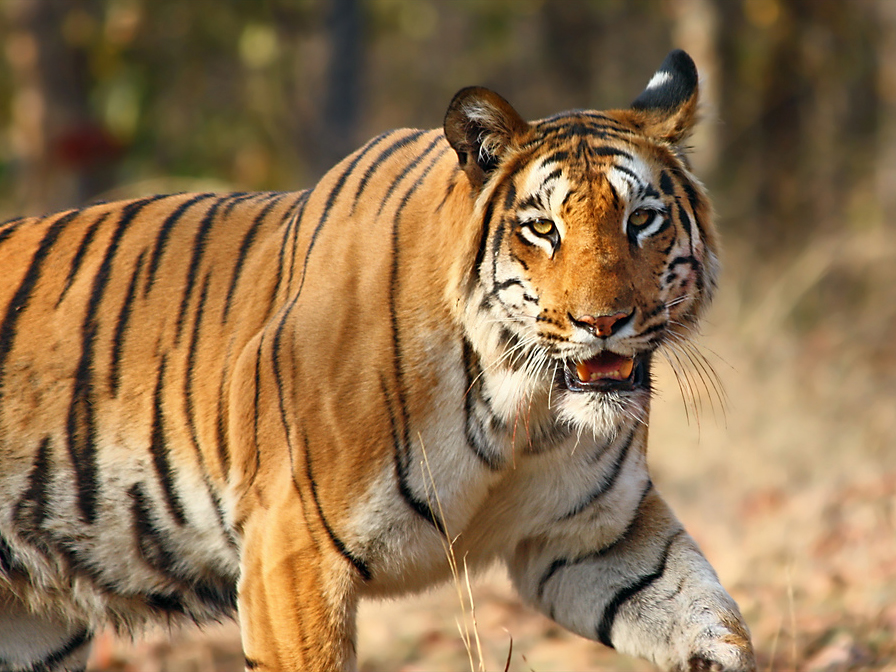
Navegaon National Park
The Navegaon National Park, today a key component of the larger Navegaon-Nagzira Tiger Reserve (NNTR), sits beautifully in the Gondia and Bhandara districts of eastern Maharashtra. Known locally as “Navegaon Bandh” (New Village Dam), its history is a remarkable tale of ancient engineering, tribal royalty, and an extraordinary avian paradise.
The Historical Narrative of Navegaon
1. The Engineering Feat of the Kohali Brothers (1300 A.D.)
The heart of the park is the spectacular 11-square-kilometer Navegaon Lake. It wasn’t formed naturally—it is a 700-year-old man-made wonder.
- The Royal Mandate: In the early 14th century, Rani Durgavati (the visionary queen of the Gond Dynasty) married King Dalpat Shah. Determined to protect her subjects from erratic monsoons, she commissioned a massive water-conservation project.
- The Master Builders: She selected the Kohali community, an indigenous tribe celebrated for their inherited, generational mastery of geology, stone-cutting, and dam excavation. Two brothers—Kolhu and Chimna Patil—were tasked with building the Navegaon reservoir.
- An Industrial Exodus: The brothers painstakingly relocated 12 villages that would be flooded by the reservoir, creating the “New Village” (Navegaon) to resettle them. Hundreds of workers were paid in conch and mollusc shells. Massive herds of cattle were driven back and forth over the dumped soil to compact the dam walls for maximum structural durability.
- The Legend of the Golden Fish: To celebrate the dam’s completion, the brothers caught a large fish of the Wadis species, adorned it with 30 tolas of heavy gold jewelry, and released it back into the lake as an offering to the gods. Local lore claims this glittering golden fish was spotted swimming in the crystal waters for decades afterward.
2. The Seven Sisters & Kolhasur Hill
The landscape of the park still visually preserves the family history of its builders:
- Sat-Bahini: Deeply attached to their seven sisters, Kolhu and Chimna constructed a specific, secondary protective embankment and named it Sat-Bahini (“Seven Sisters Dam”).
- Kolhasur Hill: Because Kolhu Patil passed away childless, the local people named the prominent hill peak that rises directly out of the lake water Kolhasur (or Kolhu Patil’s hill) to ensure his name survived permanently.
3. Dr. Salim Ali’s Sanctuary
In modern history, Navegaon became world-famous through the eyes of Dr. Salim Ali, India’s legendary “Birdman.” Upon exploring the lake and its dense surrounding forest in the mid-20th century, he declared that this single pocket sheltered nearly 60% of all bird species found across the entire state of Maharashtra. In honor of his documentation, the central wetland zone houses the Dr. Salim Ali Bird Sanctuary.
4. Evolutionary Timeline to Tiger Reserve
National Park Notification
1975
Recognizing the critical wetland ecosystem, an area of 133.78 sq. km was formally declared Navegaon National Park on November 22, 1975.
The Nagzira Alignment
2012
The adjacent Nagzira Wildlife Sanctuary was structurally realigned with Navegaon’s conservation framework to build a contiguous wildlife corridor.
Declaration of NNTR
2013
On December 12, 2013, the forest was officially combined to form the Navegaon-Nagzira Tiger Reserve (NNTR), acting as India’s 44th official Tiger Reserve.