
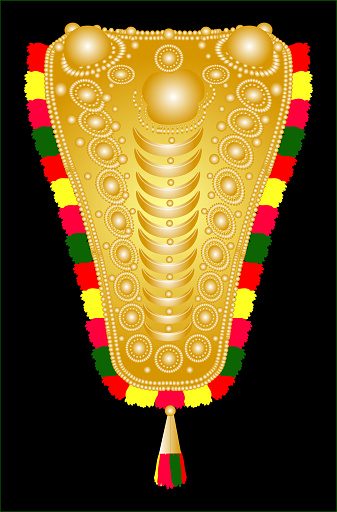
Nettipattam (or Nettipattom) – Home Decor
Nettipattam (or Nettipattom) is the iconic golden forehead caparison traditionally crafted to adorn temple elephants during Kerala’s temple festivals (such as Thrissur Pooram). Combining deep spiritual symbolism with exquisite metalwork, it has evolved into one of Kerala’s most cherished traditional wall decor pieces.
1. Etymology & Historical Context
Etymology: The word is derived from two Malayalam words: “Netti” (forehead) and “Pattom” (band or strap).
Mythological Origin: According to Hindu legend, Lord Brahma was the first deity to create a forehead ornament for Airavata, the pristine white elephant and mount of Lord Indra.
Cosmic Symbolism: A traditional Nettipattam is considered a visual depiction of the Hindu cosmos and pantheon:
Lord Ganesha: Represented by the top prominent dome (Kumbham).
The Trimurti: Representations of Brahma, Vishnu, and Shiva.
Celestial Elements: Represents the Navagrahas (nine planets), Saptarishis (seven sages), Ashta-Vasus, and Chandrakala (crescent moons).
2. Infrastructure, Materials & Crafting Process
Crafting an authentic, full-scale elephant Nettipattam requires around 15–20 days of detailed handiwork by master artisans (predominantly centered in Thrissur and Tripunithura).
Core Materials
Base Fabric: Heavy jute sacking bonded with thick cotton cloth (Jagathnath cloth), lined with red cotton or velvet fabric along the border.
Metals: Hand-hammered copper or brass, coated or plated with pure gold leaf/gold paint to create its brilliant luster.
Embellishments: Colorful woolen threads and tassels along the perimeter.
Structural Layout & Metal Components
A full traditional Nettipattam consists of thousands of individually stitched metal elements:
Koomban Kinnam / Kumbham: The pointed, domed top section.
Vattakkanam: Two large circular/semi-circular side discs.
Mookkanam: Central alignment motif representing the Trimurti.
Chandrakala: A series of crescent moon-shaped metal plates arranged in descending order (typically 11 crescents).
Metallic Spheres & Bubbles: Dozens of half/full metal balls and thousands of tiny golden metallic beads (goli) meticulously hand-stitched onto the jute base.
Modern Wall Decor Adaptation: Modern home-decor versions range from 1 to 5 feet in height. While maintaining traditional motifs, interior wall hangings often use lighter brass plating, wood backing, or molded fiber cores to keep them lightweight for mounting.
3. Frequently Asked Questions (FAQs)
Q1: Is it auspicious to hang a Nettipattam at home?
Yes. In Vastu and traditional Malayali belief, hanging a Nettipattam attracts positive energy, peace, and financial prosperity while warding off negative energies.
Q2: What is the best direction/location to place a Nettipattam on a wall?
It is typically hung in prominent, high-energy areas of the house—such as the living room feature wall, entrance foyer, or Pooja room. Vastu recommendations generally suggest placing it facing the East or North to invite light, clarity, and abundance.
Q3: How do you maintain and clean a decorative Nettipattam?
Dusting: Clean regularly with a soft, dry micro-fiber cloth or a gentle feather duster.
Avoid Water/Chemicals: Never use harsh chemical cleaners, wet rags, or metal polishes on gold-painted or fiber-coated pieces, as this can tarnish the golden sheen or rust the underlying metal wire/cloth.
Storage: Keep away from direct moisture, extreme humidity, or direct rain.
Q4: What is the difference between an elephant Nettipattam and a wall-decor Nettipattam?
An elephant Nettipattam is built to heavy-duty architectural specifications (measuring 6–7+ feet), using thick leather/jute backing and heavier beaten copper to withstand outdoor temple processions. A decor Nettipattam is lightweight, scaled down (1.5 to 5 feet), and tailored with hanging hooks for indoor mounting.