
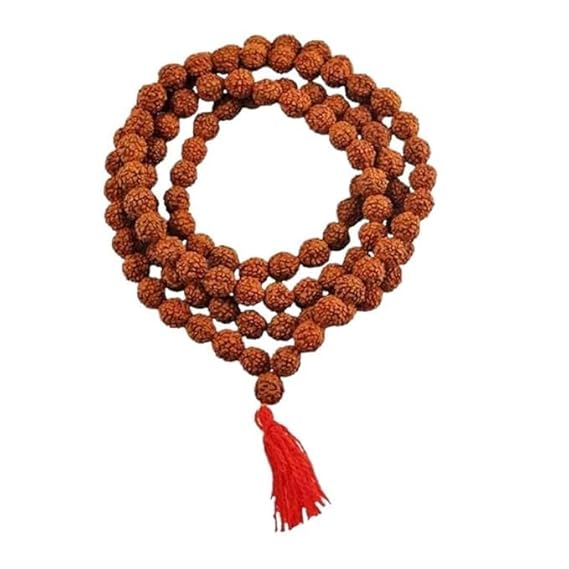
Rudraksha Beads Chain – Rudraksha Beads Chain Oxidized, Original Silver And Gold
Rudraksha beads are the natural seeds of the Elaeocarpus ganitrus tree. Known as the “tears of Lord Shiva,” they are widely worn for meditation, spiritual protection, and physical well-being.
Rudraksha Supply Chain
The supply chain moves from high-altitude forests to finished spiritual chains and malas:
Cultivation & Sourcing: Harvested primarily in the Himalayan regions of Nepal, parts of Indonesia (Java), and South India. Nepali beads are larger with prominent clefts (mukhis), while Indonesian seeds are smaller and smoother.
Harvesting: Natural blue fruit (“blue marble fruit”) ripens and falls from mature trees.
Pulp Removal & Cleaning: Fruits are soaked in water to soften the outer skin. The soft pulp is peeled away, and the hard inner seeds are scrubbed with stiff brushes.
Grading & Inspection: Beads are sorted by size, structural integrity, and the number of natural vertical grooves (mukhis or faces, ranging from 1 to 21+).
Drilling & Stringing: Artisans carefully drill a natural center hole to avoid damaging the inner chambers. Beads are strung on silk thread, red cord, copper wire, silver, or gold links.
Conditioning & Distribution: Beads are oiled with natural oils (such as mustard or sandalwood oil) to prevent cracking before being shipped to global markets.
Processing & Infrastructure Facilities
Soaking & Cleaning vats: Temperature-controlled water tanks used to soften outer fruit pulp safely.
Precision Drilling Stations: Micro-drills equipped with thin diamond bits to widen natural central channels cleanly without splitting the seed.
X-Ray & Lab Testing Testing Setup: Non-destructive X-ray imaging equipment used to inspect internal seed chambers and verify genuine mukhi structures against glued or carved counterfeits.
Oil Conditioning & Storage Units: Controlled environments used to treat beads with vegetable or floral oils to ensure long-term physical stability and prevent brittle fractures.
Frequently Asked Questions (FAQs)
Q1: What is a Mukhi in a Rudraksha bead?
A mukhi refers to the natural vertical lines or clefts running from the top of the bead to the bottom. Each mukhi represents a different facet, deity, or planetary energy (5-Mukhi is the most common and widely worn).
Q2: How many beads should a standard Rudraksha chain have?
A full traditional mala contains 108 + 1 beads (the single extra bead is called the Guru bead or Bindu, which acts as the focal point during chanting). Shorter neck or wrist chains typically have 27, 36, or 54 beads.
Q3: Can anyone wear a Rudraksha chain?
Yes. Unlike many gemstone prescriptions, standard Rudraksha beads (especially 5-Mukhi) can be worn by anyone regardless of gender, age, or background.
Q4: How do I test if my Rudraksha bead is genuine?
X-Ray Inspection: The most reliable method is an X-ray test, which reveals the internal seed compartments matching the outer mukhi count.
Avoid Water/Copper Coin Tests: Popular DIY tricks (like floating/sinking or spinning between copper coins) are unreliable due to density variations and synthetic weighted fakes.
Q5: How do you care for a Rudraksha chain?
Keep it clean by washing it periodically with warm water and a soft brush. Dry completely in a warm spot, then apply a small amount of pure mustard or olive oil to keep the seed hydrated and prevent cracking. Avoid chemical soaps, shampoos, and direct contact with synthetic perfumes.
What are the key differences between Nepali and Indonesian Rudraksha beads in terms of size, price, and effectiveness?
Both Nepali and Indonesian beads originate from the same biological tree species (Elaeocarpus ganitrus). However, differences in soil, climate, and elevation give them distinct physical, financial, and practical attributes.
1. Size and Physical Appearance
Nepali Rudraksha:
Size: Noticeably larger, generally ranging between 18 mm to 35 mm in diameter.
Surface Texture: Bold, rugged, and heavily textured with pronounced “thorns”.
Mukhi Clarity: Features deep, wide, clearly visible natural grooves running top-to-bottom that can be easily counted with the naked eye.
Indonesian (Java) Rudraksha:
Size: Much smaller and compact, usually between 5 mm to 15 mm.
Surface Texture: Smooth, lightweight, and uniform.
Mukhi Clarity: Mukhi lines are finer and shallower, often requiring close inspection or a magnifying lens to verify.
2. Price and Supply
Nepali Rudraksha: Higher Price Premium
Nepal accounts for a small fraction of total global supply.
Due to lower harvesting yields, higher mass, and huge demand in Vedic astrology, standard 5-Mukhi Nepali beads cost 3–5x more than Indonesian ones. Rare high-mukhi beads (like 14-Mukhi or Gauri Shankar) from Nepal command significant prices.
Indonesian Rudraksha: Budget-Friendly
Indonesia accounts for roughly 70%+ of global Rudraksha production.
Abundant availability makes them highly affordable. They are the standard choice for affordable 108-bead Japa malas and daily jewelry.
3. Energetic Profile & Effectiveness
Speed & Intensity of Energy:
Nepali Beads: Due to their larger biomass, thicker seed chamber walls, and high-altitude origin, Nepali beads are believed to emit a faster, stronger electromagnetic resonance. Practitioners often feel their effects in a shorter period (around 20–40 days).
Indonesian Beads: Their energy is softer, steadier, and works more gradually over time (typically 45–90 days).
Spiritual & Astrological Validity:
Astrological Remedies: Vedic astrologers often specifically prescribe Nepali beads for targeted planetary remedies or specific doshas, where rapid energetic shifts are desired.
Daily Japa & Wearing: Both origins carry identical fundamental spiritual properties. Scriptures do not invalidate Indonesian beads; a 5-Mukhi Indonesian bead carries the same deity energy as a 5-Mukhi Nepali bead.
At a Glance: Which Should You Choose?
RequirementBest ChoiceReason
Astrological Remedies / Specific Dosha CorrectionNepaliStronger, faster-acting energetic profile preferred by astrologers.
108-Bead Japa Mala for Daily ChantingIndonesianLightweight, comfortable on the neck/fingers, and affordable.
Single-Bead Pendant or Statement RingNepaliBold size and prominent Mukhi lines create a strong visual presence.
First-time Users & Budget SeekersIndonesianCost-effective way to experience authentic Rudraksha without a large investment.
Break down the meanings, benefits, and recommended uses of different Rudraksha Mukhis from 1-Mukhi to 14-Mukhi ?
Each Rudraksha Mukhi (face or cleft line) corresponds to a ruling deity, a planetary influence, and specific physical or spiritual benefits.
MukhiRuling Deity & PlanetPrimary Meanings & BenefitsRecommended For
1-MukhiLord Shiva
SunUltimate oneness, supreme consciousness, and destruction of negative karmas.Leaders, spiritual seekers, meditators, and those seeking detachment from worldly illusions.
2-MukhiArdhanarishvara
MoonHarmony in relationships, emotional stability, and inner peace.Couples, business partners, and anyone suffering from emotional instability or anxiety.
3-MukhiAgni Dev (Fire God)
MarsBurns past karma, boosts self-esteem, removes laziness, and fuels ambition.Students, creative workers, and individuals recovering from past trauma or low confidence.
4-MukhiLord Brahma
MercuryEnhances intelligence, vocal clarity, logical thinking, and communication skills.Teachers, researchers, public speakers, writers, and students.
5-MukhiLord Kalagni Rudra
JupiterOverall health, blood pressure balance, peace of mind, and mental clarity.Universal—safe and beneficial for anyone of any age to wear daily.
6-MukhiLord Kartikeya
VenusWillpower, focus, charm, grounding, and relief from emotional distress.Managers, professionals needing focus, and performers.
7-MukhiGoddess Lakshmi
SaturnFinancial growth, abundance, protection against financial stagnation, and Saturn (Shani) remedies.Entrepreneurs, business owners, professionals, and those facing Saturn planetary alignment issues (Sadesati).
8-MukhiLord Ganesha
RahuRemoves obstacles, brings wisdom, success in new ventures, and counters Rahu doshas.People starting new businesses or career transitions, and those facing persistent hurdles.
9-MukhiGoddess Durga
KetuFearlessness, dynamism, spiritual energy (Shakti), and protection against negative forces.Working women, sports professionals, and individuals seeking energy and protection.
10-MukhiLord Vishnu
All PlanetsPeace, protection from black magic/evil eye, legal success, and planetary harmony.Administrators, attorneys, and those seeking spiritual and physical security.
11-MukhiLord Hanuman
Mars/SaturnCourage, fearlessness, heightened intuition, and mastery over senses.Travelers, athletes, military personnel, and deep yoga practitioners.
12-MukhiLord Surya (Sun)
SunRadiance, administrative authority, charisma, self-worth, and vitality.Executives, politicians, doctors, and public leaders.
13-MukhiLord Kamadeva
VenusAttraction, charisma, negotiation skills, manifestation, and earthly fulfillment.Marketers, artists, negotiators, and people in sales or media industries.
14-MukhiLord Shiva / Hanuman
SaturnKnown as Deva Mani (Divine Gem)—awakens the Third Eye chakra, sharpens intuition, and aids decision-making.High-level executives, investors, spiritual gurus, and decision-makers.
Wearing Guidelines
Universal Safe Wear: 5-Mukhi, 6-Mukhi, and 10-Mukhi can be worn by anyone without prior astrological consultation.
Higher Mukhis (1, 12, 14): Due to their strong energetic impact, high-mukhi beads are often worn individually as pendants or in specific combination malas (Siddha Mala).
How do you combine different Rudraksha Mukhis into a Siddha Mala, and what are the rules for stringing them?
A Siddha Mala is one of the most potent combinations in Rudraksha therapy. It unites beads of various Mukhi levels into a single mala to balance all seven chakras, appease all planetary influences, and fulfill spiritual and material goals.
Composition of a Classical Siddha Mala
A standard, comprehensive Siddha Mala typically incorporates 16 distinct holy beads:
Standard Mukhis: 1-Mukhi through 14-Mukhi (one bead of each).
Special Dual Beads:
Gauri Shankar: Two naturally conjoined beads representing Shiva and Parvati for relationship and family harmony.
Ganesha Rudraksha: A bead featuring a trunk-like protrusion for obstacle removal and intellect.
Spacer Beads: Small 5-Mukhi Indonesian or Nepali beads placed between the primary higher-Mukhi beads to complete the neck circumference and maintain proper alignment.
Essential Rules for Stringing a Siddha Mala
Proper stringing ensures that the bio-electric circuit of the Rudraksha beads flows continuously without physical or energetic blockages.
Head-to-Tail Alignment (Polarity Principle):
Rudraksha beads have natural energy poles: the top stem where the fruit attaches is the Head (Mukha), and the bottom point is the Tail (Bindu).
Rule: Beads must be strung Head-to-Head and Tail-to-Tail in a continuous loop, or linked sequentially Head-to-Tail. Arranging them randomly disrupts their natural electromagnetic flow.
Chakra & Numerical Ordering:
Lower Mukhis (1 to 7) generally form the base/sides of the mala, while higher Mukhis (8 to 14), Gauri Shankar, and Ganesha beads are placed closer to the heart or center pendant positions.
The 1-Mukhi or 14-Mukhi bead is traditionally designated as the central pendant (or Guru Bead) at the bottom focal point.
Protection & Cappings:
Silver, Gold, or Copper Wire: Encasing individual beads in pure silver or gold wire caps protects the delicate outer edges from chipping against neighboring beads.
Thread Option: If stringing on silk or nylon cord, place small knots or 5-Mukhi spacer beads between each main bead to prevent direct friction and wear.
Metal Compatibility:
Silver and gold are excellent conductors of natural energy. Silver offers a cooling, stabilizing effect, while gold amplifies the energetic vibration of higher Mukhis.
Activation & Purification (Prana Pratishtha):
Before wearing a newly strung Siddha Mala, wash it in clean water or unpasteurized milk, dry it thoroughly, condition it with a drop of sandalwood or olive oil, and energize it with the chanting of Om Namah Shivaya.