
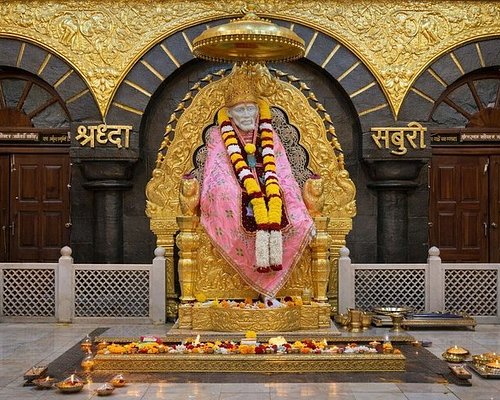
Shirdi
Shirdi, located in the Rahata Taluka of the Ahmednagar (Ahilyanagar) district, is a globally revered town that serves as the home of the 19th-century saint Shri Sai Baba. Once a tiny, secluded village consisting of just a few thatched huts, Shirdi has evolved over the past century into a major spiritual hub, drawing millions of pilgrims from all over the world regardless of their religion or background.
Historical Highlights
1. The Arrival of an Unknown Fakir (Mid-19th Century)
The history of modern Shirdi begins entirely with the arrival of Sai Baba. He first appeared in the village as a young lad of about 16 years, sitting silently under a neem tree in a state of deep meditation.
- He left for a brief period but returned permanently around 1858 with a marriage procession.
- When he stepped down in the village, a local temple priest named Mahalsapati welcomed him by saying, “Aao, Sai” (Welcome, Sai). The name stuck, and he became known to the world as Sai Baba.
2. The Transformation of Dwarkamai
For decades, Sai Baba lived an ascetic life in a dilapidated local mosque that he affectionately named Dwarkamai.
- To break religious barriers, he lived in a mosque but kept a perpetual sacred fire (Dhuni) burning inside it, a practice rooted in both Hindu and Sufi traditions.
- He also planted a sacred garden called Lendi Baug. As his reputation for performing miracles, healing the sick, and teaching universal brotherhood grew, the small village of Shirdi steadily became a crowded sanctuary for seekers from across India.
3. The Mahasamadhi (1918)
On October 15, 1918 (the day of Dussehra), Sai Baba took his Mahasamadhi (left his mortal body). His remains were interred in a grand stone building originally constructed by a wealthy devotee named Gopalrao Booty to serve as a Krishna temple. This building is today the globally famous Samadhi Mandir.
Key Historical & Spiritual Places to Visit
- Shri Saibaba Sansthan Temple (Samadhi Mandir): The main shrine complex housing the sacred tomb of Sai Baba. Towering above the white marble tomb is a magnificent, life-sized white marble idol of Baba carved by sculptor Balaji Vasant Talim, seated on a solid golden throne.
- Dwarkamai: The heart of Shirdi. This unique mosque is where Baba spent the majority of his life. Visitors can still see the Dhuni Mai (the perpetual fire maintained continuously for over a century), the stone on which Baba used to sit, and his original grinding stone.
- Gurusthan: The exact spot under a neem tree where Sai Baba was first seen by the villagers. It is believed that lighting incense here cures ailments. The leaves of this specific neem tree are uniquely famous for losing their natural bitterness and tasting sweet.
- Chavadi: A small historic building where Baba slept on alternate nights during his later years. Every Thursday, a massive, traditional procession carrying Baba’s padukas (footprints) moves from Dwarkamai to Chavadi, maintaining a ritual that started during his lifetime.
- Lendi Baug: A peaceful garden that Baba tended daily. It houses a perpetually burning oil lamp (Nanda Deep) enclosed between a pair of trees he planted.