
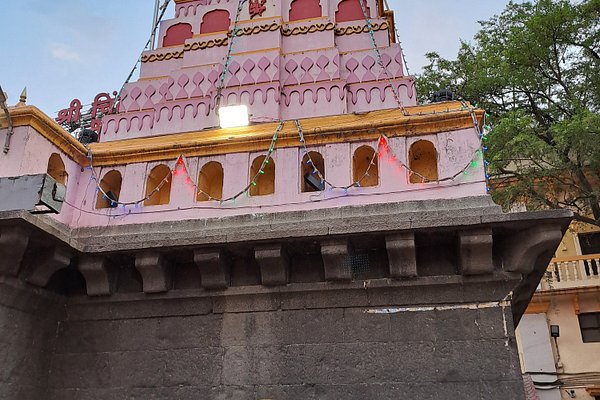
Siddhatek
Situated on the northern bank of the Bhima River in the Ahmednagar district of Maharashtra, Siddhatek is a peaceful village carrying massive spiritual weight. It is home to the Shree Siddhivinayak Temple, which holds a unique status as the second stop in the holy Ashtavinayak pilgrimage circuit and stands out as a place of immense yogic power (Siddhi).
Historical & Mythological Heritage
The Divine Battle Against Madhu and Kaitabha
According to ancient Puranic legends, during the creation of the universe, Lord Brahma emerged from a lotus growing out of Lord Vishnu’s navel. As Brahma began his work, two fierce demons named Madhu and Kaitabha arose from Vishnu’s earwax and began disrupting the cosmic order, stealing the Vedas.
Lord Vishnu battled the demons for 5,000 long years but was unable to defeat them. Seeking an explanation, Vishnu approached Lord Shiva, who revealed that the obstacle was due to a failure to worship Lord Ganesha before commencing the war.
Vishnu retired to the hill at Siddhatek and performed rigorous penance, chanting the powerful Shadakshar Mantra dedicated to Ganesha. Pleased by his immense devotion, Ganesha appeared and granted Vishnu the Siddhi (divine spiritual powers) necessary to slay the demons. Because Vishnu achieved his ultimate spiritual success here, the hill was named Siddhatek and the deity became known as Siddhivinayak (the giver of success).
Historical Royal Patronage
The temple structure sitting atop the hill today was built and progressively expanded during the 18th-century Maratha Empire:
- Ahilyabai Holkar: The legendary, noble queen of Indore built the grand stone sanctum sanctorum (Garbhagriha) that houses the deity today.
- Peshwa Leaders: High officials of the Peshwa court, including the prominent courtier Haripant Phadke, constructed the inner stone pathways and the large assembly hall. Phadke funded major expansions after successfully reclaiming his lost political status, attributing his comeback entirely to his prayers at Siddhatek.
Architectural and Ritual Peculiarities
- The Right-Sided Trunk (Siddhipitha): Unlike the other seven Ashtavinayak idols whose trunks turn to the left, the Siddhivinayak idol at Siddhatek features a trunk turned to the right. In Hindu iconography, a right-trunked Ganesha (Dakshinabhimukhi) is exceptionally powerful and strict, requiring rigid, pure rituals and flawless devotion to appease.
- The Giant Pradakshina Route: The temple sits on a hillock surrounded by a dense forest of Babul (acacia) trees. The traditional circumambulation (Pradakshina) path requires walking entirely around the hill itself rather than just the inner shrine. This walk spans a distance of roughly 5 kilometers over rugged terrain.