
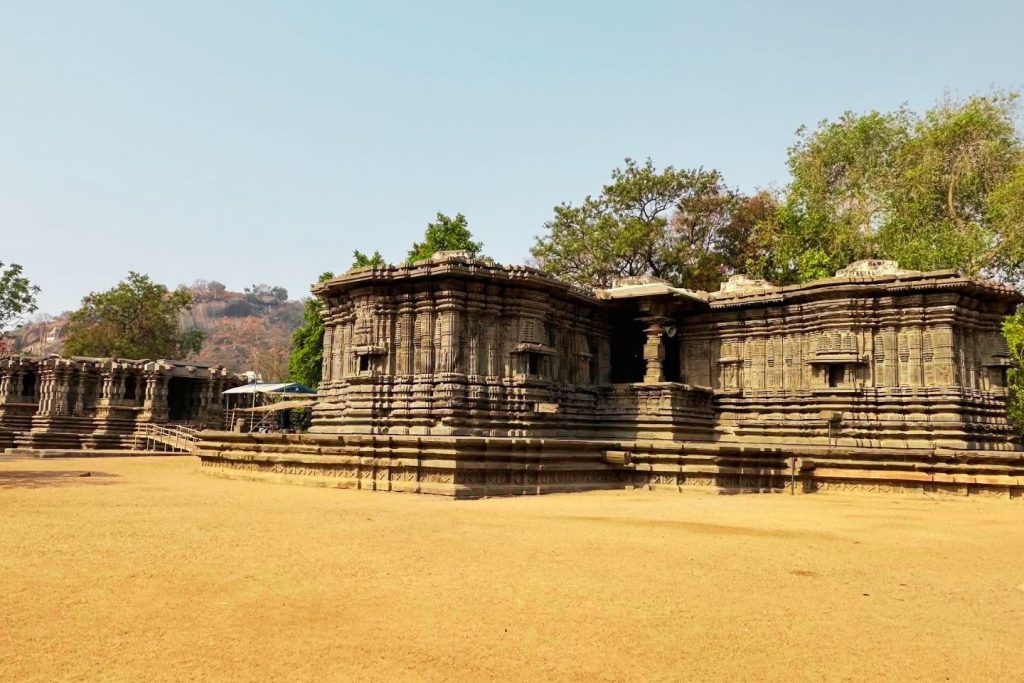
Thousand Pillar Temple
The Thousand Pillar Temple, officially known as the Rudreshwara Swamy Temple, is an architectural marvel located in the twin cities of Hanamkonda-Warangal in Telangana, India. Built during the golden age of the Kakatiya dynasty, it stands as a brilliant showcase of ancient Dravidian and Kakatiyan style engineering, characterized by its fine stone carvings, complex geometry, and majestic star-shaped layout.
Historical Overview
The temple was commissioned in 1163 CE by the powerful Kakatiya monarch, King Rudra Deva. It was constructed to celebrate the sovereignty and expansion of his empire, serving as a prominent spiritual center in his capital city.
The structure is a Trikutalaya, meaning it houses three distinct shrines under a single roof. These shrines are dedicated to three major Hindu deities: Lord Shiva (Rudreshwara), Lord Vishnu, and Lord Surya (the Sun God). The shrines face towards the east, west, and south, leaving the north side open for the main entrance porch.
Like many historical monuments in the Deccan region, the Thousand Pillar Temple suffered severe damage during the early 14th century due to invasions by the Delhi Sultanate (specifically the forces of Alauddin Khilji). Later, parts of the complex were further damaged by regional conflicts and shifting sandy soil foundations. In recent decades, the Archaeological Survey of India (ASI) undertook a massive, multi-year restoration project to completely dismantle and reconstruct the collapsed parts of the temple—especially its iconic Kalyana Mandapam (marriage hall)—using advanced architectural preservation techniques