
Trimbakeshwar

Trimbakeshwar

Trimbakeshwar, a serene ancient town nestled at the foothills of the Brahmagiri mountains in the Nashik district of Maharashtra, holds immense historical and spiritual weight. It is globally renowned for housing one of the twelve sacred Jyotirlingas (self-manifested shrines of Lord Shiva) and serves as the literal birthplace of the Godavari River, the longest river in Peninsular India.

Historical & Mythological Highlights

​1. The Mythological Origin: Sage Gautama & the Godavari

​According to ancient Hindu scriptures (Puranas), the region faced a catastrophic, multi-year drought.

  • ​The great Sage Gautama lived here and maintained an inexhaustible granary through his severe penance. Jealous of his virtue, other sages engineered a trick involving a magical cow that died in his fields.
  • ​To purify himself of the sin of Gau-hatya (killing a cow), Sage Gautama prayed intensely to Lord Shiva to bring the celestial river Ganga down to earth.
  • ​Shiva granted the boon, releasing the river from his locks onto the Brahmagiri hills. The river became known locally as Gautami or Godavari. At Gautama’s request, Lord Shiva also manifested himself there as the Trimbakeshwar Jyotirlinga.

​2. Construction of the Modern Temple (1755–1786)

​While the site has been a place of worship for millennia, the magnificent black-stone structure standing today was commissioned by Peshwa Balaji Baji Rao (also known as Nana Saheb) in the mid-18th century.

​The construction began around 1755 and took 31 years to complete, costing an astronomical sum at the time. The Peshwas built it using local black basalt stone, designing it to look like a formidable structural fortress capable of resisting invasions.

​3. The Royal Maratha Subjugation & Trimbak Fort

​Perched on the cliffs right above the temple town sits the historic Trimbak Fort (Brahmagiri Fort). It was a highly contested military asset during the Anglo-Maratha Wars.

​The fort was seamlessly captured by Chhatrapati Shivaji Maharaj in 1670, bringing it into the Maratha Empire. It later served as a vital stronghold for the Peshwas before eventually being besieged and ceded to the British East India Company in 1818.

​ Key Historical & Sacred Structures

  • Trimbakeshwar Jyotirlinga Mandir: A spectacular example of Indo-Aryan temple architecture. The entire temple is surrounded by massive stone walls. The apex of the temple is adorned with an intricate, towering Sikhara.
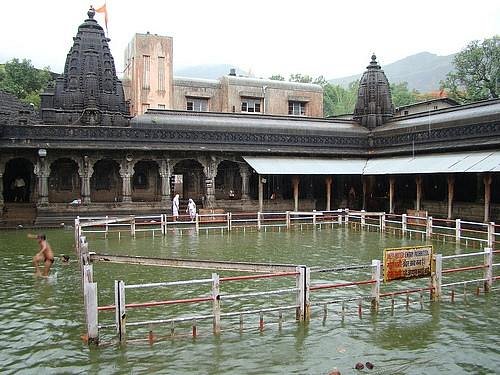
  • Kushavarta Kund: A sacred, stone-rimmed water tank located inside the town center. Built in the 18th century by Maratha naval chief Shrimant Raoji Saheb Parnerkar, it captures the underground flow of the Godavari River. Taking a dip here is considered a mandatory purification ritual before entering the main temple sanctum.
  • Brahmagiri Hill: A steep, rugged mountain rising 1,298 meters above sea level. Devotees climb a historic stone staircase of over 700 steps to reach the top, where the river Godavari trickles out from a stone reservoir shaped like a cow’s mouth (Gorakhnath Cave).

FAQs

What makes the Trimbakeshwar Jyotirlinga unique compared to the other eleven?
Unlike all other Jyotirlingas, which feature a single protruding stone deity representing Lord Shiva, the lingam at Trimbakeshwar is a three-faced depression in the ground. These three miniature lingams represent the Hindu Trinity: Lord Brahma, Lord Vishnu, and Lord Shiva. Due to the natural erosion caused by water continuously trickling inside the cavity, the faces are covered with a protective silver crown.
What is the connection between Trimbakeshwar and the Nashik Kumbh Mela?
Trimbakeshwar is one of the four exclusive locations in India that hosts the massive Simhastha Kumbh Mela once every 12 years. While the general holy bathing occurs at Ram Kund in Nashik city, Trimbakeshwar’s Kushavarta Kund is the exclusive site where the elite Sadhus belonging to various ancient monastic orders (Akharas) perform their royal ritual baths (Shahi Snan).
Trimbakeshwar for ancestral rituals?
Because of its mythological roots tied to purification and salvation, Trimbakeshwar is considered the prime destination in India for performing specific planetary and ancestral pacification rituals. Highly trained local Vedic scholars perform specialized rituals here, such as the Narayan Nagbali, Kalsarpa Dosh Nivaran, and Tripindi Shradh.
When is the best time of year to visit Trimbakeshwar?
The winter window from October to March features cool, pleasant daytime weather ideal for temple queues. However, if you plan to climb Brahmagiri Hill, the Monsoon season (July to September) is incredibly beautiful, turning the entire mountain range into a lush green landscape accented by dozens of cascading seasonal waterfalls.
How do I book online entry tickets or special darshan passes for the Trimbakeshwar Shiva Temple?
To bypass the extensive general public lines at the Trimbakeshwar Shiva Temple, you can book an Online Donation Darshan Pass (often referred to as the VIP or Quick Darshan Pass). This minimizes your waiting time down to roughly 30–45 minutes. The official process must be completed directly through the temple's verified board. Step-by-Step Booking Process Navigate to the Official Portal Use a web browser Go exclusively to the official website run by the trust: trimbakeshwartrust.com and head to the "Online Donation Darshan Pass Booking" section. 2 Fill in Devotee Profiles Keep identity cards handy Enter the primary traveler's full name, age, and address. You must select and provide a valid government photo ID number (such as an Aadhaar Card or PAN Card). 3 Add Accompanying Co-Travelers Up to 4 additional family members If you are visiting with family, click on "Add Persons" to input their individual names, ages, and distinct photo ID details under your main token. Choose the Darshan Date & Time Slot Select target calendar day Pick your intended date of visit. Choose your preferred time interval from the active hourly slots available on the system. 5 Process the Secure Payment Completed via UPI or Net Banking Review the summaries and complete your payment via secure banking portals or UPI channels. The cost is ₹200 per person. 6 Download and Print the QR Pass Crucial for physical verification Once successful, go to your 'Transaction History' page to download the generated QR-code token. Print a physical paper copy to carry along with you. Essential Ticket & Fee Details Pass Rate: ₹200 per individual. Exemptions: Children under the age of 10 years and Divyangjan (differently-abled individuals) are completely exempt from these pass charges. Note: Differently-abled individuals must carry a valid UDID certificate or authorized medical proof to show at the entrance gates. Validity: The pass is strictly non-transferable, non-refundable, and only valid for the specific chosen calendar date (with the final entry permitted up to 9:00 PM). Vital Rules for Entering the Temple ​The Original ID Mandate: At the specialized Entry Gate, the manager will verify your printed pass. Every person registered under the token must carry the exact original physical ID card (not screenshots) that was logged online during the booking phase. ​Electronic Device Ban: Mobile phones, smartwatches, recording cameras, and power banks are strictly prohibited past the primary security perimeter. You should leave these items inside your vehicle, at your hotel room, or use the trust-operated baggage locker systems nearby. A Note on Special Pujas: If you are booking specific complex planetary rituals like the Kaal Sarp Dosh Nivaran or Narayan Nagbali, please note that these are coordinated through certified local priests (Tamrapatradhari Purohits belonging to the Purohit Sangh). These rituals are typically performed in dedicated halls outside the main inner sanctum.

Price From : ₹4500/-

Address

Near Avaloormadam temple, thathampally po, pin code 688013, Alleppey, Kerala, India