
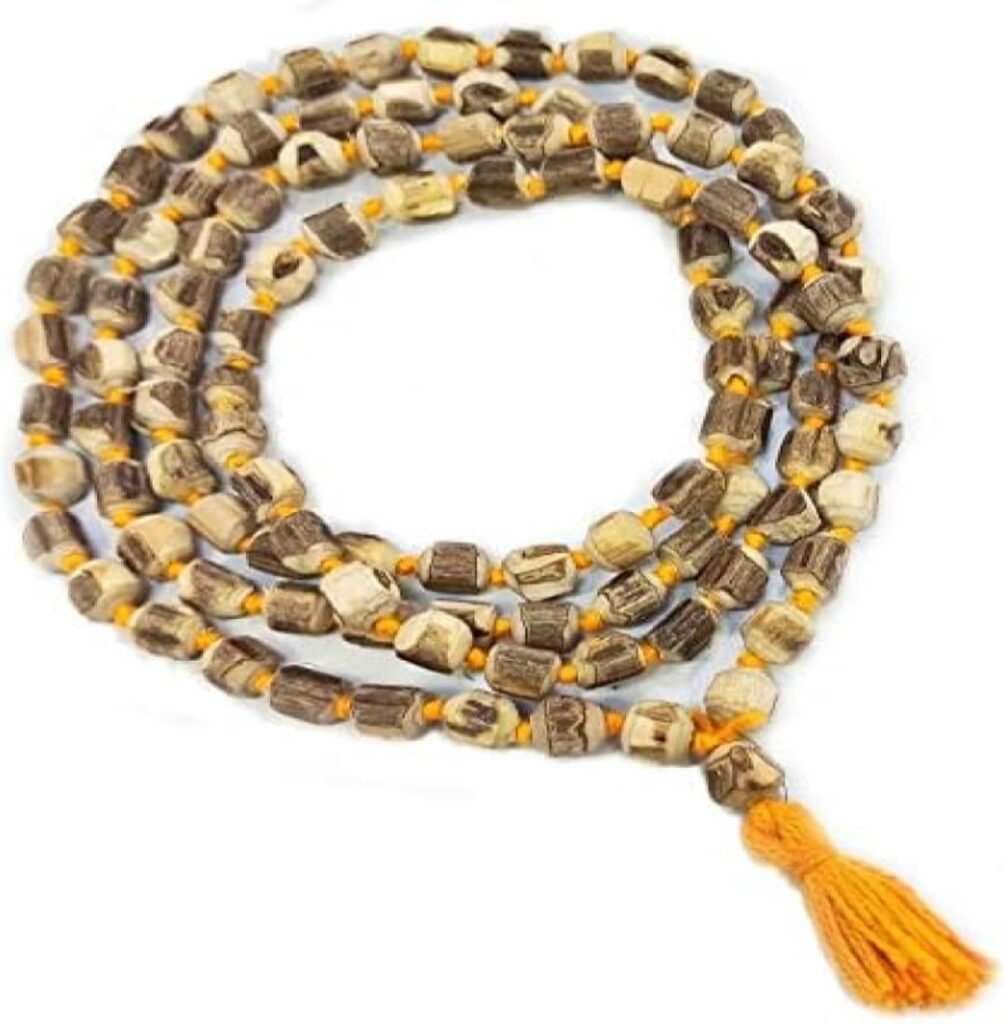
Tulsi wood Chain – Original Silver Tulsi wood Chain
Tulsi wood (Ocimum sanctum / Holy Basil) holds deep spiritual significance, especially within Vaishnavism and Hindu traditions. Unlike structural or commercial timber, Tulsi is harvested primarily from the dried woody stems and roots of mature plants to create sacred items like Japa Malas (meditation beads), Kanthi Malas (neck beads), and small carvings
Tulsi Wood Supply Chain
The production and distribution of Tulsi wood items follow a specialized, devotional supply chain centered largely around spiritual hubs like Mathura, Vrindavan, and Mayapur:
Cultivation & Harvesting: Tulsi plants are grown organically in farms and ashrams. Since living Tulsi plants are considered sacred and worshipped, wood is strictly harvested from plants that have dried out naturally or reached the end of their life cycle.
Raw Material Sourcing: Dried woody stems and thick roots are collected, bundled, and transported to artisan clusters.
Primary Processing (Peeling & Cutting): The outer bark is manually peeled away to reveal the smooth, light-beige inner wood. The stems are sliced into uniform cylindrical or spherical blocks.
Artisanal Bead Crafting:
Handmade: Artisans hand-turn, shape, and drill holes through each bead using micro-lathes or hand tools.
Machine-Made: Small-scale motorized bead-cutting tools produce uniform beads in larger volumes.
Polishing & Threading: Beads are smoothed (often without synthetic chemical varnishes to maintain purity) and manually strung into 108-bead Japa malas or multi-strand Kanthi necklaces. Metal caps (silver or gold) are added for premium variants.
Distribution & Retail: Finished malas are sold through pilgrimage centers, temple shops, online spiritual stores, and international distributors serving global devotional communities.
Infrastructure & Production Facilities
Collection & Curing Sheds: Dry, well-ventilated storage spaces to air-dry harvested stems without mold or moisture decay.
Micro-Lathes & Drill Equipment: Small benchtop lathes and high-speed precision drills designed for thin, delicate wooden stems.
Sanitize & Clean Workspaces: Dust-free assembly areas where artisans work in ritual purity to string and pack the sacred items.
Traceability & Verification Setup: Testing or certification processes to verify authentic Tulsi wood against cheap wooden counterfeits.
Frequently Asked Questions (FAQs)
Q1: What is the spiritual significance of wearing Tulsi wood?
In Hindu tradition, wearing Tulsi beads near the skin (such as a Kanthi mala) is believed to provide spiritual protection, clear negative energy, and foster devotion.
Q2: Can Tulsi wood get wet?
Occasional contact with clean water is fine, but soaking or wearing Tulsi malas while showering with harsh soaps and hot water can cause the untreated natural wood to soften, crack, or discolor over time.
Q3: How can you tell real Tulsi wood from fake wood beads?
Authentic Tulsi wood is lightweight, has a subtle natural herbal scent, and shows slight variations in texture and grain. Synthetic or cheap substitute woods are often painted, heavy, uniformly dark, or lack any natural herbal aroma.
Q4: How should Tulsi wood beads be maintained?
To prevent drying out or snapping, condition the beads periodically with a drop of pure mustard oil, sesame oil, or ghee, and store them in a clean, dry cotton pouch when not in use.
Explain the differences between 1-round, 2-round, 3-round, and metal-capped Tulsi Kanthi malas ?
Tulsi Kanthi malas differ primarily in their physical construction, bead size, visual appearance, and regional or spiritual traditions.
Mala TypeDesign & ConstructionTypical Bead SizeKey Features & Suitability
1-Round (Single Strand)A single continuous loop fitted closely around the throat.Medium to Large (6text{ mm} – 10text{ mm})Minimalist & Lightweight: Simple to wear daily. Popular among beginners, children, or those seeking a subtle neckband.
2-Round (Double Strand)Two parallel strands wrapped tightly around the neck.Small to Medium (3text{ mm} – 6text{ mm})Balanced Aesthetic: Offers a fuller look than a single strand without feeling restrictive. Very common in daily devotional wear.
3-Round (Triple Strand)Three neat, layered strands lining the throat.Fine / Small (2text{ mm} – 4text{ mm})Traditional Distinction: Highly favored in Gaudiya Vaishnava traditions. Represents dedicated spiritual commitment (diksha or sadhana).
Metal-Capped (Silver/Gold)Each bead is encased at both ends with metal caps and linked via wire loops.Custom / Medium (5text{ mm} – 8text{ mm})Enhanced Durability & Premium Look: Prevents thread fraying and water damage to bead centers. Often worn for special ceremonies or gifted.
Key Differences Summary
Strand Density: As the number of rounds increases (1 to 3), the individual bead diameter typically gets smaller so the mala sits comfortably without feeling bulky against the neck.
Durability: Standard 1-, 2-, and 3-round malas rely on thread or nylon string, requiring occasional re-stringing if exposed to water. Metal-capped versions use metal wiring, making them considerably stronger and long-lasting.
Customary Usage: While all variants carry equal spiritual sanctity, 3-round and metal-capped malas are often chosen by initiated practitioners or worn during traditional religious functions.