
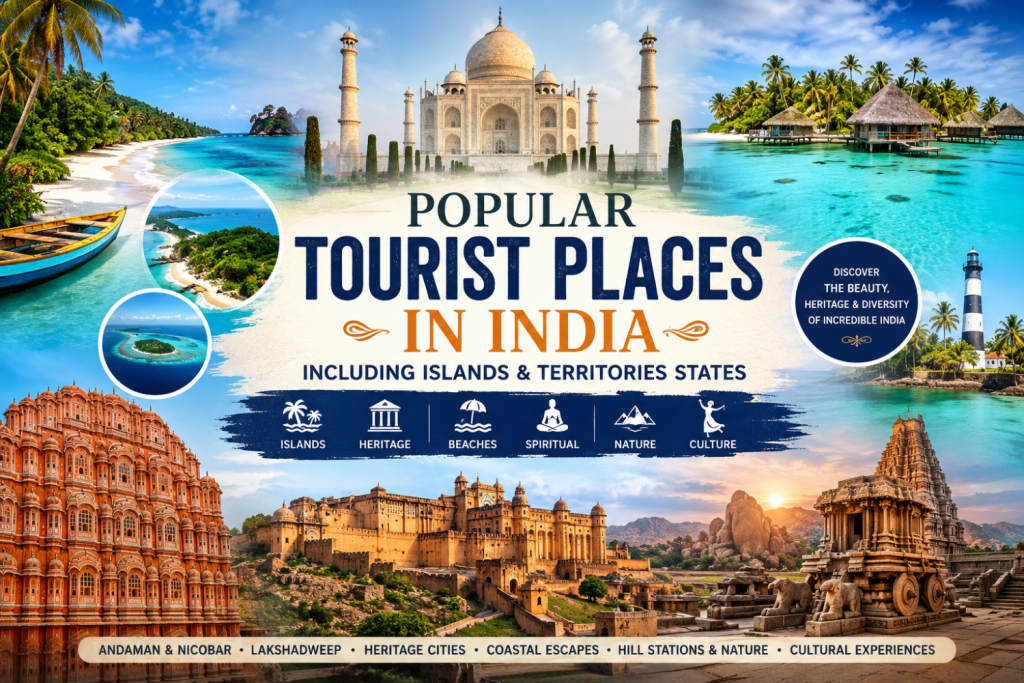
The Andaman and Nicobar Islands (Bay of Bengal)
Located far off the eastern coast of mainland India, this massive archipelago features over 500 lush tropical islands. They are world-famous for their dense rainforests, vibrant coral reefs, and deep colonial history.
Capital: Port Blair
Top Places to Visit:
Havelock Island (Swaraj Dweep): Famous for Radhanagar Beach, which is consistently ranked among the best and cleanest white-sand beaches in Asia.
Neil Island (Shaheed Dweep): A beautifully quiet, relaxed island known for its coral bridges and rich marine life.
Cellular Jail (Port Blair): A historic, highly revered national memorial that tells the story of India’s freedom fighters.
Barren Island: Home to the only active volcano in South Asia.
Lakshadweep Islands (Arabian Sea)
Located off the southwestern coast near Kerala, Lakshadweep is a collection of 36 stunning coral atolls. Unlike the rugged, forested Andamans, Lakshadweep is all about low-lying sand keys, expansive turquoise lagoons, and peaceful coconut groves. It is a prime destination for scuba diving, snorkeling, and pristine beach stays.
Capital: Kavaratti
Top Places to Visit:
Bangaram Island: A stunning, uninhabited teardrop-shaped island featuring a magnificent encircling coral reef and crystal-clear lagoon.
Agatti Island: Houses the territory’s main airport strip, offering a breathtaking aerial view of the deep blue ocean as you land.
Minicoy Island: Located furthest south, famous for its distinct Maldivian-influenced culture, traditional dances, and a historic 19th-century British lighthouse.
Other Notable Coastal Islands of India
While not independent territories, these unique islands are directly connected to mainland states and make fantastic travel stops:
Majuli (Assam): Located in the mighty Brahmaputra River, it is officially the largest river island in the world and a massive hub for Assamese Neo-Vaishnavite culture.
Pamban Island (Tamil Nadu): The historic island home to Rameswaram, connected to mainland India by the spectacular, iconic Pamban Sea Bridge.
Diu Island: A small coastal island territory off the coast of Gujarat, famous for its grand 16th-century Portuguese fort and quiet sandy beaches.
As of 2026, India has 8 Union Territories ( State in india)
1. National Capital Territory (NCT) of Delhi
The administrative heart and capital of India. It has its own elected legislative assembly and chief minister, blending a massive metropolitan city with deep history, Mughal-era monuments, and modern corporate hubs.
2. Jammu and Kashmir
Reorganized into a Union Territory in 2019, this northern region is world-famous for its majestic Himalayan valleys, snow-capped peaks, and scenic places like Srinagar, Gulmarg, and Pahalgam.
3. Ladakh
Also carved out as a separate Union Territory in 2019, Ladakh is a high-altitude cold desert region known for its dramatic landscapes, deep blue alpine lakes (like Pangong Tso), and ancient Buddhist monasteries.
4. Puducherry (formerly Pondicherry)
Located on the southern coast, this charming coastal territory has its own elected assembly. It is famous for its uniquely preserved French Quarter, featuring mustard-colored colonial villas, cobblestone streets, and serene beaches.
5. Dadra and Nagar Haveli and Daman and Diu
Merged into a single Union Territory in 2020, these coastal enclaves sit near the borders of Gujarat and Maharashtra. They feature scenic forts, beautiful beaches, and a rich Portuguese colonial heritage.
6. Chandigarh
A beautifully planned modern city designed by the famous architect Le Corbusier. It serves a unique dual purpose: it is a Union Territory on its own, but also serves as the shared capital city for two neighboring states, Punjab and Haryana.
7. Andaman and Nicobar Islands
A massive, stunning archipelago of over 500 tropical islands located far out in the Bay of Bengal. It is famous for its white-sand beaches, rich coral reefs, and prime scuba diving destinations.
8. Lakshadweep
India’s smallest Union Territory, located in the Arabian Sea off the coast of Kerala. It consists of 36 breathtaking coral atolls, pristine turquoise lagoons, and quiet, coconut-shaded beaches.
Heritage & Cultural Marvels
Agra
Agra is a globally renowned historic city situated on the banks of the Yamuna River. Travelers flock here to experience the timeless grandeur of the Mughal Empire and its breathtaking architectural achievements.
Home to the iconic Taj Mahal, one of the Seven Wonders of the World.
Features the massive red sandstone walls of the Agra Fort.
Ideal to visit between October and March when the weather is comfortably cool.
Jaipur
Jaipur, widely known as the “Pink City,” serves as a vibrant window into India’s royal legacy and Rajput heritage. The city seamlessly pairs its grand historic forts and bustling traditional bazaars with upscale modern hospitality.
Famous for hilltop fortifications like Amer Fort and the distinctive honeycomb facade of Hawa Mahal.
Renowned for magnificent luxury palaces, heritage hotels, and authentic Rajasthani cuisine.
Best experienced during the cooler winter months from October to March.
Hampi
Hampi is an evocative UNESCO World Heritage Site defined by its surreal, boulder-strewn landscape and monumental ruins. Once the prosperous capital of the historic Vijayanagara Empire, it feels like an open-air museum for history enthusiasts.
Scattered with hundreds of ancient temple ruins, royal pavilions, and carved monuments.
Highlights include the majestic, still-active Virupaksha Temple.
Popular for coracle boat rides along the scenic Tungabhadra River.
Coastal Escapes & Spiritual Journeys
Goa
Goa is India’s premier beach destination, celebrated for its laid-back tropical lifestyle and vibrant fusion of Indian and Portuguese cultures. It draws diverse crowds ranging from luxury seekers to backpackers looking for seaside relaxation.
Offers a vast coastline featuring popular, lively stretches like Anjuna and quieter palm-fringed spots like Palolem Beach.
Showcases stunning Portuguese-era churches, spice plantations, and historic forts.
Famous for legendary beachside shacks, night markets, and fresh seafood.
Varanasi
Varanasi is one of the world’s oldest continuously inhabited cities and stands as the spiritual heart of India. Located along the sacred Ganges River, it offers an intense, deeply moving glimpse into traditional Hindu rituals.
Famous for its sprawling stone “ghats” where pilgrims gather for spiritual cleansing and morning yoga.
Features the captivating Ganga Aarti ceremony held every evening at Dashashwamedh Ghat.
Renowned for dawn boat rides that provide a respectful vantage point of the city’s ancient spiritual traditions.
Mountains & Nature Paradises
Munnar
Munnar is an idyllic mountain retreat nestled quietly in the Western Ghats. It serves as a perfect escape from bustling city life, drawing nature lovers with its perpetually misty climate and sprawling green landscapes.
blanketed by endless manicured green tea plantations and rolling hills.
Offers rich biodiversity nearby at Eravikulam National Park, home to the endangered Nilgiri tahr.
Perfect for trekking, waterfall views, and visiting local tea museums.
Alappuzha Houseboat / Houseboats In Alleppey Kerala
Alleppey Houseboats (Kettuvallams) offer a quintessential Kerala backwater experience, converting traditional wooden cargo boats into floating boutique accommodations. Cruising through the palm-fringed canals, Vembanad Lake, and paddy fields of Alappuzha provides an intimate view of rural backwater life.
Alleppey Houseboats Categories & Amenities
- Deluxe Alleppey Houseboat: Air conditioning operates during the night only (typically 9:00 PM to 6:00 AM). Open-deck dining area with standard meals included.
Premium Alleppey Houseboat: Controlled or full-time AC in bedrooms. Upgraded interiors, glassed living areas, and enhanced food menus.
Luxury Alleppey Houseboat / Ultra-Luxury Alleppey Houseboat: 24-hour AC across the entire vessel, private upper decks, upper balcony seating, jacuzzi options, and personal chef customization.
Every booking is strictly private and exclusive to your group with 3 dedicated crew members: a captain, an oarsman/engine driver, and a chef.
Typical Itinerary & Timing
- Overnight Cruise (Most Popular):
- Check-in: 12:00 PM
Cruise: 12:00 PM – 5:30 PM (includes a lunch break)
Anchorage: 5:30 PM to 8:00 AM (Government regulations require boats to anchor overnight to allow local fishermen to lay nets).
Check-out: 9:00 AM after morning cruise and brea fast.
Day Cruise: 11:00 AM – 5:00 PM (includes lunch and evening tea/snacks).
Frequently Asked Questions (FAQs)
Q: Is food provided on the houseboat?
Yes, standard packages are full-board, including welcome drinks, lunch, evening tea with Kerala snacks (e.g., banana fritters), dinner, and breakfast. Authentic Kerala meals feature traditional rice, local vegetables, and fresh backwater fish (Karimeen fry). Pure vegetarian, vegan, or custom meal plans are accommodated upon request.
Q: What backwater routes do the houseboats take?
The most popular choices are the Alleppey Round (covering Punnamada Lake, Kuttanad paddy fields, and narrow canals) and the Alleppey to Kumarakom route across Vembanad Lake. Note that large multi-bedroom boats stick to main waterways, while smaller 1-2 bedroom boats can navigate narrower, picturesque canals.
Q: When is the best time to visit?
- Peak Season (October to February): Cool, pleasant weather with minimal humidity—ideal for backwater cruising.
Monsoon Season (June to September): Lush greenery and lower rates, though cruising stops during heavy downpours.
Q: Are houseboats safe for families and solo travelers?
Yes. All registered houseboats carry mandatory safety equipment, including life jackets, fire extinguishers, and trained crew certified in first aid.
Q: How do I manage mosquitoes and insects onboard?
Because boats anchor along the canal banks in the evening, insects can gather near open lights. Premium/Luxury boats feature enclosed glass living areas with full-time AC to prevent insects from entering. Repellent sprays or creams are recommended for open-air seating areas.
Alappuzha (Alleppey) encapsulates the quintessential tropical beauty of Southern India, earning it the nickname “Venice of the East.” It is a serene aquatic paradise defined by an intricate network of canals, lagoons, and traditional rural life.
Famous for overnight stays on traditional luxury houseboats cruising through the tranquil backwaters.
Fringed with countless leaning coconut palms and verdant paddy fields.
Hosts the thrilling Nehru Trophy Boat Race annually amidst high energetic crowds.
Ladakh
Ladakh is a high-altitude mountain plateau offering some of the most dramatic, rugged landscapes in the entire Himalayan region. Known for its distinct Tibetan-influenced culture, it is a prime hub for high-adventure travel and alpine trekking.
Home to surreal natural wonders like the brilliant blue Pangong Tso Lake and the high-altitude Nubra Valley.
Punctuated by historic white-washed Buddhist monasteries perched precariously on desert peaks.
Features some of the highest motorable mountain passes in the world, making it legendary for motorcycle road trips.
Would you prefer to narrow down your choices by a specific region of India, or are you looking for a particular style of holiday like an adventure trek, a historic tour, or a relaxing beach vacation?
🏛️ North India
Famous for its dramatic Himalayan landscapes, historic forts, and cultural landmarks.
Leh-Ladakh (Jammu & Kashmir / Ladakh): High-altitude desert landscapes, stunning crystal-clear lakes (like Pangong Tso), and ancient Buddhist monasteries.
Jaipur & Udaipur (Rajasthan): The “Pink City” and “City of Lakes.” Ideal for royal palaces, massive forts, vibrant bazaars, and heritage stays.
Varanasi (Uttar Pradesh): One of the world’s oldest continuously inhabited cities, deeply spiritual, famous for its grand evening Ganga Aarti on the ghats.
Manali & Kasol (Himachal Pradesh): Popular mountain escapes offering lush valleys, adventure sports, and scenic cafe cultures.
🌊 West India
A vibrant mix of vast deserts, stunning coastlines, and bustling cosmopolitan hubs.
Goa: Renowned for its beautiful beaches, vibrant nightlife, Portuguese heritage architecture, and coastal spice plantations.
Rann of Kutch (Gujarat): A massive salt marsh desert that comes alive during the winter Rann Utsav with traditional music, crafts, and white moonlit landscapes.
Matheran & Mahabaleshwar (Maharashtra): Scenic hill stations in the Western Ghats known for lush green plateaus, viewpoints, and pleasant weather.
Mumbai (Maharashtra): The dynamic, fast-paced capital of dreams, featuring colonial architecture like the Gateway of India and the iconic Marine Drive.
🌿 East & Northeast India
Known for its rich colonial history, untouched natural beauty, and distinct cultural tea gardens.
Darjeeling & Kalimpong (West Bengal): Famous for sweeping views of Mount Kanchenjunga, historic toy trains, and sprawling emerald tea estates.
Puri & Konark (Odisha): Home to pristine spiritual beaches and the architectural marvel of the UNESCO-listed Konark Sun Temple.
Shillong & Cherrapunji (Meghalaya): The “Scotland of the East,” famous for living root bridges, massive waterfalls, and incredibly lush, mist-covered hills.
Kaziranga National Park (Assam): A crucial wildlife sanctuary hosting the world’s largest population of the great Indian one-horned rhinoceros.
🌴 South India
A paradise of tranquil backwaters, towering ancient temples, and rich coastal heritage.
Munnar & Alleppey (Kerala): The absolute highlights of the southwest—Munnar offers rolling tea-covered hills, while Alleppey is world-famous for overnight cruises on traditional luxury houseboats through peaceful, palm-fringed backwaters.
Hampi (Karnataka): The captivating ruins of the historical Vijayanagara Empire, set amidst a surreal, boulder-strewn landscape.
Ooty & Kodaikanal (Tamil Nadu): Classic, cool-climate hill stations nestled in the Nilgiri and Palani hills, famous for lakes, mist, and pine forests.
Mahabalipuram (Tamil Nadu): A coastal town featuring spectacular, ancient rock-cut temples and shore shrines right on the beach.
🐅 Central (Middle) India
The heart of India, celebrated for its dense wildlife reserves and incredible architectural history.
Khajuraho (Madhya Pradesh): A UNESCO World Heritage site renowned for its stunningly intricate, 1,000-year-old temples covered in masterful stone carvings.
Kanha & Bandhavgarh National Parks (Madhya Pradesh): Premier tiger reserves with dense sal forests, offering some of the best wildlife safaris in the country.
Pachmarhi (Madhya Pradesh): The only hill station in central India, known as the “Queen of Satpura,” featuring quiet waterfalls, ancient caves, and deep valleys.
Kullu and Manali are located in the North Indian state of Himachal Pradesh.
They are nestled in the mountains, with Kullu being a beautiful valley and Manali being a famous hill station located just about 40 kilometers (25 miles) further north along the Beas River.
1. Ancient Roots & Mythology
The entire region is historically referred to as Kulanth Peeth, which literally translates from Sanskrit to “The End of the Habitable World.” Ancient people believed that beyond these massive snow-capped mountains lay nothing but uninhabitable wilderness.
Manali (The Land of Manu): According to Hindu mythology, Manali is named after the sage Manu. Legend says that when a catastrophic flood destroyed the world, Manu stepped off his ark right here to recreate human life. The village of Old Manali houses the only temple in India dedicated entirely to Sage Manu.
The Mahabharata Connection: The region is heavily featured in the epic Mahabharata. It is believed that Bhima (one of the Pandava brothers) killed a cruel demon named Hadimb here and married his sister, Hadimba. Today, the 16th-century wooden Hadimba Temple stands nestled in Manali’s dense Dhungri van (pine forest) as a major historical landmark.
2. A Strategic Silk Road Trade Hub
Before it became a tourist paradise, the Kullu Valley was a crucial geopolitical route.
The Ancient Highway: It served as a major commercial trade link between the plains of India, the high-altitude regions of Ladakh and Tibet, and onwards to Central Asia.
The Cargo: Traders moved massive caravans through these treacherous mountain passes, transporting silk, wool, salt, spices, and precious stones.
3. The Transformation of the Local Kingdom
For centuries, Kullu was ruled by local chieftains called Pal kings.
The Capital Shift: In the 17th century, King Jagat Singh changed the landscape of the valley forever. He moved the capital from Naggar to Sultanpur (modern-day Kullu town).
Kullu Dussehra: In 1660, King Jagat Singh brought an idol of Lord Raghunath (Rama) from Ayodhya and installed it as the supreme ruler of the valley. This marked the birth of the world-famous Kullu Dussehra festival. Unlike the rest of India, where effigies are burned, Kullu Dussehra is a historic week-long gathering where hundreds of local valley deities are brought down in colorful chariots to pay homage to Lord Raghunath.
4. British Colonial Influence
The British took administrative control of the region in 1846 following the First Anglo-Sikh War. They transformed Kullu and Manali in two major ways:
Apple Orchards: A British officer named Captain R.C. Lee introduced the first commercial apple orchards to the valley in 1870. The climate was so perfect that apple cultivation quickly became the backbone of the region’s economy.
The Escape from Heat: The British elite began using Manali as a quiet mountain getaway to escape the scorching summers of the Indian plains, paving the way for it to eventually become the major global tourism hub it is today.