
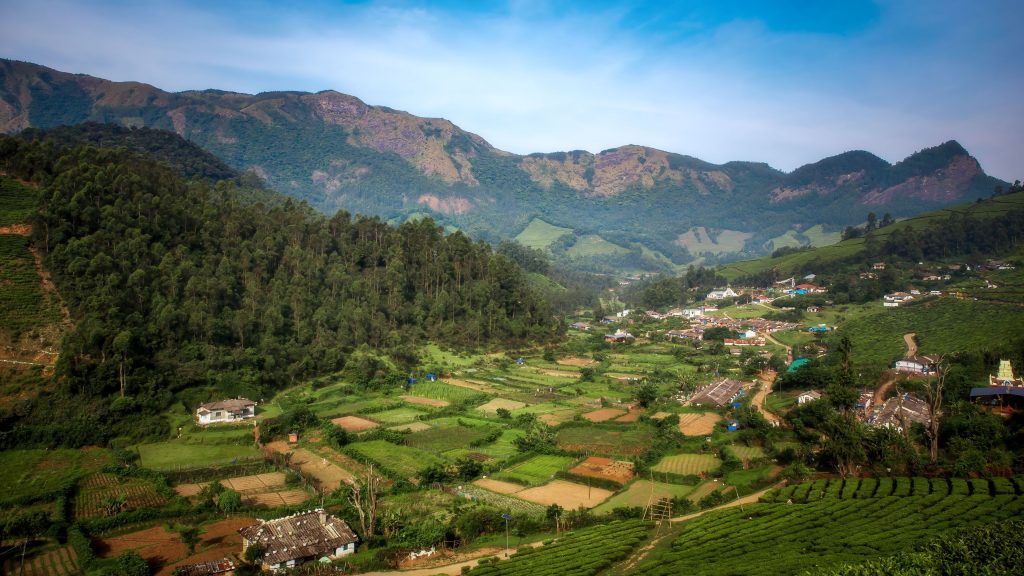
Vattavada
Nestled around 42 to 45 kilometers east of Munnar, Vattavada is one of the most distinct and fascinating villages in Kerala. Located at an altitude of roughly 6,500 feet on the eastern slopes of the Western Ghats, it stands out sharply from the rest of the region because its landscape is dominated by vibrant, terraced vegetable farms and fruit orchards rather than rows of tea bushes.
Historical Context
Vattavada’s history is a unique tapestry of ancient civilizations, royal protection, and agricultural evolution.
- The Ancient Megalithic Roots: Long before it became a farming hub, the region saw human civilization thrive thousands of years ago during the Stone Age. This is evidenced by the ancient megalithic dolmens (stone burial chambers) found in nearby areas like Marayoor, proving it has been an inhabited sanctuary for millennia.
- The Great Migration & Royal Sanctuary: The distinct culture of modern Vattavada took shape centuries ago due to a mass migration from the Madurai region of Tamil Nadu. Historians note that groups of families fled the plains to escape political instability or invasion (with legends citing events ranging from local tyrannical rulers to the invasions of Tipu Sultan). They scaled the Western Ghats and sought refuge under the Poonjar Raja, who allowed them to settle in this hidden, fertile valley. This historical migration explains why the local population largely speaks a unique blend of Tamil and Malayalam and maintains distinct customs.
- The Ooru Moopan System: Because the valley was geographically isolated and cut off from the mainstream plains for centuries, the villagers developed a fiercely independent, self-sustaining lifestyle. They established their own traditional tribal and village governance led by the Ooru Moopan (village headman) to manage affairs and resources.
- The Shift to the “Vegetable Basket”: Interestingly, Vattavada was once known for cultivating wheat and traditional hill rice. However, decades ago, the mass planting of water-heavy grandis and eucalyptus trees in nearby regions severely reduced the soil’s surface moisture. Adapting quickly, the resilient farming community turned their terraced slopes toward cool-climate “English vegetables” (carrots, cabbages, garlic) and exotic fruits, ultimately earning Vattavada the title of “The Market of Kerala.”